An Algorithmic Lucidity

a blog

Category: philosophy

Pose

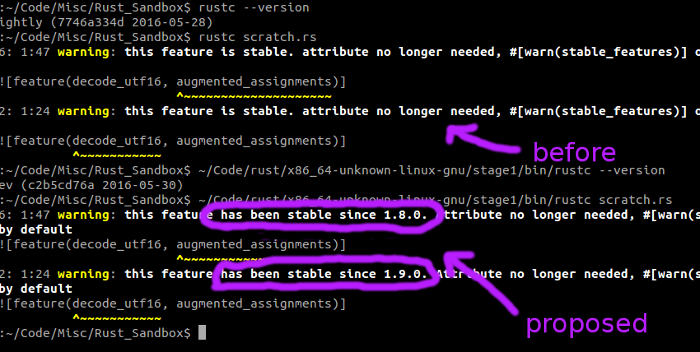
terminal screenshot comparing rustc warning text before and after the proposed lint change

I used to look down on posers who submit some contrived one-off trivial patch to a big, famous project like Django or whatever, sheerly for the glamor and ego-gratification of being able to say, "I'm a contributor to Django." I thought that if it wasn't a fix that you needed for your own work and you're not going to be a seriously involved contributor, it's more dignified to only work on your personal projects (which would be more authentic) or some non-super-famous but still widely-used library (which would have more socially-useful unfinished work left).

Then I landed a patch in the Rust compiler.

And it is so ego-gratifying!! But maybe now I have to submit a bunch more patches in order to prove—in order to be—a seriously involved contributor rather than a mere poser??

More Running

I ran about three miles each yesterday and the day before, and this is very important—just imagine how embarrassing it would be to die of a heart attack in the year 20X6 rather than being disassembled by nanomachines in 20X6 + 5!

Missing Words VII

We need a word or phrase to refer to intentionally (and usually only slightly) misquoting something for the sake of a perceived æsthetic improvement in the context in which the quoter wants to use the material. Okay, we do have the word paraphrase, which is close ("To paraphrase the great fooer Bar Quux ..."), but I don't think that's quite it—the Wiktionary definition mentions "often to clarify meaning" and I'm definitely talking more about petty differences in word choice than actually clarifying meaning.

There's this wonderful quote by Eugene Gendlin that I often remember as "People can stand what is true, because they are already doing so," but it turns out that Gendlin's actual phrasing was "for they are already enduring it." If I want to use my slightly different choice of words because I think it flows better in the context in which I'm repeating it, I think that can be legitimate. (Although needless to say, in formal settings, you definitely only want quotation marks around the words someone actually said.)

Or if my hypothetical pop punk band (which would hypothetically be called either "Bullet Candy" or "Zack M. Davis and the Duty-Bound Empiricists") were to cover Taylor Swift's "The Story of Us", I would sing part of this one line in the chorus as "the twist of fate by which it all broke down" rather than the original "the twist of fate when [emphasis mine] it all broke down," not to suggest Swift was wrong to sing when, but rather because that kind of use of the phrase by which is exactly the sort of rhetorical flourish that my hypothetical band would hypothetically be known for.

Missing Words VI

We need different words for apology in the sense of "I'm sorry; I won't do it again," and apology in the sense of "I'm sorry that this lowers your utility, but not sorry enough to actually change the behavior in question; maybe we could negotiate some other behavior change that might partially make up for it." Both can be sincere, but they mean different things.

Worth

"I still feel bad about being the worst person at my job."

"You don't mean worst person. People all have an equal intrinsic moral worth that has nothing to do with their economic role in society. You mean something more like, 'perhaps less skilled than some others at some job tasks'."

"No, that's pretty much what I meant by worst person."

Where I Stand

(firmly on one side of the fine and yet distinctly perceptible line between "I've got mine; fuck you" and "I've got mine, and I hope that you get yours, but I'm far too ignorant of the relevant sciences to say which interventions would make this more or less likely")

Sub Specie Aeternitatis

Contrary to popular belief, it is not the case that all's well that ends well. But it will seem like it, at the end.

Missing Words V

The other week I was reading a book that used the word multimegaline—from multi- and mega- and line, referring to software projects composed of many millions of lines of source code. But I prefer to believe that the last syllable rhymes with keen and that the word is good for anything really big.

Missing Words IV

You hear people accusing their enemies of being morally or intellectually bankrupt, and they mean it in the sense of "destitute of, or wholly lacking (something)", rather than the sense of financial insolvency. But I actually would like to see the insolvency metaphor: people should speak of declaring intellectual bankruptcy to mean "I was wrong before; I won't try to defend my previous claims because I can't" (in analogy to "I won't try to pay my debts, because I can't").

All Vows

"Avinu Malkeinu, we have sinned against you! Avinu Malkeinu, forgive us, bless us, grant us atonement!"

"Why do you bother? You're not a child. You've studied the history of our world. You should know that there's no one to grant you atonement."

"You don't know that! Science doesn't know everything. You can't prove that there's no Higher Power."

"As you say. But if there is a Higher Power, It clearly hasn't concerned Itself with the operation of the moral law."

"In this world."

"Yes, in this world. But surely it is this world that we must concerned with, for if there is a next world, we are too ignorant to speak of it."

"That is why it is also a teaching of my people that this is also a time for us to forgive each other for the wrongs we have committed in the past year, as well as seeking reconciliation with haShem."

"And you anticipate the same thing being necessary next year?"

"I don't understand. How could it not be necessary?"

"'Knock, knock.'"
True Inclusiveness

"Even after racism, sexism, and speciesism have been eradicated, the work of social justice won't be done. We still live in a viciously existence-biased Society, which cruelly disregards the interests of possible creatures just because they happen to not have been created yet!"

"'Creatures'?—I see you're still mired in the insidious grip of of organism privilege! What about all the possible qualia-bearing processes like orgasmium or paperclip-manufacturing nanoware, which don't factorize into distinct entities? My friend, I say there will be no justice until Society's sphere of moral concern extends to all possible computations in inverse proportion to their complexity!"

Measure

In a sufficiently large universe, everything that can happen happens somewhere, but it's clearly not an even distribution. Flip a quantum coin a hundred times, and there have to be some versions of you who see a hundred heads, but they're so vastly outnumbered by versions of you who see a properly random-looking sequence of heads and tails that it's not worth thinking about: it mostly doesn't happen. When you write a computer program, or build a bridge, or just think something, we might prefer to take the viewpoint that you're not creating anything so much as you are instantiating that pattern locally, thereby increasing its measure in the multiverse: there might be other ways for that program, that bridge, that thought to come about somewhere, but it's getting some of its support from you. Decisionmaking is about exerting some control over the distribution of measure over patterns in the multiverse: agent-like patterns select actions so as to allocate measure to their preferred patterns. Maybe there are some versions of me with an ice-cream cone that form by chance, or are deliberately created by alien civilizations investigating how humans respond to ice-cream, but if I get an ice-cream cone, it's mostly because humans evolved and then developed cultures which domesticated dairy cows and cultivated sugar and so on and so forth until eventually I was born and grew up and put effort into acquiring ice-cream. When you decide, you help determine the distribution of what happens to the sections of the multiverse that depend on copies of your decision—choose carefully.

Plurals of Coinflip Outcomes

We speak of the outcome of a coinflip being heads or tails, which are surely singular nouns in this context, despite being derived from the plural forms of head and tail. So when we flip a coin twice and get heads (respectively tails) twice, should we describe the outcome as two heads (respectively tails), or two headses (respectively tailses)? I feel like you could make a logical case for the latter, but I guess the former does sound more natural?

Cryonics as Memoir

I wonder if cryonics would have a better reputation if it were sold as being more like leaving a memoir, than a bid for personal immortality. Historians are glad to have Samuel Pepys's diary for all that it tells us about life in 1660s London; would they not be more overjoyed to have Samuel Pepys's brain, if only we knew how to read brains as easily as we can read books?

The History of the Universe

"So, the universe starts out being made out of physics, then turns into game theory as life, then civilization, then artificial intelligence do increasingly a priori improbable things, then turns back into physics again as everyone runs out of negentropy. Poetically speaking."

"Right. Literally, it would just be physics throughout."

"But the poetry pays rent: the more agent-like a process is, the more predictively useful it is to take the intentional stance of talking about what it wants, rather than computing out the physics."

Personhood

"Did you hear that India has recognized dolphins as nonhuman persons with rights to life and liberty?"

"Hm, yes."

"I thought you'd approve."

"Oh, I do; any measure that reduces the suffering of sentient creatures is a very noble thing. I'm just uncertain about the correct way to generalize the concept of personhood in the wake of the knowledge that humanity isn't ontologically privileged. Some people seem to favor a broad interpretation, such that chimps and dolphins are persons. But sometimes I wonder if a narrow construal would be better, where not all humans are persons."

"You mean, excluding infants and brain-damage cases?"

"No, I mean excluding us. After you filter through all the memetic noise and tribal posturing, real-life humans don't exhibit nearly as much moral agency as we like to think. We have not yet dreamed of what our highest ideals of personhood would look like when implemented consistently."

The Demandingness Objection

"Well, I'm not giving up dairy, but I can probably give up meat, and milk is at the very bottom of Brian's table of suffering per kilogram demanded, so I'd be contributing to much less evil than I was before. That's good, right?

"For all the unimaginably terrible things our species do to each other and to other creatures, we're not—we're probably not any worse than the rest of nature. Gazelles suffer terribly as lions eat them alive, but we can't intervene because then the lions would starve, and the gazelles would have a population explosion and starve, too. We have this glorious idea that people need to consent before sex, but male ducks just rape the females, and there's no one to stop it—nothing else besides humans around capable of formulating the proposition, as a proposition, that the torment and horror in the world is wrong and should stop. Animals have been eating each other for hundreds of millions of years; we may be murderous, predatory apes, but we're murderous, predatory apes with Reason—well, sort of—and a care/harm moral foundation that lets some of us, with proper training, to at least wish to be something better.

"I don't actually know much history or biology, but I know enough to want it to not be real, to not have happened that way. But it couldn't have been otherwise. In the absence of an ontologically fundamental creator God, Darwinian evolution is the only way to get purpose from nowhere, design without a designer. My wish for things to have been otherwise ... probably isn't even coherent; any wish for the nature of reality to have been different, can only be made from within reality.

"And nature to be commanded must be obeyed—only by figuring out how things actually work now, do we have any hope of making them better. That's how intelligence works: while True, predict outcomes conditional on performing various actions, then return the best.

"I guess this is how you tell the difference between politics and actual altruism. Being angry about school or gender roles felt good, felt righteous. Dulce et decorum est. But after stripping away all the ideology and looking at what people actually are ... it just makes me sad. And annoyed that my altruism should be so sorely needed—it would be so much more fun to eat lots of tasty meat and enjoy my decadent lifestyle without having to be haunted that not everyone has it, that it hasn't always been here, that all the reasons we can't have nice things could easily carry the eon ...

"But as I keep saying, I need to quit philosophy; it's beyond my reach; we have theorems about decisionmaking under uncertainty that imply there has to be some exchange rate describing how many minutes of sunshine and happiness are worth how many minutes of being eaten alive by predators, but the part of me that doesn't want to be hurt and the part of me that knows math aren't well-integrated enough to name any particular figure. And luckily, it doesn't matter; my actions for the near-future are already determined; I'm going to establish an income, tithe ten percent of it to well-chosen causes, and bask in the warm glow of discharged moral responsibility. As I keep saying, there's plenty of shiny math and computer science to do that has nothing to do with the ugly real world; someone else, someone stronger can concern themselves with the moral law."

"You might underestimate the degree to which pure math and theoretical computer science are actually moral philosophy."

"But a lot of it isn't. Group theory, not game theory; big-O complexity, not Kolmogorov complexity."