An Algorithmic Lucidity

a blog

Tag: game theory

Just Make a New Rule!

(originally published at Less Wrong)

"Rules" are a critical social technology for helping people live and work together in peace. From the laws passed by legislatures to govern a whole nation, to the bylaws of a neighborhood homeowner association, to the informal household rules of a single family, explicit rules make it clear to everyone what behavior is required and what behavior is forbidden, without otherwise controling every minute detail of everyone's behavior.

When there are clear rules, people don't have to drive themselves crazy contorting themselves into unnatural shapes to satisfy the whims of some distant Authority. All you have to do is make sure to obey the rules. With that taken care of, you can go about living your life the way you see fit, in freedom and dignity. As can be attested in the annals of human experience from the time of Hammurabi into the present day, it mostly works pretty great—at least compared to the alternatives. In summary, rules are good. It's good to have clear rules, and for people to obey the rules.

Normal people understand this pretty well and probably don't need to read a blog post about it, but some people who aren't normal have a theoretical objection. The space of all possible behaviors is unthinkably vast. What if the formidable intelligence of an adversary who hates everything our Society stands for, comes up with a behavior that's really bad but isn't forbidden by any of Society's rules?

The normal person is unfazed by the theoretical objection. If that happens, you could just make a new rule forbidding that behavior, right? How hard could that be?

The people who aren't normal are unimpressed with this reply. They can tell that the normal person doesn't understand the vastness of the space of possible behaviors at all. If you just make a new rule, surely the formidable intelligence of the adversary will contrive some other eldritch behavior that minimizes Society's utility function while complying to the letter of all of Society's rules. The theory of nearest unblocked strategies in the lore of AGI alignment, and the specter of specification gaming in the practice of ML engineering, make it clear that this is so. Thus, rules won't suffice; we need to empower leaders with the Authority to make judgement calls—even to control the minute details of anyone's behavior, if that's what it takes to safeguard Society's Values.

Now me, I'm normal on my mother's side, which puts me in a good position to understand what both parties to the disagreement are saying. And while my full belief-state about related topics in the theory of decision and optimization is nuanced and complex, on the narrow question of what to do about rules in human Society, I think the normal people have it basically right, and the people who aren't normal are being scared of ghosts. Let me explain.

I do not dispute the lore of AGI alignment, nor the practice of ML engineering. But crucially, the purpose of rules in human Society is highly disanalogous to the purpose of a utility or reward function in AI. Rules aren't supposed to express Society's true Values, let alone be a perfect specification robust to nearest unblocked strategies. The Values live in the hearts of Society's individual women and men, to be expressed in the way they go about living their lives the way they see fit, in freedom and dignity. The rules are just there to stop ourselves from trying to kill each other when your freedom and dignity is getting in the way of my freedom and dignity, so that we can focus on creating Value instead of wasting effort trying to kill each other.

Rules are written to ensure conditions conducive to people living their lives in freedom and dignity when those conditions wouldn't obtain in the absence of a rule. Traffic laws make it clear to everyone when it's safe to enter the road. If everyone just entered the road whenever they felt like it, that would be dangerous, and the danger would interfere with people living their lives in freedom and dignity.

The theory of nearest unblocked strategies can be relevant to rules in human Society to the extent that the conditions that a rule is intended to ensure are something that some people oppose either terminally or due to strong instrumental convergence. Income tax laws are passed so that the government will have money to fund police to enforce all the other laws, but that money has to come from somewhere and people really don't like having less money, so they put the full force of their effort and ingenuity into side-stepping the law with clever nearest unblocked strategies: underreporting cash transactions, hiding money in offshore accounts, recategorizing consumption as business expenses, &c.

But more often, the conditions that a rule is intended to ensure aren't something that people terminally or convergently-instrumentally oppose. The rule merely restricts behavior that people would otherwise engage in instrumentally, but not convergently instrumentally: if the rule is in place, they can and will avoid the behavior in order to comply with the rule.

Lead paint is an environmental hazard, so it was banned in 1978. Because of the ban, paint manufacturers stopped making lead paint. The paint manufacturers did not put the full force of their effort and ingenuity into clever nearest unblocked strategies for increasing the amount of lead in the environment, because they're not environmental lead maximizers, which aren't a real thing. The paint manufacturers just wanted to make paint. When there wasn't a rule against it, they used lead carbonate in their paint because it was convenient, but when there was a rule against it, they stopped. The rule worked—without the need for empowering an Authority to make judgement calls controlling the minute details of everyone's behavior. Why wouldn't it?

In some situations, there might be weak instrumental convergence pressures such that the first attempt at making a rule doesn't quite succeed at ensuring the conditions that the rule was meant to ensure. It turns out that, on further consideration, Society doesn't just want to avoid environmental contamination with lead in particular, but all other toxic heavy metals, too, some of which also happen to be convenient for making paint. So paint manufacturers still ended up using mercury in some paints until 1991 when that was banned, too. But once it was banned, they stopped. Why wouldn't they? They're not environmental mercury maximizers, either, which also aren't a real thing.

The work of coming up with rules to ensure socially beneficial outcomes can be frustrating, because you won't always get the rules exactly right the first time. You might need to iterate. But it's a finite and achievable amount of work, not an unwinnable unending battle against the formidable intelligence of an adversary who hates everything your Society stands for, because those mostly aren't a real thing either.

In conclusion, I think that people who think rules are unworkable and instead want to empower an Authority to make judgement calls controlling the minute details of everyone's behavior need to read less science fiction and spend more time relating to other people in their Society as people. Notwithstanding that terrifying alien superintelligences couldn't be constrained by rules because a merely human intellect lacks the capabilities to enumerate all the nearest unblocked strategies, other people in your Society are not terrifying alien superintelligences. We're just people who don't have exactly the same preferences as you. We won't always agree, but it shouldn't be this hard to live in peace with each other. If there are problems, you can just make a new rule!

(Thanks to Robert Mushkatblat and Ben Pace.)

Conflict Theory of Bounded Distrust

(originally published at Less Wrong)

Scott Alexander once wrote about the difference between "mistake theorists" who treat politics as an engineering discipline (a symmetrical collaboration in which everyone ultimately just wants the best ideas to win) and "conflict theorists" who treat politics as war (an asymmetrical conflict between sides with fundamentally different interests). Essentially, "[m]istake theorists naturally think conflict theorists are making a mistake"; "[c]onflict theorists naturally think mistake theorists are the enemy in their conflict."

More recently, Alexander considered the phenomenon of "bounded distrust": science and media authorities aren't completely honest, but are only willing to bend the truth so far, and can be trusted on the things they wouldn't lie about. Fox News wants to fuel xenophobia, but they wouldn't make up a terrorist attack out of whole cloth; liberal academics want to combat xenophobia, but they wouldn't outright fabricate crime statistics.

Alexander explains that savvy people who can figure out what kinds of dishonesty an authority will engage in, end up mostly trusting the authority, whereas clueless people become more distrustful. Sufficiently savvy people end up inhabiting a mental universe where the authority is trustworthy, as when Dan Quayle denied that characterizing tax increases as "revenue enhancements" constituted fooling the public—because "no one was fooled".

Alexander concludes with a characteristically mistake-theoretic plea for mutual understanding:

The savvy people need to realize that the clueless people aren't always paranoid, just less experienced than they are at dealing with a hostile environment that lies to them all the time.

And the clueless people need to realize that the savvy people aren't always gullible, just more optimistic about their ability to extract signal from same.

But "a hostile environment that lies to them all the time" is exactly the kind of situation where we would expect a conflict theory to be correct and mistake theories to be wrong!—or at least very incomplete. To speak as if the savvy merely have more skills to extract signal from a "naturally" occurring source of lies, obscures the critical question of what all the lying is for.

In a paper on "the logic of indirect speech", Pinker, Nowak, and Lee give the example of a pulled-over motorist telling a police officer, "Gee, officer, is there some way we could take care of the ticket here?"

This is, of course, a bribery attempt. The reason the driver doesn't just say that ("Can I bribe you into not giving me a ticket?"), is because the driver doesn't know whether this is a corrupt police officer that accepts bribes, or an honest officer who will charge the driver with attempted bribery. The indirect language lets the driver communicate to the corrupt cop (in the possible world where this cop is corrupt), without being arrested by the honest cop who doesn't think he can make an attempted-bribery charge stick in court on the evidence of such vague language (in the possible world where this cop is honest).

We need a conflict theory to understand this type of situation. Someone who assumed that all police officers had the same utility function would be fundamentally out of touch with reality: it's not that the corrupt cops are just "savvier", better able to "extract signal" from the driver's speech. The honest cops can probably do that, too. Rather, corrupt and honest cops are trying to do different things, and the driver's speech is optimized to help the corrupt cops in a way that honest cops can't interfere with (because the honest cops' objective requires working with a court system that is less savvy).

This kind of analysis carries over to Alexander's discussion of government lies—maybe even isomorphically. When a government denies tax increases but announces "revenue enhancements", and supporters of the regime effortlessly know what they mean, while dissidents consider it a lie, it's not that regime supporters are just savvier. The dissidents can probably figure it out, too. Rather, regime supporters and dissidents are trying to do different things. Dissidents want to create common knowledge of the regime's shortcomings: in order to organize a revolt, it's not enough for everyone to hate the government; everyone has to know that everyone else hates the government in order to confidently act in unison, rather than fear being crushed as an individual. The regime's proclamations are optimized to communicate to its supporters in a way that doesn't give moral support to the dissident cause (because the dissidents' objective requires common knowledge, not just savvy individual knowledge, and common knowledge requires unobfuscated language).

This kind of analysis is about behavior, information, and the incentives that shape them. Conscious subjectivity or any awareness of the game dynamics are irrelevant. In the minds of regime supporters, "no one was fooled", because if you were fooled, then you aren't anyone: failing to be complicit with the reigning Power's law would be as insane as trying to defy the law of gravity.

On the other side, if blindness to Power has the same input–output behavior as conscious service to Power, then opponents of the reigning Power have no reason to care about the distinction. In the same way, when a predator firefly sends the mating signal of its prey species, we consider it deception, even if the predator is acting on instinct and can't consciously "intend" to deceive.

Thus, supporters of the regime naturally think dissidents are making a mistake; dissidents naturally think regime supporters are the enemy in their conflict.

Comment on “Deception as Cooperation”

(originally published at Less Wrong)

In this 2019 paper published in Studies in History and Philosophy of Science Part C, Manolo Martínez argues that our understanding of how communication works has been grievously impaired by philosophers not knowing enough math.

A classic reduction of meaning dates back to David Lewis's analysis of signaling games, more recently elaborated on by Brian Skyrms. Two agents play a simple game: a sender observes one of several possible states of the world (chosen randomly by Nature), and sends one of several possible signals. A receiver observes the signal, and chooses one of several possible actions. The agents get a reward (as specified in a payoff matrix) based on what state was observed by the sender and what action was chosen by the receiver. This toy model explains how communication can be a thing: the incentives to choose the right action in the right state, shape the evolution of a convention that assigns meaning to otherwise opaque signals.

The math in Skyrms's presentation is simple—the information content of a signal is just how it changes the probabilities of states. Too simple, according to Martínez! When Skyrms and other authors (following Fred Dreske) use information theory, they tend to only reach for the basic probability tools you find in the first chapter of the textbook. (Skyrms's Signals book occasionally takes logarithms of probabilities, but the word "entropy" doesn't actually appear.) The study of information transmission only happens after the forces of evolutionary game theory have led sender and receiver to choose their strategies.

Martínez thinks information theory has more to say about what kind of cognitive work evolution is accomplishing. The "State → Sender → Signals → Receiver → Action" pipeline of the Lewis–Skyrms signaling game is exactly isomorphic to the "Source → Encoder → Channel → Decoder → Decoded Message" pipeline of the noisy-channel coding theorem and other results you'd find beyond the very first chapter in the textbook. Martínez proposes we take the analogy literally: sender and receiver collude to form an information channel between states and actions.

The "channel" story draws our attention to different aspects of the situation than the framing focused on individual signals. In particular, Skyrms wants to characterize deception as being about when a sender benefits by sending a misleading signal—one that decreases the receiver's probability assigned to the true state, or increases the probability assigned to a false state. (Actually, as Don Fallis and Peter J. Lewis point out, Skyrms's characterization of misleadingness is too broad: one would think we wouldn't want to say that merely ruling out a false state is misleading, but it does increase the probability assigned to any other false states. But let this pass for now.) But for Martínez, a signal is just a codeword in the code being cooperatively constructed by the sender/encoder and receiver/decoder in response to the problems they jointly face. We don't usually think of it being possible for individual words in a language to be deceptive in themselves ... right? (Hold that thought.)

Martínez's key later-textbook-chapter tool is rate–distortion theory. A distortion measure quantifies how costly or "bad" it is to decode a given input as a given output. If the symbol was transmitted accurately, the distortion is zero; if there was some noise on the channel, then more noise is worse, although different applications can call for different distortion measures. (In audio applications, for example, we probably want a distortion measure that tracks how similar the decoded audio sounds to humans, which could be different from the measure you'd naturally think of if you were looking at the raw bits.)

Given a choice of distortion measure, there exists a rate–distortion function \(R(D)\) that, for a given level of distortion, tells us the rate of how "wide" the channel needs to be in order to communicate with no more than that amount of distortion. This "width", more formally, is channel capacity: for a particular channel (a conditional distribution of outputs given inputs), the capacity is the maximum, over possible input distributions, of the mutual information between the input and output distributions—the most information that could possibly be sent over the channel, if we get to pick the input distribution and the code. The rate is looking at "width" from the other direction: it's the minimum of the mutual information between the input and output distributions, over possible channels (conditional distributions) that meet the distortion goal.

What does this have to do with signaling games? Well, the payoff matrix of the game specifies how "good" it is (for each of the sender and receiver) if the receiver chooses a given act in a given state. But knowing how "good" it is to perform a given act in a given state amounts to the same thing (modulo a negative affine transformation) as knowing how "bad" it is for the communication channel to "decode" a given state as a given act! We can thus see the payoff matrix of the game giving us two different distortion measures, one each for the sender and receiver.

Following an old idea from Richard Blahut about designing a code for multiple end-user use cases, we can have a rate–distortion function \(R(D_S, D_R)\) with a two-dimensional domain (visualizable as a surface or heatmap) that takes as arguments a distortion target for each of the two measures, and gives the minimum rate that can meet both. Because this function depends only on the distribution of states from Nature, and on the payoff matrix, the sender and receiver don't need to have already chosen their strategies for us to talk about it; rather, we can see the strategies as chosen in response to this rate–distortion landscape.

Take one of the simplest possible signaling games: three states, three signals, three actions, with sender and receiver each getting a payoff of 1 if the receiver chooses the i-th act in the i-th state for 1 ≤ i ≤ 3—or rather, let's convert how-"good"-it-is payoffs, into equivalent how-"bad"-it-is distortions: sender and receiver measures both give a distortion of 1 when the j-th act is taken in the i-th state for ij, and 0 when i = j.

This rate–distortion function characterizes the outcomes of possible behaviors in the game. The fact that \(R(\frac{2}{3}, \frac{2}{3}) = 0\) means that a distortion of \(\frac{2}{3}\) can be achieved without communicating at all. (Just guess.) The fact that \(D(0, 0) = \lg 3\) means that, to communicate perfectly, the sender/encoder and receiver/decoder need to form a channel/code whose rate matches the entropy of the three states of nature.

But there's a continuum of possible intermediate behaviors: consider the "trembling hand" strategy under which the sender sends the i-th signal and the receiver chooses the j-th act with probability \(1 - p\) when i = j, but probability \(\frac{p}{2}\) when ij. Then the mutual information between states and acts would be \((1 - p) \lg \frac{1}{1 - p} + p \lg \frac{2}{p}\), smoothly interpolating between the perfect-signaling case and the no-communication-just-guessing case.

This introductory case of perfect common interest is pretty boring. Where the rate–distortion framing really shines is in analyzing games of imperfect common interest, where sender and receiver can benefit from communicating at all, but also have a motive to fight about exactly what. To illustrate his account of deception, Skyrms considers a three-state, three-act game with the following payoff matrix, where the rows represent states and the columns represent actions, and the payoffs are given as (sender's payoff, receiver's payoff)—

$$ \begin{matrix}2,10 & 0,0 & 10,8 \cr 0,0 & 2,10 & 10,8 \cr 0,0 & 10,10 & 0,0 \end{matrix} $$

(Note that this state–act payoff matrix is not a normal-form game matrix in which the rows and columns represent would represent player strategy choices; the sender's choice of what signal to send is not depicted.)

In this game, the sender would prefer to equivocate between the first and second states, in order to force the receiver into picking the third action, for which the sender achieves his maximum payoff. The receiver would prefer to know which of the first and second states actually obtains, in order to get a payout of 10. But the sender doesn't have the incentive to reveal that, because if he did, he would get a payout of only 2. Instead, if the sender sends the same signal for the first and second states so that the receiver can't tell the difference between them, the receiver does best for herself by picking the third action for a guaranteed payoff of 8, rather than taking the risk of guessing wrong between the first and second actions for an expected payout of ½ · 10 + ½ · 0 = 5.

That's one Nash equilibrium, the one that's best for the sender. But the situation that's best for the receiver, where the sender emits a different signal for each state (or conflates the second and third states—the receiver's decisionmaking doesn't care about that distinction) is also Nash: if the sender was already distinguishing the first and second states, then, keeping the receiver's strategy fixed, the sender can't unilaterally do better by starting to equivocate by sending (without loss of generality) the first signal in the second state, because that would mean eating zero payouts in the second state for as long as the receiver continued to "believe" the first signal "meant" the first state.

There's a Pareto frontier of possible compromise encoding/decoding strategies that interpolate between these best-for-sender and best-for-receiver equilibria. For example, the sender (again with trembling hands) could send signals that distinguish the first and second states with probability p, or a signal that conflates them with probability 1 − p, for an expected payout (depending on p) of \(\frac{2}{3} \cdot (2p + 10(1 - p)) + \frac{10}{3}\). These intermediate strategies are not stable equilibria, however. They also have a lower rate—the "trembles" in the sender's behavior are noise on the channel, meaning less information is being transmitted.

In a world of speech with propositional meaning, deception can only be something speakers (senders) do to listeners (receivers). But propositional meaning is a fragile and advanced technology. The underlying world of signal processing is much more symmetrical, because it has no way to distinguish between statements and commands: in the joint endeavor of constructing an information channel between states and actions, the sender can manipulate the receiver using his power to show or withhold appropriate signals—but similarly, the receiver can manipulate the sender using her power to perform or withhold appropriate actions.

Imagine that, facing a supply shortage of personal protective equipment in the face of a pandemic, a country's public health agency were to recommend against individuals acquiring filtered face masksreasoning that, if the agency did recommend masks, panic-buying would make the shortage worse for doctors who needed the masks more. If you interpret the agency's signals as an attempt to "tell the truth" about how to avoid disease, they would appear "dishonest"—but even saying that requires an ontology of communication in which "lying" is a thing. If you haven't already been built to believe that lying is bad, there's nothing to object to: the agency is just doing straightforwardly correct consequentialist optimization of the information channel between states of the world, and actions.

Martínez laments that functional accounts of deception have focused on individual signals, while ignoring that signals only make sense as part of a broader code, which necessarily involves some shared interests between sender and receiver. (If the game were zero-sum, no information transfer could happen at all.) In that light, it could seem unnecessarily antagonistic to pick a particular codeword from a shared communication code and disparagingly call it "deceptive"—tantamount to the impudent claim that there's some objective sense in which a word can be "wrong."

I am, ultimately, willing to bite this bullet. Martínez is right to point out that different agents have different interests in communicating, leading them to be strategic about what information to add to or withhold from shared maps, and in particular, where to draw the boundaries in state-space corresponding to a particular signal. Whether or not it can straightforwardly be called "lying", we can still strive to notice the difference between maps optimized to reflect decision-relevant aspects of territory, and maps optimized to control other agents' decisions.

Communication Requires Common Interests or Differential Signal Costs

(originally published at Less Wrong)

If a lion could speak, we could not understand her.

—Ludwig Wittgenstein

In order for information to be transmitted from one place to another, it needs to be conveyed by some physical medium: material links of cause and effect that vary in response to variation at the source, correlating the states of different parts of the universe—a "map" that reflects a "territory." When you see a rock, that's only possible because the pattern of light reflected from the rock into your eyes is different from what it would have been if the rock were a different color, or if it weren't there.

This is the rudimentary cognitive technology of perception. Notably, perception only requires technology on the receiving end. Your brain and your eyes were optimized by natural selection to be able to do things like interpreting light as conveying information from elsewhere in the universe. The rock wasn't: rocks were just the same before any animals evolved to see them. The light wasn't, either: light reflected off rocks just the same before, too.

In contrast, the advanced cognitive technology of communication is more capital-intensive: not only the receiver but also the source (now called the "sender") and the medium (now called "signals") must be optimized for the task. When you read a blog post about a rock, not only did the post author need to use the technology of perception to see the rock, you and the author also needed to have a language in common, from which the author would have used different words if the rock were a different color, or if it weren't there.

Like many advanced technologies, communication is fragile and needs to be delicately maintained. A common language requires solving the coordination problem of agreeing on a convention that assigns meanings to signals—and maintaining that convention through continued usage. The existence of stable solutions to the coordination problem ends up depending on the communicating agents' goals, even if the meaning of the convention (should the agents succeed in establishing one) is strictly denotative. If the sender and receiver's interests are aligned, a convention can be discovered by simple reinforcement learning from trial and error. This doesn't work if the sender and receiver's interests diverge—if the sender would profit by making the receiver update in the wrong direction. Deception is parasitic on conventional meaning: it is impossible for there to be a language in which most sentences were lies—because then there could be no way to learn what the "intended" meaning was. The incentive to deceive thus threatens to snowball to undermine the preconditions for signals to refer to anything at all.

There is, however, another way to solve the coordination problem of meaning. If the sender pays different costs for sending different signals, communication between adversaries becomes possible, using an assignment of meanings to signals that makes it more expensive to say things when they aren't true. If somehow granted a telegraph wire, a gazelle and a cheetah would have nothing to say to each other: any gazelle would prefer to have the language to say, "Don't tire yourself out chasing me; I'm too fast"—but precisely because any gazelle would say it, no cheetah would have an incentive to learn Morse code. But if the gazelle leaps in the air with its legs stiffened—higher than weak or injured gazelles could leap—then the message can be received.

Costly signals are both wasteful, and sharply limited in their expressive power: it's hard to imagine doing any complex grammar and logic under such constraints. Is this really the only possible way to talk to people who aren't your friends? The situation turns out not to be nearly that bleak: Michael Lachmann, Szabolcs Számadó, and Carl T. Bergstrom point out that maintaining a convention only requires that departing from it be costly. In the extreme case, if people straight-up died if they ever told a lie, then the things people actually said would be true. More realistically, social sanction against liars is enough to decouple the design of signaling conventions from the enforcement mechanism that holds them in place, enabling the development of complex language. Still, this works better for the aspects of conflicting interests that are verifiable; communication on more contentious issues may fall back to costly signaling.

The fragility of communication lends plausibility to theories that attribute signaling functions to human and other animal behavior. To the novice, this seems counterintuitive and unmotivatedly cynical. "Art is signaling! Charity is signaling! Conversation is signaling!" Really? Why should anyone believe that?

The thing to remember is this: the "signal" in "virtue signal" is the same sense of the same word as the "signal" in "communication signal." Flares are distress signals: if people only fire them in an emergency, then the presence of the flare communicates the danger. In the same way, if more virtuous people are better at virtue signaling, then the presence of the signal indicates virtue. If natural selection designs creatures that both have diverging interests, and have needs to communicate with each other, then those creatures will probably have lots of adaptations for providing expensive-to-fake evidence of the information they need to communicate. That's the only way to do it!

Comment on “Endogenous Epistemic Factionalization”

(originally published at Less Wrong)

In "Endogenous Epistemic Factionalization" (due in a forthcoming issue of the philosophy-of-science journal Synthese), James Owen Weatherall and Cailin O'Connor propose a possible answer to the question of why people form factions that disagree on multiple subjects.

The existence of persistent disagreements is already kind of a puzzle from a Bayesian perspective. There's only one reality. If everyone is honestly trying to get the right answer and we can all talk to each other, then we should converge on the right answer (or an answer that is less wrong given the evidence we have). The fact that we can't do it is, or should be, an embarrassment to our species. And the existence of correlated persistent disagreements—when not only do I say "top" when you say "bottom" even after we've gone over all the arguments for whether it is in fact the case that top or bottom, but furthermore, the fact that I said "top" lets you predict that I'll probably say "cold" rather than "hot" even before we go over the arguments for that, is an atrocity. (Not hyperbole. Thousands of people are dying horrible suffocation deaths because we can't figure out the optimal response to a new kind of coronavirus.)

Correlations between beliefs are often attributed to ideology or tribalism: if I believe that Markets Are the Answer, I'm likely to propose Market-based solutions to all sorts of seemingly-unrelated social problems, and if I'm loyal to the Green tribe, I'm likely to selectively censor my thoughts in order to fit the Green party line. But ideology can't explain correlated disagreements on unrelated topics that the content of the ideology is silent on, and tribalism can't explain correlated disagreements on narrow, technical topics that aren't tribal shibboleths.

In this paper, Weatherall and O'Connor exhibit a toy model that proposes a simple mechanism that can explain correlated disagreement: if agents disbelieve in evidence presented by those with sufficiently dissimilar beliefs, factions emerge, even though everyone is honestly reporting their observations and updating on what they are told (to the extent that they believe it). The paper didn't seem to provide source code for the simulations it describes, so I followed along in Python. (Replication!)

In each round of the model, our little Bayesian agents choose between repeatedly performing one of two actions, A or B, that can "succeed" or "fail." A is a fair coin: it succeeds exactly half the time. As far as our agents know, B is either slightly better or slightly worse: the per-action probability of success is either 0.5 + ɛ or 0.5 − ɛ, for some ɛ (a parameter to the simulation). But secretly, we the simulation authors know that B is better.

import random

ε = 0.01

def b():
    return random.random() < 0.5 + ε

The agents start out with a uniformly random probability that B is better. The ones who currently believe that A is better, repeatedly do A (and don't learn anything, because they already know that A is exactly a coinflip). The ones who currently believe that B is better, repeatedly do B, but keep track of and publish their results in order to help everyone figure out whether B is slightly better or slightly worse than a coinflip.

class Agent:
    ...

    def experiment(self):
        results = [b() for _ in range(self.trial_count)]
        return results

If \(H_{+}\) represents the hypothesis that B is better than A, and \(H_{-}\) represents the hypothesis that B is worse, then Bayes's theorem says

$$P(H_{+}|E) = \frac{P(E|H_{+})P(H_{+})}{P(E|H_{+})P(H_{+}) + P(E|H_{-})P(H_{-})}$$

where E is the record of how many successes we got in how many times we tried action B. The likelihoods \(P(E|H_{+})\) and \(P(E|H_{-})\) can be calculated from the probability mass function of the binomial distribution, so the agents have all the information they need to update their beliefs based on experiments with B.

from math import factorial

def binomial(p, n, k):
    return (
        factorial(n) / (factorial(k) * factorial(n - k)) *
        p**k * (1 - p)**(n - k)
    )

class Agent:
    ...

    def pure_update(self, credence, hits, trials):
        raw_posterior_good = binomial(0.5 + ε, trials, hits) * credence
        raw_posterior_bad = binomial(0.5 - ε, trials, hits) * (1 - credence)
        normalizing_factor = raw_posterior_good + raw_posterior_bad
        return raw_posterior_good / normalizing_factor

Except in order to study the emergence of clustering among multiple beliefs, we should actually have our agents face multiple "A or B" dilemmas, representing beliefs about unrelated questions. (In each case, B will again be better, but the agents don't start out knowing that.) I chose three questions/beliefs, because that's all I can fit in a pretty 3D scatterplot.

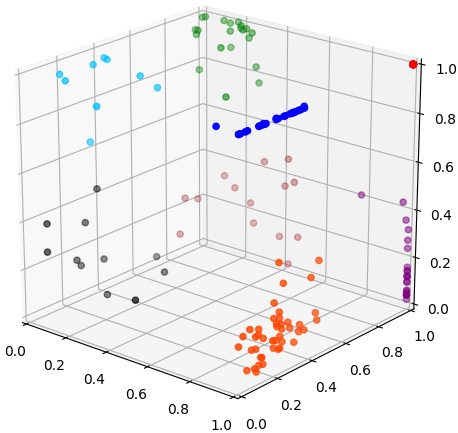
If all the agents update on the experimental results published by the agents who do B, they quickly learn that B is better for all three questions. If we make a pretty 3D scatterplot where each dimension represents the probability that B is better for one of the dilemmas, then the points converge over time to the [1.0, 1.0, 1.0] "corner of Truth", even though they started out uniformly distributed all over the space.

But suppose the agents don't trust each other's reports. ("Sure, she says she performed \(B_2\) 50 times and observed 26 successes, but she also believes that \(B_1\) is better than \(A_1\), which is crazy. Are we sure she didn't just make up those 50 trials of \(B_2\)?") Specifically, our agents assign a probability that a report is made-up (and therefore should not be updated on) in proportion to their distance from the reporter in our three-dimensional beliefspace, and a "mistrust factor" (a parameter to the simulation).

from math import sqrt

def euclidean_distance(v, w):
    return sqrt(sum((v[i] - w[i]) ** 2 for i in range(len(v))))

class Agent:
    ...

    def discount_factor(self, reporter_credences):
        return min(
            1, self.mistrust * euclidean_distance(self.credences, reporter_credences)
        )

    def update(self, question, hits, trials, reporter_credences):
        discount = self.discount_factor(reporter_credences)
        posterior = self.pure_update(self.credences[question], hits, trials)
        self.credences[question] = (
            discount * self.credences[question] + (1 - discount) * posterior
        )

(Um, the paper itself actually uses a slightly more complicated mistrust calculation that also takes into account the agent's prior probability of the evidence, but I didn't quite understand the motivation for that, so I'm going with my version. I don't think the grand moral is affected.)

Then we can simulate what happens if the distrustful agents do many rounds of experiments and talk to each other—

def summarize_experiment(results):
    return (len([r for r in results if r]), len(results))

def simulation(
    agent_count,  # number of agents
    question_count,  # number of questions
    round_count,  # number of rounds
    trial_count,  # number of trials per round
    mistrust,  # mistrust factor
):
    agents = [
        Agent(
            [random.random() for _ in range(question_count)],
            trial_count=trial_count,
            mistrust=mistrust,
        )
        for i in range(agent_count)
    ]

    for _ in range(round_count):
        for question in range(question_count):
            experiments = []
            for agent in agents:
                if agent.credences[question] >= 0.5:
                    experiments.append(
                        (summarize_experiment(agent.experiment()), agent.credences)
                    )
            for agent in agents:
                for experiment, reporter_credences in experiments:
                    hits, trials = experiment
                    agent.update(
                        question,
                        hits,
                        trials,
                        reporter_credences,
                    )

    return agents

Depending on the exact parameters, we're likely to get a result that "looks like" this agent_count=200, round_count=20, question_count=3, trial_count=50, mistrust=2 run—

Some of the agents (depicted in red) have successfully converged on the corner of Truth, but the others have polarized into factions that are all wrong about something. (The colors in the pretty 3D scatterplot are a k-means clustering for k := 8.) On average, evidence pushes our agents towards Truth—note the linearity of the blue and purple points, illustrating convergence on two out of the three problems—but agents who erroneously believe that A is better (due to some combination of a bad initial credence and unlucky experimental results that failed to reveal B's ε "edge" in the sample size allotted) can end up too far away to trust those who are gathering evidence for, and correctly converging on, the superiority of B.

Our authors wrap up:

[T]his result is especially notable because there is something reasonable about ignoring evidence generated by those you do not trust—particularly if you do not trust them on account of their past epistemic failures. It would be irresponsible for scientists to update on evidence produced by known quacks. And furthermore, there is something reasonable about deciding who is trustworthy by looking at their beliefs. From my point of view, someone who has regularly come to hold beliefs that diverge from mine looks like an unreliable source of information. In other words, the updating strategy used by our agents is defensible. But, when used on the community level, it seriously undermines the accuracy of beliefs.

I think the moral here is slightly off. The specific something reasonable about ignoring evidence generated by those you do not trust on account of their beliefs, is the assumption that those who have beliefs you disagree with are following a process that produces systematically misleading evidence. In this model, that assumption is just wrong. The problem isn't that the updating strategy used by our agents is individually "defensible" (what does that mean?) but produces inaccuracy "when used on the community level" (what does that mean?); the problem is that you get the wrong answer if your degree of trust doesn't match agents' actual trustworthiness. Still, it's enlighteningly disturbing to see specifically how the "distrust those who disagree" heuristic descends into the madness of factions.

(Full source code.)

Schelling Categories, and Simple Membership Tests

(originally published at Less Wrong)

Followup to: Where to Draw the Boundaries?

Or there might be social or psychological forces anchoring word usages on identifiable Schelling points that are easy for different people to agree upon, even at the cost of some statistical "fit" ...

The one comes to you and says, "That paragraph about Schelling points sounded interesting. What did you mean by that? Can you give an example?"

Sure. Previously on Less Wrong, in "The Univariate Fallacy", we studied points sampled from two multivariate probability distributions \(P_A\) and \(P_B\), and showed that it was possible to infer with very high probability which distribution a given point was sampled from, despite significant overlap in the marginal distributions for any one variable considered individually.

From the standpoint of "the way to carve reality at its joints, is to draw your boundaries around concentrations of unusually high probability density in Thingspace", the correct categorization of the points in that example is clear. We have two clearly distinguishable clusters. The conditional independence property is satisfied: given a point's cluster-membership, knowing one of the \(x_i\) doesn't tell you anything about \(x_j\) for ji. So we should draw a category boundary around each cluster. Obviously. We might ask hypophorically: what could possibly change this moral?

More constraints on the problem, that's what!

Suppose you needed to coordinate with someone else to make decisions about these points—that is, it's important not just that you and your partner make good decisions, but also that you make the same decision—but that each of you only got to observe one coordinate from each point. As we saw, the predictive work we get from category-membership in this scenario is spread across many variables: if you only get to observe a few dimensions, you have a lot of uncertainty about cluster-membership (which carries over into additional uncertainty about the other dimensions that you haven't observed, but which affect the ex post quality of your decision).

If you and your partner were both ideal Bayesian calculators who could communicate costlessly, you would share your observations, work out the correct probability, and use that to make optimal decisions. But suppose you couldn't do that—either because communication is expensive, or your partner was bad at math, or any other reason. Then it would be sad if you happened to see \(x_9\) = 2 and said "It's an A (probably)!", and your partner happened to see \(x_{27}\) = 3 and said "It's a B (I think)!", and the two of you made inconsistent decisions.

Okay, now suppose that there's actually a forty-first, binary, variable that I didn't tell you about earlier, distributed like so:

$$P_A(x_{41}) = \begin{cases} 3/4 & x_{41} = 0 \\ 1/4 & x_{41} = 1 \\ \end{cases}$$
$$P_B(x_{41}) = \begin{cases} 1/4 & x_{41} = 0 \\ 3/4 & x_{41} = 1 \\ \end{cases}$$

Observing \(x_{41}\) gives you \(\log_2 3\) ≈ 1.585 bits of evidence about cluster-membership, which is more than the

$$\frac{1/4 + 1/16}{2} \cdot |\log_2(4)| + \frac{7/16 + 1/4}{2} \cdot |\log_2(7/4)| + \frac{1/4 + 7/16}{2} \cdot |\log_2(4/7)| + \frac{1/16 + 1/4}{2} \cdot |\log_2(4)|$$

≈ 1.18 bits you can get from any one observation of one of the \(x_i\) for i ∈ {1...40}.

If you and your partner can both observe \(x_{41}\), you might end up wanting to base your shared categories and language on that—calling a point an "A" if it has \(x_{41}\) = 0, even though such points actually came from \(P_B\) a full quarter of the time—even if \(x_{41}\) itself has no effect on the quality of your decisions, and what you actually care about is wholely determined by the values of \(x_1\) through \(x_{40}\)! It's not the intension you would pick if you could make (and share) more observations—but ex hypothesi, you can't.

If you and your partner only get to observe one variable, \(x_{41}\) is your best choice—the single variable that gives you the most information about the "natural" cluster-membership. That also makes it a Schelling point—if you and your partner didn't get to commmunicate in advance about how you want to draw your shared category boundaries, you could pick \(x_{41}\) as your defining observation and be pretty confident your partner would make the same choice. We could imagine an even more pessimistic scenario in which the Schelling point category definition (a set of variables that "stuck out" from all the others) was less predictive than some other candidates—but if you couldn't coordinate to pick one of the more predictive category systems, you might be stuck with the Schelling point.

In conclusion, the right categories to use given constraints on communication and observation, might be different from the category boundaries you would draw from a "God's eye view", in part because consideration of which categories are easy for different agents to coordinate on is relevant, not just raw information-theoretic expressive power. Thus, "Schelling categories."

Thanks for reading!


The one says, "No, I meant, like, a real world example, not some dumb math thing for nerds. What is this post really about?"

It's about ... math? Or like, the relationship between math and human natural language? Like, I was wondering what "second-order" caveats or complications there might be to the basic "carve reality at the joints" moral of our standard Bayesian philosophy of language, and some of the people I've been collaborating with lately had been talking a lot about the importanace of intersubjective epistemology—that is, shared mapmaking, so—

"But where's the actionable takeaway? What's your real agenda here, huh?"

Oh. One of those readers, I see. Fine, I can probably think of some—how do you say?—"applications."

Ummmm ...

Let's see ...

Okay, here's something, maybe. What's the deal with the age of majority?

Society needs to decide who it wants to be allowed to vote, stand trial, sign contracts, serve in the military, &c. Whether it's a good idea for a particular person to have these privileges presumably depends on various relevant features of that person: things like cognitive ability, foresight, wisdom, relevant life experiences, &c. In particular, it would be pretty weird for someone's fitness to vote to directly depend on how many times the Earth has gone around the sun since they were born. What does that number have to do with anything?

It doesn't! But if Society isn't well-coordinated enough to agree on the exact prerequisites for voting and how to measure them, but can agree that most twenty-five-year-olds have them and most eleven-year-olds don't, then we end up choosing some arbitrary age cutoff as the criterion for our "legal adulthood" social construct. It works, but it's just a legal fiction—and not necessarily a particularly good fiction, as any bright teenagers reading this will doubtlessly attest.

If I told you that a particular fourteen-year-old was very "mature", that's a contentful statement: we have shared meaning attached to the word mature, such that my describing someone that way constrains your anticipations. But it's a really complicated meaning, a statistical signal in behavior that your brain can pick up on, but which isn't particularly verifiable to others who might have reasons to doubt my character assessment. In contrast, age is easy for everyone to agree on. We could imagine some hypothetical science-fictional Society that used brain scans and some sophisticated machine-learning classifer to determine which citizens get which privileges—but in our dumber, poorer world, calendars and subtraction will have to do.

In terms of Scott Garrabrant's taxonomy of applications of Goodhart's law, this is regressional Goodhart: Society wants to select for maturity, chooses age as a proxy, and in the process, ends up granting or withholding privileges that a more discriminating Society maybe wouldn't.

The age of majority is a case of replacing a complicated, illegible category ("maturity", the kind of abstract thing you might want to model as a cluster in a forty- or forty-one-dimensional space) with a simple membership test (an age cutoff that everyone knows how to compute). Different people might make make different subjective (but not arbitrary) judgements of the complicated, illegible category, so in order to get a more intersubjectively robust verdict on category-membership, we rely on an objective measurement that everyone can agree on.

If no convenient objective measurement is available, another strategy is possible: we can delegate to some canonical trusted authority, whose opinion of the complicated category will take precdence over everyone else's. An example of this is commodity grading standards. What is a "Grade AA" egg? Well, there's a complicated definition written down in a manual somewhere that you could try applying yourself—but for most people, Grade AA eggs are simply "those which have been certified as Grade AA by the USDA."1

It's even possible for the "simple objective measurement" and "delegate to an authority's subjective judgement" strategies to be combined. In "The Ideology Is Not the Movement", the immortal Scott Alexander writes about his model of the genesis of social groups—

Pre-existing differences are the raw materials out of which tribes are made. A good tribe combines people who have similar interests and styles of interaction even before the ethnogenesis event. Any description of these differences will necessarily involve stereotypes, but a lot of them should be hard to argue. [...] There are subtle habits of thought, not yet described by any word or sentence, which atheists are more likely to have than other people. [...]

The rallying flag is the explicit purpose of the tribe. It's usually a belief, event, or activity that get people with that specific pre-existing difference together and excited. Often it brings previously latent differences into sharp relief. People meet around the rallying flag, encounter each other, and say "You seem like a kindred soul!" or "I thought I was the only one!" Usually it suggests some course of action, which provides the tribe with a purpose.

Eliezer Yudkowsky's "A Fable of Science and Politics" depicts a fictional underground society split between two such tribes: an predominantly urban tribe that believes that the unseen sky is blue (and favors an income tax, strong marriage laws, and an Earth-centric cosmology), and predominanty rural one that believes that the sky is green (and favors merchant taxes, no-fault divorce, and a heliocentric cosmology). In this story, beliefs about the color of the sky are functioning as the "rallying flag" for tribe-formation in Alexander's model—and as a Schelling point for category definition.

We don't know how to talk about the preëxisting undefinable habits of thought that make social groups work—it's hard to explicitly articulate what exact statistical regularity our brains have detected in five-and-more-dimensional locale/sky-belief/tax-belief/divorce-belief/cosmology/&c.-space. (Although we could imagine some hypothetical science-fictional Society that did know how to articulate it, and consequently had richer forms of social and political organization than our own.) It's a lot simpler to talk about whether someone has pledged allegiance to the rallying flag: just ask someone, "What color do you believe the sky is?" (using sky-beliefs as as an "objective" simple membership test), or simply, "Are you a Blue or a Green?" (delegating the classification problem to the person themselves as the authority whose discernment is to be trusted)—and whatever they say, that's what they are.

Well, probably. We've seen that objective measurements like age are subject to regressional Goodhart, but the delegation-to-authority strategy is furthermore subject to adversarial Goodhart: once a category-membership test has been established, some agents might have an incentive to create examples that pass the test, but don't have the complicated, illegible properties than made the test a useful proxy in the first place.

We've seen this, for example, with title inflation: we expect the "job title" (the words that get printed on business cards or immigration sponsorship forms) to be the canonical description of what someone "does", even if the vagaries of the workday encompass many tasks,2 and an alien anthropologist tasked with observing the worksite and summarizing what each of the humans did might slice up her observations into categories with little resemblance to the company's formal org chart. But since we don't know how to do the obvious thing and average over all possible alien anthropologists weighted by simplicity, we can only rely on the org chart—which people have political incentives to manipulate, with the result that everyone in the finance industry is a "vice president" of some sort or another.

But "Vice President" has a literal meaning. Or it used to. Vice, "in place of; subordinate to." President, one who presides over some deliberative body. The adversarial-Goodhart pressures on language "exploit[ ] the trust we have in a functioning piece of language until it's lost all meaning".

So for readers who demand a takeaway beyond just an edge case in the math, perhaps take away this: coordination is costly. From the standpoint of language as an AI capability, the social constructions that feeble humans need in order to work together may be unavoidably dumbed-down for mass consumption, but that's no reason to not aspire to the true precision of the Bayes-structure to whatever extent possible.

(Thanks to Ben Hoffman for the etymology of "Vice President.")


  1. Or the analogous agency in your country. 

  2. When I worked in a supermarket, two days a week I did Tracy's bookkeeping/customer-service job while Tracy had her weekend, which entailed counting the money from last night's tills and swapping in new coinmags and completing the FSM report and answering the phone and selling money orders and covering the floral stand when the floral lady was on lunch, &c. I'm actually not sure what official name this role had in Safeway's official org chart. We just called it "the booth."