An Algorithmic Lucidity

a blog

October 2013

App Academy Diary, Week Seven

Monday 28 October 2013— The governor of Delaware was supposed to visit us today, but he totally stood us up!—supposedly because of a late airplane or something, if you even believe that. Today's assessment (on elementary JavaScript, binding of this, and the module pattern) was really straightforward, but I found the day's project (in collaboration with Irene Ngyuen) on client-side MVC quite challenging at times; I fear that we were only the second-best IreneZach team today. I'm sleeping over at the office again tonight, which seems like a good thing to do twice a week maybe?—when I stay, I can fit in some quality solo hacking time until sleep or distraction takes me, whereas I am not inclined to do so after a train and bike ride home. Case in point: I got a crude form of authentication working in Wires today! So many feels!

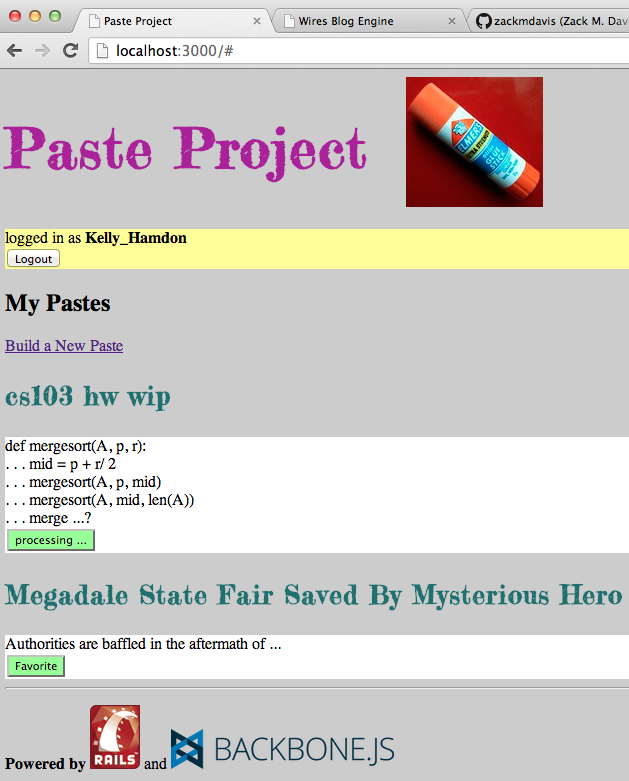
Wednesday 30 October 2013— Our focus this week is Backbone.js, a library for doing client-side stuff. I hadn't been sure what to do for my capstone project, but now (perhaps inspired by remembering how I really ought to use feeds instead of manually navigating to my favorite blogs for all the world as if it were 2003) I'm thinking of making an RSS reader and calling it Event Listener. In the evening, I made a small improvement to the Wires template engine, and I started working on an improvement to how objects inherit from the ORM base class, but it's getting late and I'm not done debugging and I wasn't planning on sleeping over tonight, so rather than pushing egregiously broken code to GitHub, I backed up my work as an online paste of a diff obtained by redirecting git stash show -p.
Learning Backbone

Thursday 31 October 2013 (or, very early Friday)— Speaking of online pastes, today I worked with Vincent Park on another make-a-Backbone-app exercise inspired by GitHub's Gist. It simply cannot be doubted that practice, as always, makes perfect. In the evening I bought a new clipboard at the Target inside the Metreon (as my old clipboard had been broken for some time, and the way in which the broken-off piece makes a great coaster had been small consolation indeed), and I hung out and made a few small improvements to Wires. I received a reminder of the importance of catching only specific exceptions—an except: block in my code was silently catching a type error that was the source of a bug, when really all I wanted was an except KeyError:—it was an easy fix this time, but in a larger project one might not be so lucky! Wires's current "template language" (if you can call it that; I'm just replacing identifiers inside "<%=" and "%>" delimiters with substitutions from a supplied dictionary) doesn't support conditionals the way EJS or ERB do, but it would be awfully nice to at least, say, render logged in as this-and-such depending on whether the user is logged in, but I have a cheap workaround in mind.
Levels

Specific is terrific,
But meta is betta.

App Academy Diary, Week Six

Tuesday 22 October 2013— I slept at the office last night for want of transportation, and ended up making some solid initial progress on a little Python web framework inspired by last week's class exercise, which I am also calling Wires. (Working on it in spare moments today alerted me to a disturbing deficit in my mental model of Python imports; you wouldn't expect organizing code into different directories to be difficult.) Yesterday I worked with Ryan Newton and today with Daphne Johnson on some JavaScript exercises.

Thursday 24 October 2013 (well, 0106 Friday)— Yesterday ("yesterday") I worked with Tommy Nast on a crude Asteroids clone using HTML canvas, and today ("today") I worked with Irene Zhou on a towers of Hanoi UI and started a Snake game using jQuery and DOM manipulation. I'm sleeping over at the office tonight, having spent the evening working on Wires.

Missing Words IV

You hear people accusing their enemies of being morally or intellectually bankrupt, and they mean it in the sense of "destitute of, or wholly lacking (something)", rather than the sense of financial insolvency. But I actually would like to see the insolvency metaphor: people should speak of declaring intellectual bankruptcy to mean "I was wrong before; I won't try to defend my previous claims because I can't" (in analogy to "I won't try to pay my debts, because I can't").

App Academy Diary, Week Five

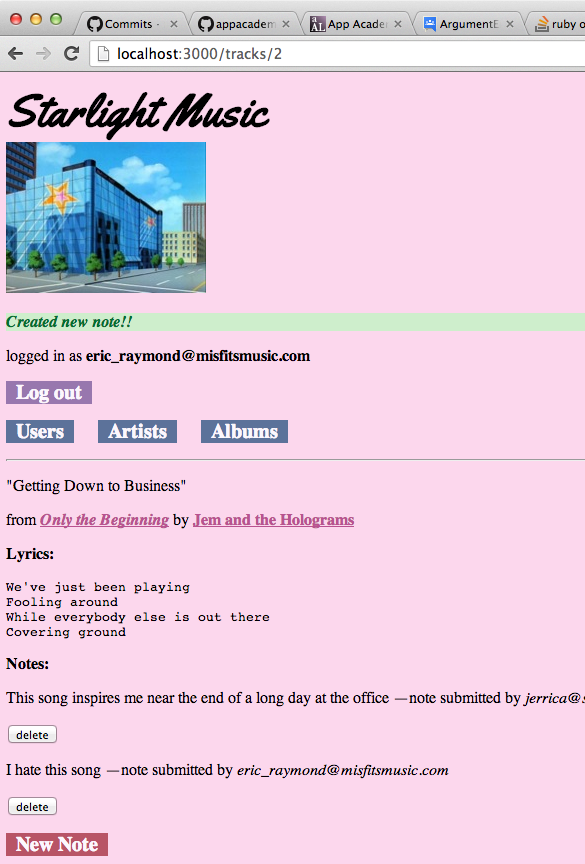
"Getting Down to Business"

Monday 14 October 2013— I'll confess that I didn't have a productive weekend at all. No excuses; I just got distracted. You could argue (I won't, but you can) that it's perfectly healthy and fine to take some well-earned relaxation on one's days off, but even relaxation is something that can be done better or worse: hours of the latest ephemeral internet amusements are probably much less rejuvenating than hours of ... I don't know, some sort of activity that doesn't involve sitting in front of a monitor?—I presume such things still exist even if I can't remember them anymore.

Still no deal in the BART contract talks; I took an evening train and slept at the office last night because we didn't know whether there would be trains in the morning. As it turns out, there were, but there likely won't be tomorrow. A moment of amusement is provided by imagining what kind of vicious and histrionic things a frustrated commuter might say if they were angry ("Curse the unions! Curse anyone who won't curse the unions! Curse anyone who won't put a light in their window and sit up all night cursing the unions! Let management fire them and hire scabs! Let hackers insert their names into the public sex-offender registry!" &c.), but in truth, I ain't even mad. (This is in accordance with policy; even if we were to suppose that I somehow knew how the labor dispute should ("should") be resolved, it would still be a waste of cognition to think about it unless we were also to suppose that people care what I think—and that's ridiculous.)

Today we did solo work on an application to keep track of musical artists and their associated albums and tracks, in the process gaining some more practice with authentication and learning about ActionMailer.

Tomorrow there's an assessment scheduled, and I really ought to have taken the time on the weekend to go through the posted practice-assessment, because I looked at it this evening, and somehow getting the specs to pass is much more difficult than I would have imagined. I may have a slight attitude problem: I tend to hold the entire idea of "studying for a test" in contempt (for surely we should study exactly the things that are worth knowing, tests merely being a instrumentally useful device for measuring what we have retained), but this is probably an error of modeling myself as having more agency than I actually have. All principles and rhetoric aside, we can predict that if I had studied for the test last week, then I wouldn't have forgotten the HAVING clause, but I didn't, so I did.

And that's terrible.

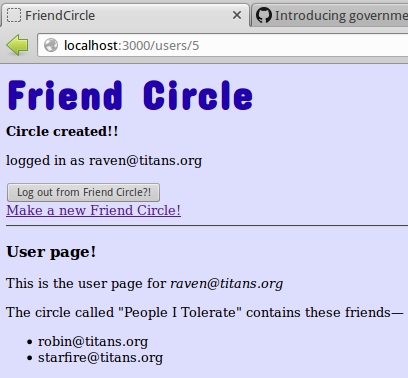
My Friend Circle

Tuesday 15 October 2013— I got all the specs to pass on the assessment with time to spare. Today's designated project was Friend Circle (!), a Google+ish thing where users can put other users in circles and share posts with them. I was scheduled to pair with Jeff Rosen, but apparently he was ill, and so I worked alone after lunch. The instructions described a somewhat ambitious project; I only got as far as letting users create circles and will have to catch up later. Associations are actually really powerful! Still no BART settlement ... and no strike, either; I decided to come home tonight, the allure of a shower and bed and privacy outweighing the travel uncertainty. Tomorrow we're going to make a very simple clone of some of the functionality of Rails itself (following up on our earlier very simple clone of some of the functionality of ActiveRecord). I guess I'll call it ... Ruby on Wires?

Thursday 17 October 2013— Writing Ruby on Wires yesterday (albeit building off the supplied skeleton) was really fun; I hooked it up to SedentaryRecord and started a blog engine ("blog engine"—well, okay, so you fill out a form and it adds your content to a page) that actually works, without Rails! Today I worked with Ben Hass again on a Reddit-like thing with RSpec tests (and FactoryGirl and Faker to construct test objects). Near the end, under Ben's leadership, we used JavaScript and jQuery to get comment forms to appear on the page in response to a user clicking "Reply", but didn't have time to actually get the comment submission to work. The trains are really going away tomorrow; perhaps I'll be able to join an ad hoc carpool at the station?

Sunday 20 October 2013— On Friday I got to the city in one the buses chartered by BART management. A television reporter asked me what I thought of the strike. I said that I didn't have anything interesting to say. She asked if I supported the strike. No, I said, then added that I think it's a waste of cognition to have opinions about things you don't have any control over.

I doubt that they used that clip.

Friday's focus was integration testing; I paired with the other Zach (Westlake). Things mostly went pretty well, but there was a frustrating period near the end of the day when we were reduced to fighting our own test framework.

Serenity

"I shall seek the serenity to accept the things I cannot change, the courage to change the things I can, and the wisdom to know the difference."

"I shall seek? What's wrong with the original God grant me?"

"What God sees fit to grant me is one of the things I can't change."

App Academy Diary, Week Four

Monday 7 October 2013— The main part of SedentaryRecord went pretty smoothly. I like my one-liner implementation of the has_many_through association better than the instructions' suggestion of writing a whole new query template; the TA Patrick pointed out that my version is inefficient (firing off two queries rather than one), but instead of writing the query-saving long version right away, I decided to try implementing validations first (one of the suggested extension ideas). That didn't go well at all; I spent a lot of time ineffectually hacking away at the problem but didn't even come up with anything worth committing!

Wednesday 9 October 2013— I did poorly on the assessment yesterday. There were eight SQL queries to write; the first five were trivial, but I bombed the last three because I'm a moron and didn't remember that the keyword for filtering aggregations was HAVING. I worked with William Ott on an ice-cream finder (which uses Google Maps APIs to print out directions to nearby ice-cream) and a Twitter client. Of course, it simply wouldn't do to write an ice-cream finder without using it to find ice-cream, so after class we took one of our program's suggestions and bought ice-cream at the Häagen-Dazs in the mall on Market and Fifth. Today I worked with David A.; we learned about routers and controllers.

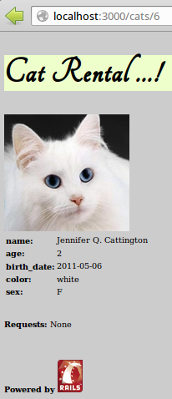
Our Cat for Rent

Thursday 10 October 2013— Dear reader, suppose yet again that you're working on the great American dog-sharing site—loser! Sharing dogs is so last week; you should have predicted that by now, everyone who's anyone would be renting cats instead. That's why today Dean Yang and I used our prodigious knowledge of not just models, but also both views and controllers, to make a mock cat-rental site! It's like this: say you visit the URL for the page that displays all the cats. Your browser issues an HTTP GET request, which is handled by the Rails router: an instance of the CatsController is spawned, and its index method is called, which puts an array of Cat objects (instantiated by the ActiveRecord ORM from their representations in the database) in an instance variable, which is then made available to a process that uses a template to decide how to express the information about the cats in HTML, which is then sent back to your browser. Similar stuff happens to let you make a new cat, or edit an existing cat.

Sunday 13 October 2013— On Friday I worked with Nathan Holland again; we added users and authentication to the cat-rental site! It's like this: in the app/config directory of the source repository there lives a file named routes.rb, which which tells Rails what to do with requests! Like, routes.rb contains a line that says "get 'login', :to => 'sessions#new'", which means that if someone issues an HTTP GET request to /login at our application's domain, that what happens next is determined by the new method in the SessionsController. As it happens, all that does is send back the log-in form generated from the template at app/views/sessions/new.html.erb. When the user submits the form, a POST request is issued to /login, which gets routed to the create method in the SessionsController! That does a few things. First, it tries to find the user in the database using the supplied credentials (username and hash-of-password). If that doesn't work, it shovels a friendly incorrect-username-or-password message onto flash[:errors] and renders the log-in page again (including the message from the flash hash). But if the user was found, then it logs them in by setting their session token, storing their current-user status in an instance variable, shoveling a friendly "Logged in from #{location}" message onto flash[:messages] (the user's location can be determined using their IP and the Geocoder gem), and redirecting to the page with all the cats!

Having accomplished this feat, Nathan and I spent a lot of time trying to push the application to Heroku so that we could test things like how to handle a user being logged in on several devices at once, but Heroku dislikes SQLite, and various attempts at troubleshooting the issue all failed horribly.