An Algorithmic Lucidity

a blog

Category: arts & culture

Comment on “Death and the Gorgon”

(originally published at Less Wrong)

(some plot spoilers)

There's something distinctly uncomfortable about reading Greg Egan in the 2020s. Besides telling gripping tales with insightful commentary on the true nature of mind and existence, Egan stories written in the 1990s and set in the twenty-first century excelled at speculative worldbuilding, imagining what technological wonders might exist in the decades to come and how Society might adapt to them.

In contrast, "Death and the Gorgon", published in the January/February 2024 issue of Asimov's, feels like it's set twenty minutes into the future. The technologies on display are an AI assistant for police officers (capable of performing research tasks and carrying on conversation) and real-time synthetic avatars (good enough to pass as a video call with a real person). When these kinds of products showed up in "'90s Egan"—I think of Worth's "pharm" custom drug dispenser in Distress (1995) or Maria's "mask" for screening spam calls in Permutation City (1994)—it was part of the background setting of a more technologically advanced world than our own.

Reading "Gorgon" in 2024, not only do the depicted capabilities seem less out of reach (our language model assistants and deepfakes aren't quite there yet, but don't seem too far off), but their literary function has changed: much of the moral of "Gorgon" seems to be to chide people in the real world who are overly impressed by ChatGPT. Reality and Greg Egan are starting to meet in the middle.

Our story features Beth, a standard-issue Greg Egan protagonist1 as a small-town Colorado sheriff investigating the suspicious destruction of a cryonics vault in an old mine: a naturally occurring cave-in seems unlikely, but it's not clear who would have the motive to thaw (murder?) a hundred frozen heads.

Graciously tolerating the antics of her deputy, who is obsessed with the department's trial version of (what is essentially) ChatGPT-for-law-enforcement, Beth proceeds to interview the next of kin, searching for a motive. She discovers that many of the cryopreserved heads were beneficiaries of a lottery for terminally ill patients in which the prize was free cyronic suspension. The lottery is run by OG—"Optimized Giving"—a charitable group concerned with risks affecting the future of humanity. As the investigation unfolds, Beth and a colleague at the FBI begin to suspect that the lottery is a front for a creative organized crime scheme: OG is recruiting terminal patients to act as assassins, carrying out hits in exchange for "winning" the lottery. (After which another mafia group destroyed the cryonics vault as retaliation.) Intrigue, action, and a cautionary moral ensue as our heroes make use of ChatGPT-for-law-enforcement to prove their theory and catch OG red-handed before more people get hurt.


So, cards on the table: this story spends a lot of wordcount satirizing a subculture that, unfortunately, I can't credibly claim not to be a part of. "Optimized Giving" is clearly a spoof on the longtermist wing of Effective Altruism—and if I'm not happy about how the "Effective Altruism" brand ate my beloved rationalism over the 2010s, I don't think anyone would deny the contiguous memetic legacy involving many of the same people. (Human subcultures are nested fractally; for the purposes of reviewing the story, it would benefit no one for me to to insist that Egan isn't talking about me and my people, even if, from within the subculture, it looks like the OpenPhil people and the MIRI people and the Vassarites and ... &c. are all totally different and in fact hate each other's guts.)

I don't want to be defensive, because I'm not loyal to the subculture, its leaders, or its institutions. In the story, Beth talks to a professor—think Émile Torres as a standard-issue Greg Egan character—who studies "apostates" from OG who are angry about "the hubris, the deception, and the waste of money." That resonated with me a lot: I have a long dumb story to tell about hubris and deception, and the corrupting forces of money are probably a big part of the explanation for the rise and predictable perversion of Effective Altruism.

So if my commentary on Egan's satire contains some criticism, it's absolutely not because I think my ingroup is beyond reproach and doesn't deserve to satirized. They (we) absolutely do. (I took joy in including a similar caricature in one of my own stories.) But if Egan's satire doesn't quite hit the mark of explaining exactly why the group is bad, it's not an act of partisan loyalty for me to contribute my nuanced explanation of what I think it gets right and what it gets wrong. I'm not carrying water for the movement;2 it's just a topic that I happen to have a lot of information about.

Without calling it a fair portrayal, the OG of "Gorgon" isn't a strawman conjured out of thin air; the correspondences to its real-world analogue are clear. When our heroine suspiciously observes that these soi-disant world-savers don't seem to be spending anything on climate change and the Émile Torres–analogue tells her that OG don't regard it as an existential threat, this is also true of real-world EA. When the Torres-analogue says that "OG view any delay in spreading humanity at as close to light-speed as possible as the equivalent of murdering all the people who won't have a chance to exist in the future," the argument isn't a fictional parody; it's a somewhat uncharitably phrased summary of Nick Bostrom's "Astronomical Waste: The Opportunity Cost of Delayed Technological Development". When the narrator describes some web forums as "interspers[ing] all their actual debunking of logical fallacies with much more tendentious claims, wrapped in cloaks of faux-objectivity" and being "especially prone to an abuse of probabilistic methods, where they pretended they could quantify both the likelihood and the potential harm for various implausible scenarios, and then treated the results of their calculations—built on numbers they'd plucked out of the air—as an unimpeachable basis for action", one could quibble with the disparaging description of subjective probability, but you can tell which website is being alluded to.

The cryonics-as-murder-payment lottery fraud is fictional, of course, but I'm inclined to read it as artistically-licensed commentary on a strain of ends-justify-the-means thinking that does exist within EA. EA organizations don't take money from the mob for facilitating contract killings, but they did take money from the largest financial fraud in history, which was explicitly founded as a means to make money for EA. (One could point out that the charitable beneficiaries of Sam Bankman-Fried's largesse didn't know that FTX wasn't an honest business, but we have to assume that the same is true of OG in the story: only a few insiders would be running the contract murder operation, not the rank-and-file believers.)

While the depiction of OG in the story clearly shows familiarity with the source material, the satire feels somewhat lacking qua anti-EA advocacy insofar as it relies too much on mere dismissal rather than presenting clear counterarguments.3 The effect of OG-related web forums on a vulnerable young person are described thus:

Super-intelligent AIs conquering the world; the whole Universe turning out to be a simulation; humanity annihilated by aliens because we failed to colonize the galaxy in time. Even if it was all just stale clichés from fifty-year-old science fiction, a bright teenager like Anna could have found some entertainment value analyzing the possibilities rigorously and puncturing the forums' credulous consensus. But while she'd started out healthily skeptical, some combination of in-forum peer pressure, the phony gravitas of trillions of future deaths averted, and the corrosive effect of an endless barrage of inane slogans pimped up as profound insights—all taking the form "X is the mind-killer," where X was pretty much anything that might challenge the delusions of the cult—seemed to have worn down her resistance in the end.

I absolutely agree that healthy skepticism is critical when evaluating ideas and that in-forum peer pressure and the gravitas of a cause (for any given set of peers and any given cause) are troubling sources of potential bias—and that just because a group pays lip service to the value of healthy skepticism and the dangers of peer pressure and gravitas, doesn't mean the group's culture isn't still falling prey to the usual dysfunctions of groupthink. (As the inane slogan goes, "Every cause wants to be a cult.")

That being said, however, ideas ultimately need to be judged on their merits, and the narration in this passage4 isn't giving the reader any counterarguments to the ideas being alluded to. (As Egan would know, science fiction authors having written about an idea does not make the idea false.) The clause about the whole Universe turning out to be a simulation is probably a reference to Bostrom's simulation argument, which is a disjunctive, conditional claim: given some assumptions in the philosophy of mind and the theory of anthropic reasoning, then if future civilization could run simulations of its ancestors, then either they won't want to, or we're probably in one of the simulations (because there are more simulated than "real" histories). The clause about humanity being annihilated by failing to colonize the galaxy in time is probably a reference to Robin Hanson et al.'s grabby aliens thesis, that the Fermi paradox can be explained by a selection effect: there's a relatively narrow range of parameters in which we would see signs of an expanding alien civilization in our skies without already having been engulfed by them.

No doubt many important criticisms could be made of Bostrom's or Hanson's work, perhaps by a bright teenager finding entertainment value in analyzing the possibilities rigorously. But there's an important difference between having such a criticism5 and merely asserting that it could exist. Speaking only to my own understanding, Hanson's and Bostrom's arguments both look reasonable to me? It's certainly possible I've just been hoodwinked by the cult, but if so, the narrator of "Gorgon"'s snarky description isn't helping me snap out of it.

It's worth noting that despite the notability of Hanson's and Bostrom's work, in practice, I don't see anyone in the subculture particularly worrying about losing out on galaxies due to competition with aliens—admittedly, because we're worried about "super-intelligent AIs conquering the world" first.6 About which, "Gorgon" ends on a line from Beth about "the epic struggle to make computers competent enough to help bring down the fools who believe that they're going to be omnipotent."

This is an odd take from the author7 of multiple novels in which software minds engage in astronomical-scale engineering projects. Accepting the premise that institutional longtermist EA deserves condemnation for being goofy and a fraud: in condemning them, why single out as the characteristic belief of this despicable group, the idea that future AI could be really powerful?8 Isn't that at least credible? Even if you think people in the cult or who work at AI companies are liars or dupes, it's harder to say that about eminent academics like Stuart Russell, Geoffrey Hinton, Yoshua Bengio, David Chalmers, and Daniel Dennett, who signed a statement affirming that "[m]itigating the risk of extinction from AI should be a global priority alongside other societal-scale risks such as pandemics and nuclear war."9

Egan's own work sometimes features artificial minds with goals at odds with their creator, as in "Steve Fever" (2007) or "Crystal Nights" (2008), and with substantial advantages over biological creatures: in Diaspora (1997), the polis citizens running at 800 times human speed were peace-loving, but surely could have glassed the fleshers in a war if they wanted to. If you believe that AI could be at odds with its creators and hold a competitive advantage, scenarios along the lines of "super-intelligent AIs conquering the world" should seem plausible rather than far-fetched—a natural phenomenon straightforwardly analogous to human empires conquering other countries, or humans dominating other animals.

Given so many shared premises, it's puzzling to me why Egan seems to have to bear so much antipathy towards "us",10 rather than than regarding the subculture more coolly, as a loose amalgamation of people interested in many of the same topics as him, but having come to somewhat different beliefs. (Egan doesn't seem to think human-level AI is at all close, nor that AI could be qualitatively superhumanly intelligent; an aside in Schild's Ladder (2002) alludes to a fictional result that there's nothing "above" general intelligence of the type humans have, modulo speed and memory.) He seems to expect the feeling to be mutual: when someone remarked on Twitter about finding it funny that the Less Wrong crowd likes his books, Egan replied, "Oh, I think they've noticed, but some of them still like the, err, 'early, funny ones' that predate the cult and hence devote no time to mocking it."

Well, I can't speak for anyone else, but personally, I like Egan's later work, including "Death and the Gorgon."11 Why wouldn't I? I am not so petty as to let my appreciation of well-written fiction be dulled by the incidental fact that I happen to disagree with some of the author's views on artificial intelligence and a social group that I can't credibly claim not to be a part of. That kind of dogmatism would be contrary to the ethos of humanism and clear thinking that I learned from reading Greg Egan and Less Wrong—an ethos that doesn't endorse blind loyalty to every author or group you learned something from, but a discerning loyalty to whatever was good in what the author or group saw in our shared universe. I don't know what the future holds in store for humanity. But whatever risks and opportunities nature may present, I think our odds are better for every thinking individual who tries to read widely and see more.12


  1. Some people say that Greg Egan is bad at characterization. I think he just specializes in portraying reasonable people, who don't have grotesque personality flaws to be the subject of "characterization." 

  2. I do feel bad about the fraction of my recent writing output that consists of criticizing the movement—not because it's disloyal, but because it's boring. I keep telling myself that one of these years I'm going to have healed enough trauma to forget about these losers already and just read ArXiv papers. Until then, you get posts like this one. 

  3. On the other hand, one could argue that satire just isn't the right medium for presenting counterarguments, which would take up a lot of wordcount without advancing the story. Not every written work can accomplish all goals! Maybe it's fine for this story to make fun of the grandiose and cultish elements within longtermist EA (and there are a lot of them), with a critical evaluation of the ideas being left to other work. But insofar as the goal of "Gorgon" is to persuade readers that the ideas aren't even worthy of consideration, I think that's a mistake. 

  4. In critically examining this passage, I don't want to suggest that "Gorgon"'s engagement with longtermist ideas is all snark and no substance. Earlier in the story, Beth compares OG believers "imagin[ing] that they're in control of how much happiness there'll be in the next trillion years" to a child's fantasy of violating relativity by twirling a rope millions of miles long. That's substantive: even if the future of humanity is very large, the claim that a nonprofit organization today is in a position to meaningfully affect it is surprising and should not be accepted uncritically on the basis of evocative storytelling about the astronomical stakes

  5. Which I think would get upvoted on this website if it were well done—certainly if it were written with the insight and rigor characteristic of a standard-issue Greg Egan protagonist. 

  6. Bostrom's "Astronomical Waste" concludes that "The Chief Goal for Utilitarians Should Be to Reduce Existential Risk": making sure colonization happens at all (by humanity or worthy rather than unworthy successors) is more important that making it happen faster. 

  7. In context, it seems reasonable to infer that Beth's statement is author-endorsed, even if fictional characters do not in general represent the author's views. 

  8. I'm construing "omnipotent" as rhetorical hyperbole; influential subcultural figures clarifying that no one thinks superintelligence will be able to break the laws of physics seems unlikely to be exculpatory in Egan's eyes. 

  9. Okay, the drafting and circulation of the statement by Dan Hendrycks's Center for AI Safety was arguably cult activity. (While Hendrycks has a PhD from UC Berkeley and co-pioneered the usage of a popular neural network activation function, he admits that his career focus on AI safety was influenced by the EA advice-counseling organization 80,000 hours. But Russell, Hinton, et al. did sign. 

  10. This isn't the first time Egan has satirized the memetic lineage that became longtermist EA; Zendegi (2010) features negative portrayals of a character who blogs at overpoweringfalsehood.com (a reference to Overcoming Bias) and a Benign Superintelligence Bootstrap Project (a reference to what was then the Singularity Institute for Artificial Intelligence). 

  11. Okay, I should confess that I do treasure early Egan (Quarantine (1992)/Permutation City (1994)/Distress (1995)) more than later Egan, but not because they devote no time to mocking the cult. It's because I'm not smart enough to properly appreciate all the alternate physics in, e.g., Schild's Ladder (2002) or the Orthogonal trilogy (2011–2013). 

  12. Though we're unlikely to get it, I've sometimes wished for a Greg Egan–Robin Hanson collaboration; I think Egan's masterful understanding of the physical world and Hanson's unsentimental analysis of the social world would complement each other well. 

Joined

(Previously on Star Trek: An Algorithmic Lucidity.)

The morning of Thursday the eighth, before heading off to see the new LCSW at the multi-specialty clinic, I was idly rereading some of the early Closetspace strips, trying to read between the lines (as it were) using the enhanced perception granted by the world-shattering insight about how everything I've cared about for the past fourteen years turns out to be related in unexpected and terrifying ways that I can't talk about because I don't want to lose my cushy psychology professorship at Northwestern University. (Victoria tells Carrie, "Not to mention you don't think like one of 'them'"; ha ha, I wonder what that means!) When I got to the part where Carrie chooses a Maj. Kira costume to wear to the sci-fi convention, it occured to me that in addition to having the exactly the right body type to cosplay Pearl from Obnoxious Bad Decision Child, I also have exactly the right body type to cosplay Jadzia Dax from Star Trek: Deep Space Nine, on account of my being tall—well, actually I'm an inch shorter than Terry Farrell—thin, white, and having a dark ponytail.

Okay, not exactly the right body type. You know what I mean.

So I ordered some cheapo Sciences-division uniform pajamas, thinking of going to some comics convention next year, but when I queried the Overmind in its gopher aspect for actual Star Trek conventions, it turned out that there was one that very weekend at the SFO Hyatt Regency (previously known to me as the host of the BABSCon My Little Pony: Friendship Is Magic convention). Online ticket sales had stopped, but allegedly "[a]vailable tickets [would] be on sale at the convention", and there was still time to upgrade my uniform order to one-day shipping.

The uniform I got (just the first suitable thing I found querying the Overmind in its Amazonian aspect; it would be possible to do better for more searching and money and shipping time) was problematic in that it's the TNG-era design and has commander's rank pips, whereas Jadzia was a lieutenant when she last wore a TNG-era uniform and (spoilers!) died in 2374 as a lieutenant commander. I considered trying to play a post-series Dax who actually faked her own death (and got Dr. Bashir to use an experimental technique to copy the Dax symbiont's memories to Ezri Tigan), then later got promoted to commander and assigned to a different post where they still wear the TNG-era uniforms for some reason. But I decided that it would be simpler to just cover the third pip with electrical tape and play Lt. Dax in 2369, just before her reassignment to Deep Space Nine. (Beyond body type, at 28, I'm even just the right age for this role, Jadzia having been born in 2341!)

(Aside: before considering the question of "who do I have the correct body type to cosplay", I had always thought that I liked/identified-with—my brain may not distinguish the two concepts as sharply as some do—Kira more than Dax, but that doesn't really make any sense: Dax, the cosmopolitan science officer whose ambition spans worlds and bodies, is far more like what I'm supposed to be than Kira, the ex-terrorist XO whose life has been structured by the struggle to defend her homeworld from Cardassian imperialism. Kira Nerys says that she trusts the wisdom of the Prophets; Jadzia Dax quietly wonders what those wormhole aliens are really up to.)

During the next few days, I watched "Soldiers of the Empire" (recommended as the best Dax episode by TrekBBS user "Bad Thoughts" in the at-the-time top search result for best dax episode returned by the Overmind in its gopher aspect) to help get into character and bought some cosmetics at Walgreens: Loréal 201 Classic Ivory "infallible pro-glow" SPF 15 foundation, Maybelline Line Stiletto "ultimate precision" liquid eyeliner (liquid eyeliner being recommended by Stephanie as the kind of makeup with which to draw Trill spots; thanks to friend of the blog Alicorn for the link), a Loréal Brunnette brow stylist definer pencil in case that turned out to be better than the eyeliner for drawing spots (it wasn't), and a stick of Maybelline 680 Mesmerizing Magenta lipstick.

(I couldn't find the liquid eyeliner myself and had to ask a store employee. She asked if there was any particular brand I wanted. "No," I said, just a eyelash hair too forcefully, "this isn't my usual area of expertise.")

So I got up early the morning of Sunday the eleventh, shaved, applied the makeup in my inexpert-would-almost-be-too-charitable way (smear on foundation, haphazardly dab eyeliner on sides of face to make Trill spots, waveringly bring lipstick to lips), put on a bra and my foam breastforms under the cheapo uniform top, and used my PADD to summon a taxi to Burlingame for the convention.

I arrived way too early for check-in, and walked up the road (wearing my black jacket over my uniform top) to the Mariott, which, unlike the Hyatt, has an outpost of the raktajino hegemon, and ordered a breakfast sandwich and the vanilla sweet-cream iced raktajino specialty medicinal. I gave my name as Jadzia, but the barista wrote Jetsy on the cup. (Maybe my voice was a little shaky, but maybe she needed to recalibrate her universal translator.)

A little bit of lipstick rubbed off on the sandwich and the straw.

I waited in the Hyatt lobby for a while, still with the jacket over my uniform, reading the Janet Mock autobiography on my PADD, until it was time to check in. After buying my Sunday wristband ($70), I wandered over to the photo-op/autograph ticketing table and bought a ticket to get a photo with Michael Dorn at 11:10 ($40). (Nana Visitor or Terry Farrell herself would have been my first choices for a celebrity photo, but they weren't there that day.)

There was still a lot of time to hang out before the theater opened for the actual convention programming, but that was fine, because actual convention programming is kind of boring; the actual point of conventions is to have an excuse to dress up and wander around and talk to people and get vanity photos of other people who are using the convention as an excuse to dress up.

A woman in the vendor hall asked me how I did my spots.

"This is my natural skin pigmentation," I said.

"Oh," she said, confused.

I leaned towards her and said in a conspiratorial whisper, "I'm not supposed to break character today! It's liquid eyeliner."

One man was wearing a particularly impressive Klingon costume. "I think I recognize you!" I said, stopping him. "I think Curzon knew you!"

"Curzon?"

"My previous host," I explained. "Can we get a photo?"

He seemed to regard me with bemused toleration as we posed for a selfie taken with my PADD.

"Those real?" he asked, referring to my breasts.

"No, I'm actually a guy," I said. "Obviously."

"I know," he said.

I sat through some actual convention programming. John de Lancie is almost as entertaining playing himself as he is as Q or Discord. In response to a question from an aspiring actor, de Lancie said that TV and movie acting is all about what you can do now, in contrast to theater, where young talent can be afforded time to develop under the tutelage of a director. He mentioned that Alarak, the character he voice-acted for Starcraft, was angry all the time, and that he imagined there should be a scene featuring Alarak relaxing by painting watercolor. He told the story (which I had already heard before, probably at BABSCon) of voicing Discord for Friendship Is Magic with minimal preparation and forgetting about the matter entirely until some months later, when he woke up to see his inbox exploding with fan mail for his part in something called "My Little Pony" ... and the correspondents were not little girls.

After de Lancie, there was a discussion with some writer-folk (the schedule said the topic would be the new series next year, but they didn't seem to know anything about it), and soon enough, it was time for my photo op with Michael Dorn.

The photo session was very assembly-line—here (unlike the autograph sessions I witnessed at other conventions) there was no pretense of your $40 giving you the opportunity to actually meet your heroes for even half a minute: this was pose, click, and it's over, time for the next fan to get in position. I had time to say to Dorn, "I'm Jadzia," but that was it.

Not that I was disappointed. A woman on the event staff commented on how happy I looked skipping down the room after the photo was taken. "My future husband!" I said.

"You're so cute," she said.

I appreciated that. On the whole, however, I feel like I was less enthusiastically received as Jadzia that day than I had been as Pearl at San Francisco Comic-Con—providing what could be seen as a disconfirmatory data point against my hypothesis that incompetent MtF crossdressing gets socially-rewarded more than same-sex cosplay (cisplay??) at these sorts of events. There are too many uncontrolled variables to make a fair comparison—this was a different (I think better) costume, of a different character, in front of a different (notably smaller, possibly older?) crowd—but a darker, more specific hypothesis comes to mind.

As Pearl at Comic-Con, no matter what catchphrases I shouted during photo ops, I read as "unapologetic man-in-a-dress not pretending to be anything else," which is cool faux-subversive gender variance. (So brave! Man Pearl is best Pearl!) Whereas Starfleet uniforms are properly unisex: the only gender cues indicating that I was trying to be Jadzia Dax rather than a male Trill lieutenant were my breastforms, the lipstick (a much weaker cue), and the foundation hopefully hiding any residual beard-shadow (a weaker cue still). That put me out of the "man merely wearing clothes reserved for the other sex" category and into "man ineffectually pretending to be a woman" territory.

Maybe that's not cool. Maybe that's just creepy to some people. Even at a science-fiction convention in the Bay Area. (Even if people in the Bay Area are not dumb enough to say what they're really thinking.) I didn't see any other crossplayers at the Star Trek con, and the only other highly visible MtF crossplayers I saw at Comic-Con were the guys with beards wearing Sailor Moon outfits (and as for the people I thought I clocked on the ten-second timescale, who can say?—maybe they were real).

I want to be able to say with the unquestioning moral certitude of my youth that none of this should matter, that distinguishing "crossplay" from cosplaying a character that happens to be the same sex as you is discriminatory (and therefore, it need not be said, bad). I chose to play a character that I genuinely admire, and because this character happened to be a woman, I decided to wear the breastforms that I coincidentally happened to already own, in order to make the costume more realistic (given that I am a man and, unlike Jadzia Dax, don't have breasts), in exactly the same way that because this character happened to be a Trill, I decided to paint spots on the sides of my face using liquid eyeliner that I happened to not already own, in order to make the costume more realistic (given that I am a human and, unlike Jadzia Dax, don't have spots on the sides of my face).

I want to say it. I miss that righteous feeling of my youth. But in these dying autumn weeks following that moment of liberating clarity, I am done pretending to be stupid. And maybe I don't want you to pretend, either.

Is There Affirmative Action for Incompetent Crossplay?

So I was at San Francisco Comic Con the other day. I don't think I find conventions themselves to be as fun as a lot of other people seem to (I didn't even last all of Saturday at BABSCon 'fourteen and 'fifteen before getting ponied out and BARTing home, and didn't even bother attending this year), but I had never cosplayed before, and had been thinking lately that I have exactly the right body type to play Pearl from Obnoxious Bad Decision Chil—I mean, Steven Universe, on account of being my being tall, thin, white, and having a big nose. (She's even pretty flat-chested!) So I ordered the Pearl dress from Hot Topic (I maybe should've gotten the XXXL instead of merely the XXL), a pink (really should be more peach, but close enough) wig, yellow gym shorts, and pink socks; improvised a gem from medical tape and the bowl of a plastic spoon; and set off Saturday morning to catch the train to the city and a short walk to the San Francisco Marriot Marquis.

The con itself was about what you'd expect, with the usual events and the usual vendor hall. The part that I found striking (enough so that I'm bothering to blog about it) was just how many compliments and photo requests I got for my costume, wholly disproportionate to its actual quality. (I enjoyed the opportunity to ham it up, proclaiming "We are the Crystal Gems!" or singing a few bars from the extended theme during photo ops.) Since this was my first time cosplaying, I don't have calibration, so it's quite possible that I got the ordinary amount of positive attention given costume quality and character popularity, but I suspect that there was something more than that going on having to do with gendered cultural expectations.

Femininity in males is stigmatized more than masculinity in females; that's why I changed in the bathroom at the con rather than wear a dress on the train, and why I don't feel like including any photos in this post despite having shared them on Facebook (visibility settings: "Custom: Friends; Except: Family") and sent them in for the next Beach City Bugle cosplay compilation post. So incompetent MtF crossdressing is "loud" relative to men playing male characters, women playing anyone, and the competent crossdressers (who were clockable on the timescale of ten seconds, but didn't instantly read as "man in a dress" the way I did), and loud things that would be stigmatized in everyday life (probably even everyday life in the Bay Area) are celebrated at Comic Con. Thus, "man Pearl is best Pearl," as I was told by a young woman (who was cosplaying a male character), even after I insistently pointed out that the other Pearl was way better than me.

Quotations V

MINUETTE: So, uh, what are you studying these days?
MOON DANCER: Science, magic, history, economics, pottery. Things like that.
MINUETTE: Yowza! You planning on being a professor or something?
MOON DANCER: No.
MINUETTE: So you're just ... studying!
MOON DANCER: Can I go now?

My Little Pony: Friendship Is Magic, "Amending Fences"

However, this corresponds to a general pattern of causal relationships: observations on a common consequence of two independent causes tend to render those causes dependent, because information about one of the causes tends to make the other more or less likely, given that the consequence has occurred. This pattern is known as selection bias or Berkson's paradox in the statistical literature (Berkson 1946) and as the explaining away effect in artificial intelligence (Kim and Pearl 1983). For example, if the admission criteria to a certain graduate school call for either high grades as an undergraduate or special musical talents, then these two attributes will be found to be correlated (negatively) in the student population of that school, even if these attributes are uncorrelated in the population at large. Indeed, students with low grades are likely to be exceptionally gifted in music, which explains their admission to the graduate school.

—Judea Pearl, Causality

"It would be nice if implementation languages provided extensible string-indexable arrays as a built in type constructor, but with the exception of awk, Perl, and a few others, they don't. There are several ways to implement such a mechanism.

Modern Compiler Design by Dick Grune, Henri E. Bal, Ceriel J. H. Jacobs, and Koen G. Langendoen (2000)

If, even as the price to be paid for a fifth vote, I ever joined an opinion for the Court that began: "The Constitution promises liberty to all within its reach, a liberty that includes certain specific rights that allow persons, within a lawful realm, to define and express their identity," I would hide my head in a bag. The Supreme Court of the United States has descended from the disciplined legal reasoning of John Marshall and Joseph Story to the mystical aphorisms of the fortune cookie.

—Antoin Scalia; Obergefell v. Hodges dissent, footnote 22

PEARL: Oh, Steven. Humans just lead short, boring, insignificant lives, so they make up stories to feel like they're a part of something bigger. They want to blame all the world's problems on some single enemy they can fight, instead of a complex network of interrelated forces beyond anyone's control.

AMETHYST: It's sad. And funny.

PEARL: Don't feel bad about it, okay?

Steven Universe, "Keep Beach City Weird"

Education is a weapon whose effects depend on who holds it in his hands and at whom it is aimed.

—Joseph Stalin

Missing Books II

A roman à clef about a very religious teenager who gradually figures out that God isn't real around ages 20 and 21, spends the next eight years feeling OK about this, then one day suddenly realizes that God not being real implies that prayers don't work, and freaks the fuck out. His friends (who grew up in the same community but don't share his incredible lack of native talent for hypocrisy) are unsympathetic. "You really thought that would work?" "Yes!" "But didn't you notice that—" (sobbing) "I didn't!"

Bayesian Gem

STEVEN

Garnet, how does future vision work?

CONNIE

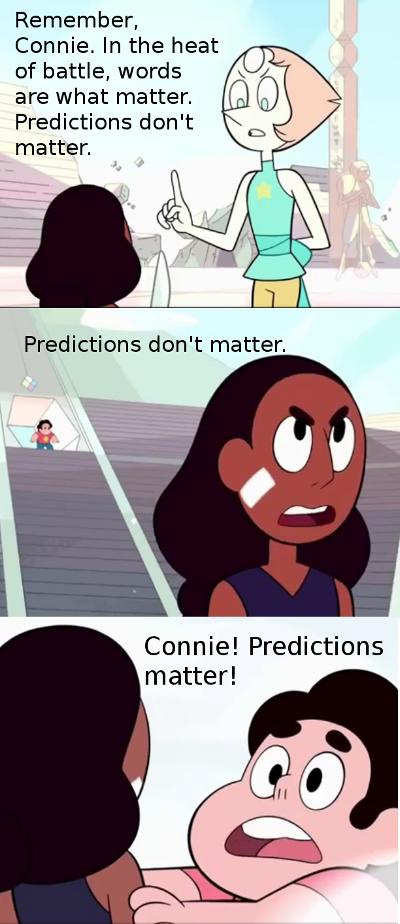
I was wondering that myself. Profitably acting on information from the future would require changing that future, a paradox at odds with our ordinary conception of causality. And yet on the other hand, acting on predictions about likely futures is precisely how intelligence works anyway ...

GARNET

Better let Pearl explain this one.

PEARL

Me? But, Garnet, I don't—

JUDEA PEARL

She was referring to me.

Quotations IV

MISTY: You know, I usually burn incense when I meditate, but the smell of a burning city can be just as relaxing.
JENNY: People are in danger! Why don't you do something?!
MISTY: They stiffed me.
JENNY: What?
MISTY: Your town. Tremorton. They wouldn't cough up the cash for services rendered.
JENNY: I have no idea what you're talking about.
MISTY: I'm a hero for hire. I save people for money. You knew that.
JENNY: And if they don't pay up, you just let them get pummeled?
MISTY: Pretty much. I have to eat, don't I?
(JENNY flies away, disgusted)
MISTY: I'm not living with my mom, like some people!

My Life as a Teenage Robot, "Mist Opportunities"

A second way of interpreting the effort level \(e^{MIN}\) is to consider that the principal and the agent do not have completely conflicting objectives. It is possible that the agent gets some utility from his work, but only up to a certain effort level. We assume that the level that the agent is willing to spontaneously offer is \(e^{MIN}\). The agency problem turns up in this case since the principal would like the agent to offer an effort greater than his spontaneous level.

—Inés Macho-Stadler and J. Davis Pérez-Castrillo, An Introduction to the Economics of Information

The judge currently accepts programs written in C, C++, Pascal, and Java, so your favorite language is probably available.

—Steven S. Skiena and Miguel A. Revilla, Programming Challenges: The Programming Contest Training Manual

I'm a slave to my spells
And yes it's true, well
I don't have as many friends as you
But I think you're nice and maybe we could be friends
And if you say no, you're toast

—"Ashley's Song", Super Smash Bros. Brawl

First world problems
They cause frustration
Forget starvation
In nations abroad
We've got plenty
That bug so many
I doubt that anyone's happy

"First World Problems", AVbyte

He is teasing me. Joviality is one of Max's preferred diffusion tactics. Taking on a deliberately inflated voice when directly addressing our differences is designed to produce an effect whereby we might wink at one another: We are both metacognizant, we both know the clichés about the other side. It isn't entirely ineffective.

Emmett Rensin

Still Yet Another Idle Wish for a Future Star Trek Series

(Previously, previously, previously on An Algorithmic Lucidity.)

"The next thing we need is a secure way to communicate with our contacts on Bajor," says Maj. Kira during Act One of Deep Space Nine Season 6, Episode 3, "Sons and Daughters", planning the secret resistance to the Dominion's occupation of Deep Space Nine ... at a table in a public bar?! Who writes this stuff?

It's too much to retcon, but since we're getting a new series soonish, I'm going to hope for an episode where, as a plot point, some people (not necessarily the protagonists) use cryptography with their universal translators to evade would-be eavesdroppers: you'd stop speaking out loud and configure your universal translator to translate your subvocalizations into noise that can only be decrypted by one of the private keys in your friends' universal translators.

"Pi Day" Is an Unholy Festival of Sin That Is Corrupting Our Children

Dear reader, it's the fourteenth day of the third month of the year, and if you're reading this blog, some charlatans or overenthusiastic youth (the subject of whose enthusiasm is not what they think it is) have probably tried to convince you to celebrate it as "Pi Day." You see (these quacks implored you) π is around 3.14, and March fourteenth is 3/14. And furthermore (they may have put to you) furthermore this year's Pi Day is special, because it's 3/14/15, which is like 3.1415! Why (an especially impudent few might have continued to venture), we should plan some grand spectacle on 9:26 a.m. on the day, which is like 3.1415926! With (and this is the part that is most inevitable and offensive) pie! Get it, because it sounds like pi and is shaped like a circle?

Dear reader, it is lies or it is worse than lies; it is blasphemy, treason, superstitious superficiality, degenerate folderol, and frivolous depravity! Do not mistake me; of course I can see as clearly as any other ape can that the numeric subsequence of the string "3.14" is same as that of the string "3/14". The former string represents an occasionally useful approximation of the circle constant which is ubiquitous in mathematics (give or take a factor of two); the latter is how people in my country abbreviate today's date. Perhaps to those who don't have anything really interesting to think about, this trivial coincidence might be worth a passing mention; apes love anything for an innocent distraction, and why begrudge that?

What is intolerable, however, is for a mathematically meaningless coincidence to be marketed as a day to celebrate mathematics, which marketing can only propagate the cruel slander that mathematics is about memorizing and manipulating figures. Not that seekers of true mathematical knowledge don't have occasion to manipulate figures from time to time—we do—but we do it because the figures actually mean something. And the similarity between the decimal number "3.14" and the date "3/14" ... doesn't really mean anything. Our dominant culture happens to prefer a base-ten place-value system, in which the representation of the quantity π happens to start with 3.14. That means: three (times ten-to-the-zeroth), plus one-tenth (which is one times ten-to-the-negative-first), plus four one-hundredths (which is four times ten-to-the-negative-second), plus other terms that our to-two-decimal-places approximation neglects. Whereas 3/14 means: the fourteenth day of the third month. It's not the same number as 3.14, even if its standard representation happens to involve the same digits in the same order.

If there must be a Pi Day, I can imagine sensible arguments for holding it once every three years and fifty-two days (around π years), or on January fourth at 3:23 a.m. (about π days into the new year), or on one of the solstices or equinoxes (when the Earth is π radians around the sun from some imagined "zero" at the opposite solstice or equinox).

But March fourteenth? What is wrong with the world such that such a travesty could gain common currency? Can't our innocent distractions at least rise to making a pretense of meaning something? Don't our cultural symbols deserve to have semantics deeper than mere empty tokens that can only be recognized, compared, and gawked at?

For the children.

Yet Another Idle Wish for a Future Star Trek Series

(Previously, previously on An Algorithmic Lucidity.)

"So, I'm not convinced that deassimilating Seven of Nine was the ethically correct choice."

"Oh?"

"I'm watching 'The Gift', and Seven clearly says, quote, 'You have imprisoned us in the name of humanity, yet you will not grant us your most cherished human right, to choose our own fate. You are hypocritical, manipulative. We do not want to be what you are!' End quote. As far as I can tell, Seven is just correct here; Janeway's pretense of acting in Seven's best interests because Seven used to be human twenty years ago, just isn't plausible."

"Since when are you a big defender of humanoid rights to self-determination? Didn't you root for the bad guys in Insurrection?"

"That was a completely different situation! Anyway, on futher thought, maybe my lament isn't so much about Janeway making the wrong decision, so much as I wish that she—or some analogue of her in an episode of some future Trek series, since wishing that Joe Menosky had made a different artistic decision in 1997 would be, uh, there's a specific word I want here ..."

"Futile?"

"—could just be honest about what she was doing. You could just say, 'Yes, I'm depriving current-you of autonomy and the entire purpose of your existence, but I don't care about that, and after a few more months of captivity, Stockholm syndrome will set in and future-corrupted-you will grow to like it,' instead of appealing to some bizarre teleology of humanness."

Twilight Sparkle Is a Disaster Waiting to Happen

I swear to Celestia, one of these days that mare is going to get somepony killed or worse. I almost suspect it's already happened and Hasbro is just sitting on the footage.

Seriously. Levitation or teleporting is fine, but you do not buck around with mind control or transformation spells unless you are absolutely sure that nothing will go wrong and that you can fix it when it does anyway. You'd think she'd learn after, I don't know, accidentally brainwashing pests into destroying the town, or unleashing a transmissible-by-sight plague of madness that wasn't stopped until Princess Celestia herself intervened, or accidentally swapping parts of her friends' souls, or accidentally transforming her friend into a horrible bat-pony abomination, or transforming herself and her friends into tiny vaguely-insectoid creatures and venturing through a closing portal to another world and only barely making it back in time.

Even plot armor isn't infinitely thick. Someday it's going to break, and I don't want to be watching when it happens.

Quotations III

I am convinced, from many experiments, I could not study, to any degree of perfection, either mathematics, arithmetic, or algebra, without being a Deist, if not an Atheist.

—John Wesley

Selfishness and altruism are positively correlated within individuals, for the obvious reason.

@InstanceOfClass

There is only one book: the world book. And all books are volumes of this one book. And all pages are pages of this world book. [...] You’re already skimming. You're already skipping over. You’re already not reading all the pages of the book.

—Khatzumoto, "All Reading Is Skimming"

The moral is that it is probably better not to sin at all, but if some kind of sin you must be pursuing,

—"Portrait of the Artist as a Prematurely Old Man" by Odgen Nash

Science may not fucking love you back.

Rachel Haywire

And that after this is accomplished, and the brave new world begins

—"The Gods of the Copybook Headings" by Rudyard Kipling

Quotations II

Just keep telling yourself: if they haven't started questioning what society tells them yet, then maybe they are not the one for you.

—"Pick-up Lines for Feminists" by Lesley Kartali

So, so what
I'm still a rock star
I got my rock moves
And I don't need you
And guess what
I'm having more fun
And now that we're done
I'm gonna show you tonight
I'm alright
I'm just fine

—"So What" by Pink

The cheaper people are to model, the larger the groups that can be modeled well enough to cooperate with them.

Michael Vassar

Quotations I

"As far as anyone knows, there's never been an animal population that was stable in the absence of predation, famine, or disease."

"Don't get discouraged," Carla said, reaching over and putting a hand on his shoulder. "That's just the history of life for the past few eons. It's not as if it's a law of physics."

The Eternal Flame by Greg Egan

Cherryl did not answer, then said suddenly, desperately, "Look ... what I don't want is charity."

"Jim must have told you—and it's true—that I never engage in charity."

"Yes, he did ... But what I mean is—"

"I know what you mean."

"But there's no reason why you should have to feel concern for me ... I didn't come here to complain and ... and load another burden on your shoulders. ... That I happen to suffer, doesn't give me a claim on you."

"No, it doesn't. But that you value all the things I value, does."

"You mean ... if you want to talk to me, it's not alms? Not just because you feel sorry for me?"

"I feel terribly sorry for you, Cherryl, and I'd like to help you—not because you suffer, but because you haven't deserved to suffer."

"You mean, you wouldn't be kind to anything weak or whining or rotten aobut me? Only to whatever you see in me that's good?"

"Of course."

Atlas Shrugged by Ayn Rand

The wizard gets the delight of working in a specialized area—magic—and gets a good look at the foundations of the Universe, the way things really work. It should be stated that there are people who consider the latter more of a curse than a blessing.

So You Want to Be a Wizard by Diane Duane

But I don't need to know the answer. I just recite to myself, over and over, until I can choose sleep:

It all adds up to normality.

Quarantine by Greg Egan