An Algorithmic Lucidity

a blog

May 2019

“But It Doesn’t Matter”

(originally published at Less Wrong)

If you ever find yourself saying, "Even if Hypothesis H is true, it doesn't have any decision-relevant implications," you are rationalizing! The fact that H is interesting enough for you to be considering the question at all (it's not some arbitrary trivium like the 1923th binary digit of π, or the low temperature in São Paulo on September 17, 1978) means that it must have some relevance to the things you care about. It is vanishingly improbable that your optimal decisions are going to be the same in worlds where H is true and worlds where H is false. The fact that you're tempted to say they're the same is probably because some part of you is afraid of some of the imagined consequences of H being true. But H is already true or already false! If you happen to live in a world where H is true, and you make decisions as if you lived in a world where H is false, you are thereby missing out on all the extra utility you would get if you made the H-optimal decisions instead! If you can figure out exactly what you're afraid of, maybe that will help you work out what the H-optimal decisions are. Then you'll be a better position to successfully notice which world you actually live in.

Minimax Search and the Structure of Cognition!

(This is a blog post adaptation of a talk I gave at !!Con West 2019!)

It all started at my old dayjob, where some of my coworkers had an office chess game going. I wanted to participate and be part of the team, but I didn't want to invest the effort in actually learning how to play chess well. So, I did what any programmer would do and wrote a chess engine to do it for me.

(Actually, I felt like writing a chess engine was too much of a cliché, so I decided that my program was an AI for a game that happens to be exactly like chess, except that everything has different names.)

My program wasn't actually terribly good, but I learned a lot about how to think, for the same reason that building a submarine in your garage in a great way to learn how to swim.

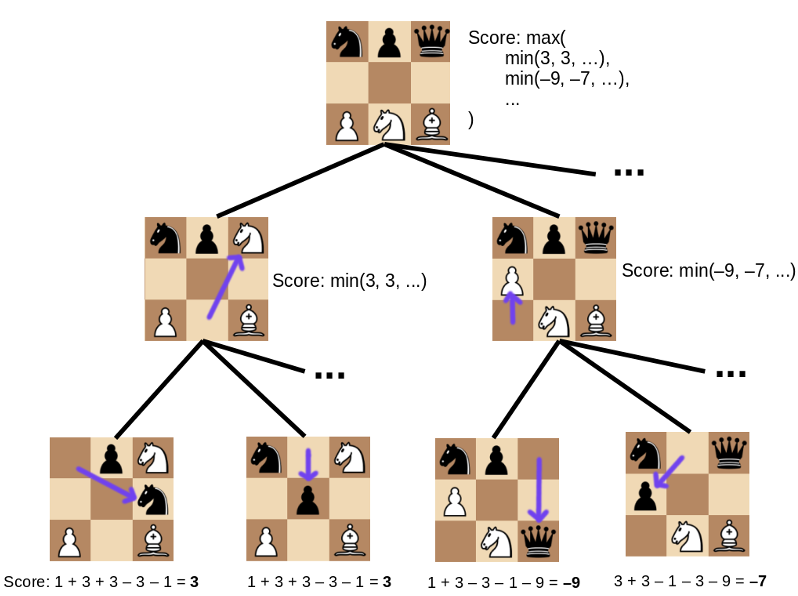
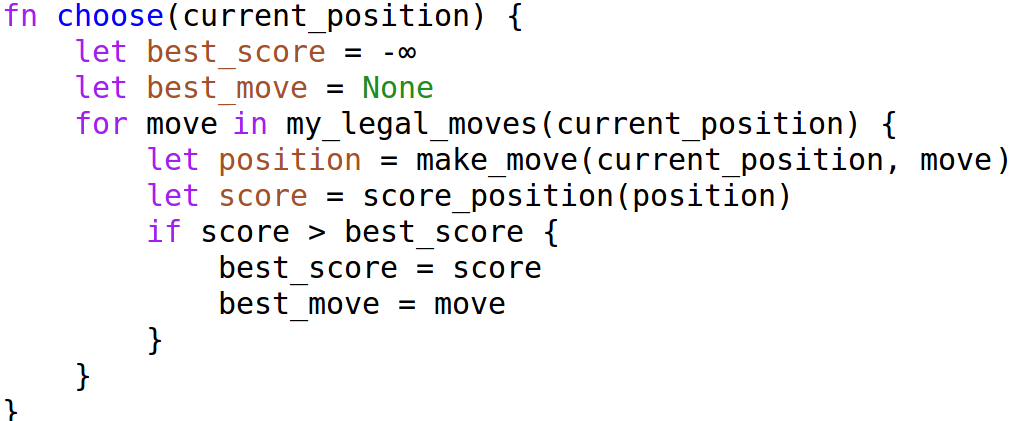
Consider a two-player board game like chess—or tic-tac-toe, Reversi, or indeed, any two-player, zero-sum, perfect information game. Suppose we know how to calculate how "good" a particular board position is for a player—in chess, this is traditionally done by assigning a point value to each type of piece and totaling up the point values of remaining pieces for each player.

Because only one player can win the game, what's good for one player is equally bad for the other: so if we add up all the piece values for one player, and subtract all the piece values for the other, we get a "score" for the board position that the first player is trying to maximize, and the second player is trying to minimize.
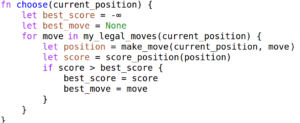
So consider a player pondering her move. For every possible legal move she could make, she knows what the board position will look like after that move, and can calculate the value of that position. So you might think she should choose the move that results in the best value: for example, if she can capture the opponent's queen, that would make the subsequent board position be worth 9 more points.

The problem with that is that it's short-sighted. If capturing the opponent's queen would just result in the opponent capturing the first player's queen back, then what looked like a 9 point gain after one turn, ends up being a wash after both players have taken their turn.
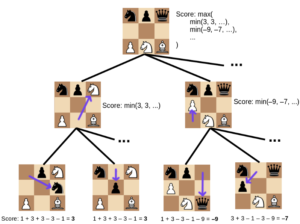
To take this into account, the first player should consider not just the immediate outcome of her move, but what the other player is likely to do after that. And the way the first player can compute what she predicts the second player will do is by asking, well, what would I do if I were in that position, except trying to minimize the score rather than maximizing it?

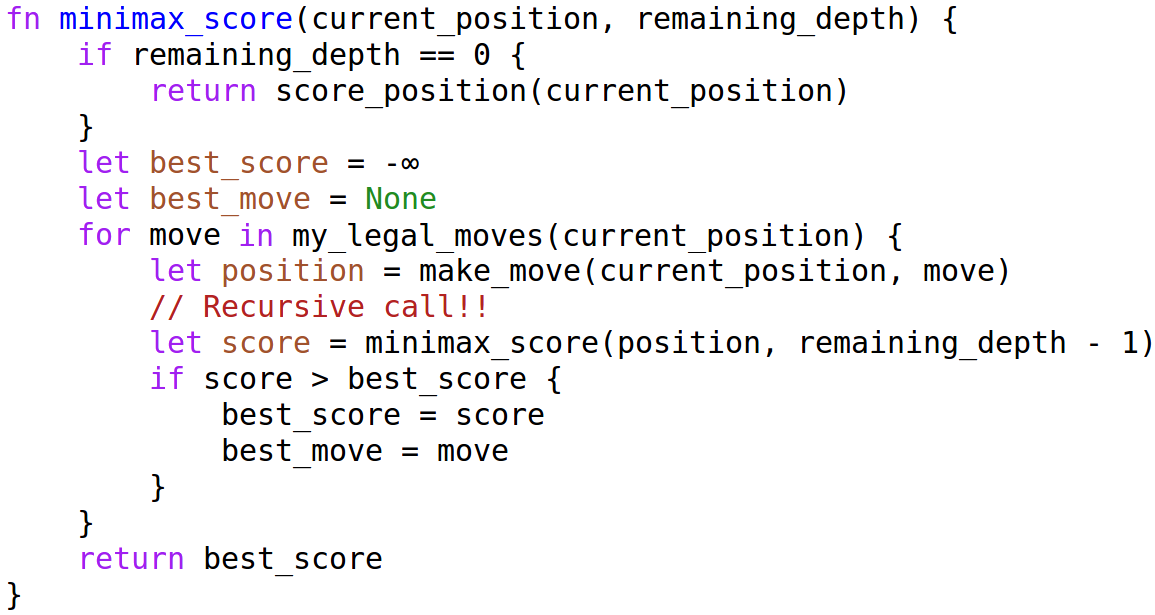
... and so on recursively. So instead of just choosing the move with the best immediate consequences, we want to look at the entire "game tree" of "my best move, given her best move, given my best move, given her best move"—down to some given depth at which we give up, take the point count at face value, and propagate that information back up the call stack.
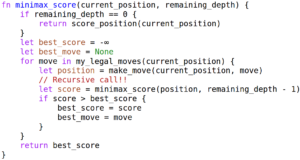
So, that's how you play chess. I want to tell you about two more philosophical insights I learned from this endeavor.

First, on the emergence of intstrumental goals. Some decision theorists like to distinguish between "terminal" goals and "instrumental" goals. Terminal goals are things that you want to achieve for their own sake—for example, love, or happiness, or winning a chess game. Whereas instrumental goals are things that you want to achieve because they lead to terminal goals: for example, washing your hair, or getting enough sleep, or capturing one of your opponent's pawns.

Chess enthusiasts have names for special board situations that are advantageous for a player.

For example, when a piece is in a position to attack two others, that's called a "fork", or when one piece moves out of the way to "reveal" an attack by another, that's called a "discovered attack."

When observing a chess engine's behavior, it's very tempting to intepret it in such "psychological" terms, as: "Oh, it's 'trying' to set up a fork; it 'wants' to set up a discovered attack."

But it can't be—literally can't be—because those concepts aren't represented anywhere in the algorithm! The code is just brute-forcing the game tree to find sequences of moves that result in capturing material. Humans don't have the raw computational power to do this efficiently, so we tend to notice features of board situations that lead to capturing matrial and give them special names, and treat them as instrumental goals to be sought out—as, indeed, our piece-counting score in our chess engine is actually just an instrumental goal that happens to typically be useful towards the terminal goal of check mate.

Similarly, if you could do a God's-eye-view brute-force search for the optimal paths through a human life, many such paths would, as a statistical regularity, happen to involve getting enough sleep—and if you don't have enough computational power, you might just want to treat that as an instrumental, tactical goal to reason about directly.

Second insight! On counterfactual reasoning. The adversarial, recursive nature of this "my best move given her best move given my best move" &c. reasoning leads to some behavior that looks very strange compared to how you would reason about optimizing an environment that isn't intelligently opposing your goals. If you're not facing an intelligent opponent, you should just make plans to directly accomplish your goals, and in particular, you wouldn't bother trying things that you can predict won't happen: you wouldn't bother packing your suitcase if you didn't intend to go anywhere.

On the other hand, maybe you would bother loading a gun even if you didn't intend to fire it. When facing an intelligent opponent, you need to take into account how your choices affect your opponent's choices. This leads our algorithm to set up attacks that it predicts won't be realized, because the credible threat constrains the opposing player's choices.

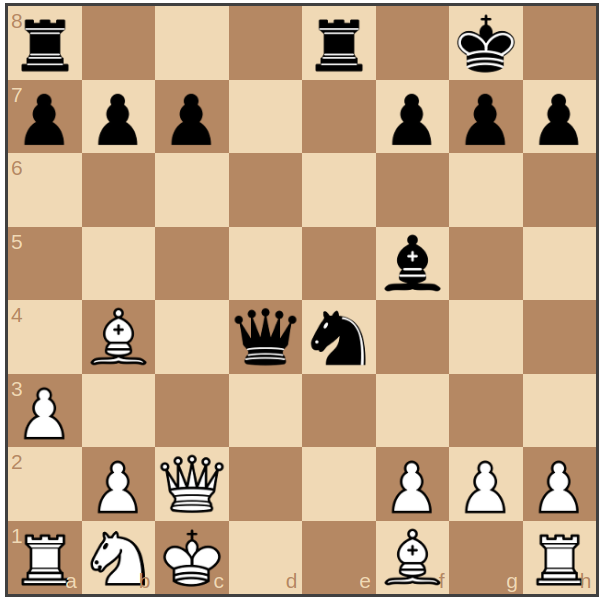
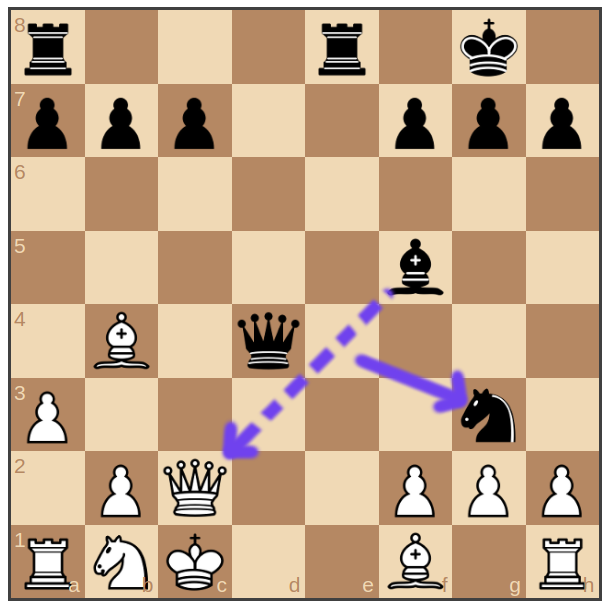
This position came up in a game with my coworkers as part of the engine's planning in a scenario where Black's previous move was moving her bishop to f5—
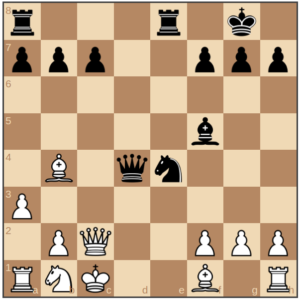
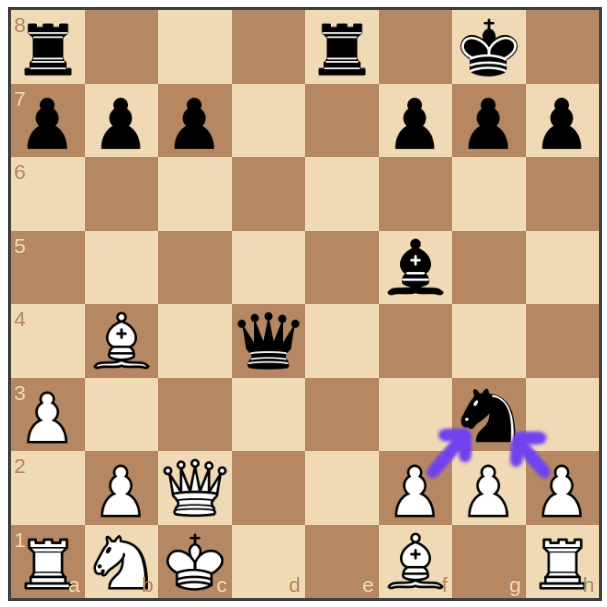
Here, the engine's predicted move for Black is knight to g3. At a first glance, this looked crazy to me: why would you move the knight to be diagonally in front of those pawns that could capture it?
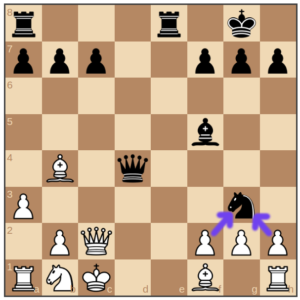
And of course, what's actually happening is that moving the knight reveals a discovered attack of the black bishop on f5 against the white queen on c2.
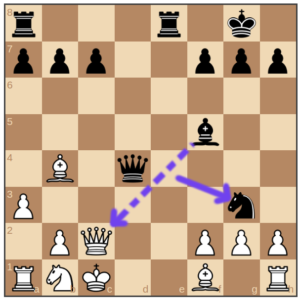
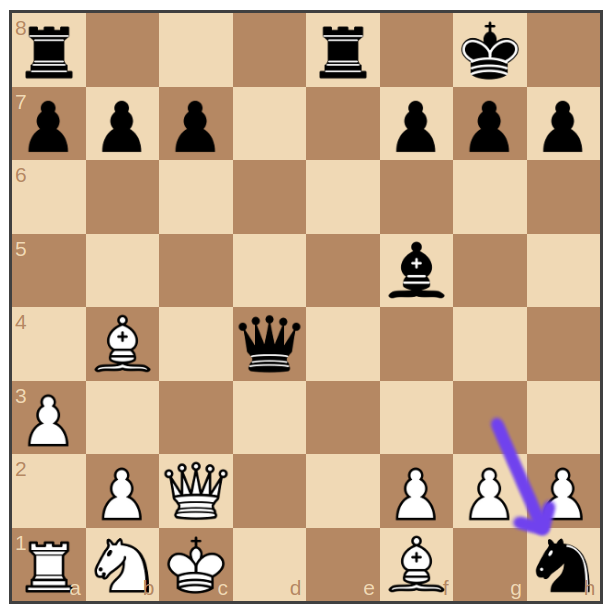
Saving the queen is more important to White than capturing the black knight, allowing Black to use her next turn to capture the white rook on h1.
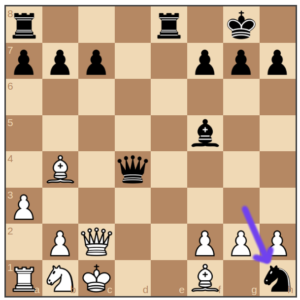
But this is pretty weird, right? The algorithm has gone to all this trouble to set up a discovered attack on the white queen—in order to capture the white rook, not the queen!

This kind of behavior has analogues in real life whenever you have situations where different agents, different systems, have conflicting goals and can respond to each other's behavior. If people can predict that if they were to commit crimes, then they would be punished—that incentivizes them to obey the law in the first place: the threat of punishment is shaping the population's behavior even if no one is actually going to be punished for that very reason.

There's an old joke about a UC Santa Cruz student sprinkling powder outside her dorm, who, when questioned, responds, "Oh, this? It's elephant repellent!"

The questioner replies, "But there aren't any elephants in Santa Cruz!"

The student counterreplies, "Well, that's how you know it's working!"

But you see, sometimes, that actually is the explanation. Thank you.
Group Theory for Wellness I

(Part of Math and Wellness Month.)

Groups! A group is a set with an associative binary operation such that there exists an identity element and inverse elements! And my favorite thing about groups is that all the time that you spend thinking about groups, is time that you're not thinking about pain, betrayal, politics, or moral uncertainty!

Groups have subgroups, which you can totally guess just from the name are subsets of the group that themselves satisfy the group axioms!

The order of a finite group is its number of elements, but this is not to be confused with the order of an element of a group, which is the smallest integer such that the element raised to that power equals the identity! Both senses of "order" are indicated with vertical bars like an absolute value (|G|, |a|).

Lagrange proved that the order of a subgroup divides the order of the group of which it is a subgroup! History remains ignorant of how often Lagrange cried.

To show that a nonempty subset H of a group is in fact a subgroup, it suffices to show that if x, yH, then xy⁻¹ ∈ H.

Exercise #6 in §2.1 of Dummit and Foote Abstract Algebra (3rd ed'n) asks us to prove that if G is a commutative ("abelian") group, then the torsion subgroup {gG | |g| < ∞} is in fact a subgroup. I argue as follows: we need to show that if x and y have finite order, then so does xy⁻¹, that is, that (xy⁻¹)^n equals the identity. But (xy⁻¹)^n equals (xy⁻¹)(xy⁻¹)...(xy⁻¹), "n times"—that is, pretend n ≥ 3, and pretend that instead of "..." I wrote zero or more extra copies of "(xy⁻¹)" so that the expression has n factors. (I usually dislike it when authors use ellipsis notation, which feels so icky and informal compared to a nice Π or Σ, but let me have this one.) Because group operations are associative, we can drop the parens to get xy⁻¹ xy⁻¹ ... xy⁻¹. And because we said the group was commutative, we can reörder the factors to get xxx...y⁻¹y⁻¹y⁻¹, and then we can consolidate into powers to get x^n y^(−n)—but that's the identity if n is the least common multiple of |x| and |y|, which means that xy⁻¹ has finite order, which is what I've been trying to tell you this entire time.

Forgive or Forget ("Or", Not "And"): A Trade-Off in Wellness Engineering

Forgiveness is an important input into Wellness, but contrary to popular belief, Forgiveness is incompatible with Forgetting. You can't just Forgive in general, you have to Forgive some specific sin in particular—but a vague description of a particular sin still corresponds to a vast space of possible sins matching that vague description.

A toy example for illustration: if you try to Forgive a three-digit integer with a 2 in the tens place, the moral force of your Forgiveness needs to spread out to cover all 9·10 = 90 possibilities (120, 121, ... 928, 929), which dilutes the amount of Forgiveness received by each integer—except the actual situation is far more extreme, because real-world sins are vastly more complicated than integers.

To truly Forgive a sin, You need to know exactly what the sin was and exactly why it happened. In order to withhold punishment, you need to compute what the optimal punishment would have been, had you been less merciful.

Thus, bounded agents can only approximate true Forgiveness, and even a poor approximation (far below the theoretical limits imposed by quantum uncertainty, which are themselves far below Absolute Forgiveness under the moral law) can be extremely computationally expensive. What we cannot afford to Forgive—where it would be impractical to mourn for weeks and months, analyzing the darkness in pain—we instead Forget.

This is how I will stop being trash, after five months of being trash. The program that sings, I was wrong; I was wrong—even if my cause was just, I was wrong, does not terminate. Even as the moral law requires that it finishes its work, the economic law does not permit it: it must be killed, its resources reallocated to something else that helps pay the rent: something like math, or whatever Wellness can exist in the presence of sin.

The Typical Set

(Part of Math and Wellness Month.)

Say you have a biased coin that comes up Heads 80% of the time. (I like to imagine that the Heads side has a portrait of Bernoulli.) Flip it 100 times. The naïve way to report the outcome—just report the sequences of Headses and Tailses—costs 100 bits. But maybe you don't have 100 bits. What to do?

One thing to notice is that because it was a biased coin, some bit sequences are vastly more probable than others: "all Tails" has probability \(0.2^{100} \approx 1.268 \cdot 10^{-70}\), whereas "all Heads" has probability \(0.8^{100} \approx 2.037 \cdot 10^{-10}\), differing by a factor of sixty orders of magnitude!!

Even though "all Heads" is the uniquely most probable sequence, you'd still be pretty surprised to see it—there's only one such possible outcome, and it only happens a \(2.037 \cdot 10^{-10}\)th of the time. You probably expect to get a sequence with about twenty Tails in it, and there are lots of those, even though each individual one is less probable than "all Heads."

Call the number of times we flip our Bernoulli coin N, and call the entropy of the coinflip H. (For the 80/20 biased coin, H is ⅕ lg 5 + 4/5 lg 5/4 ≈ 0.7219.)

It turns out for sufficiently large N (I know, one of those theorems, right?), almost all of the probability mass is going to live in a subset of \(2^{NH}\) outcomes, each of which have a probability close to \(2^{-NH}\) (and you'll notice that \(2^{NH} \cdot 2^{-NH} = 1\)).

May Is Math and Wellness Month

(Previously, previously.)

Do you ever spend five months in constant emotional pain waging a desperate and ultimately unsuccessful behind-the-scenes email campaign with the aim of securing a public clarification of a trivial philosophy-of-language issue because you're terrified that your robot cult's inability to correct politically-motivated philosophy errors implies that you've lost the Mandate of Heaven and are therefore unfit to prevent the coming robot apocalypse?

Yeah, me neither.

Did you know that May is Math and Wellness Month (source: me)?? Math and Wellness month is traditionally celebrated by performing super-well at one's dayjob, going to the gym a lot, and studying math in the evenings!