An Algorithmic Lucidity

a blog

Draft of a Letter to a Former Teacher, Which I Did Not Send Because Doing So Would Be a Bad Idea

Dear [name redacted]:

So, I'm trying (mostly unsuccessfully) to stop being bitter, because I'm powerless to change anything, and so being bitter is a waste of time when I could be doing something useful instead, but I still don't understand how a good person like you can actually think our so-called educational system is actually a good idea. I can totally understand being practical and choosing to work within the system because it's all we've got; there's nothing wrong with selling out as long as you get a good price. If you think you're actually helping your students become better thinkers and writers, then that's great, and you should be praised for having more patience than me. But I don't understand how you can unambiguously say that this gargantuan soul-destroying engine of mediocrity deserves more tax money without at least displaying a little bit of uncertainty!

You said in a previous message that a lot of your students are sheep-like, that they'll never do anything valuable that they're not told to do—but doesn't it seem likely that the system's bureaucratic, anti-intellectual, anti-curiosity culture of death has made them that way? I'm finishing my math degree at SF State (because I'm a coward, because people expect it, because my father is paying tuition and it's easier than getting a real job), and trying to talk to my fellow "math majors" is a source of constant heartbreak, because as far as I can tell, it has never occurred to most of them that knowledge and skills are useful for anything other than pleasing local authority figures. You try to tell them about some new idea you've been working on (see my posts at http://zackmdavis.net/blog/category/mathematics/ for examples of the sorts of things math people think about), and they just stare at you blankly and say, "What class is this for?"

You can't think of a polite answer to that, so you say to them: "Well, what have you been thinking about lately?"

Another blank stare. "Nothing."

"Well, what have you been doing, then? "

"Homework."

"Okay, but presumably the homework was about something ..."

"Calculus three."

"But what particular topi—you know, with respect, I don't think you understand what I'm trying to do here."

Quite often, to my horror (but not shock), it turns out that my interlocutor is planning on becoming a high-school teacher.

But people have been complaining about the incompetence and bad morals of youth for millennia—that's nothing new. Surely at least the University itself is designed to help young minds aspiring to something greater than earning a goddamned piece of paper?

Well, no. They don't give a fuck. They don't even pretend to give a fuck. (Individual professors are wonderful people, but you can't just directly pay them for tutoring; everything goes through the institution.) Earlier this year, after having wasted two years taking mostly worthless so-called "general education" classes at Diablo Valley College (including one in which we spent two class periods watching The Wizard of Oz, including one in which we were instructed to use colored pencils to indicate on a map which states belonged to the Union and which to the Confederacy), it seemed clear to me that the next step in my mathematical development was to study real analysis—the rigorous underpinnings of the differential and integral calculus which all educated people are familiar with. (Right?) But there's a mandatory prerequisite. I asked if I could take the prerequisite course concurrently with real analysis. Two different professors told me that I could not. I emailed the professor scheduled to teach real analysis, attaching a little paper I had written (admittedly rather trivial, but not bad for a mere undergraduate, I thought) about analogues of pi in the \(L^p\) spaces over \(\mathbb{R}^n\). I did not receive a reply.

Oh, well, I thought, my proof skills aren't actually that great; maybe it's for the best. I show up to the prerequisite class, and what's the first topic? Basic propositional logic, something I have known for five years. What's the last topic, in these final weeks of the course? The uncountability of the reals, something I have known for six years. And I am expected to sit there and obey, even though it is completely obvious to everyone in the room that I am not drawn from the same distribution as the other students, because large hierarchical organizations are structurally incapable of nurturing individual minds; all they can do is shove people around and treat them as fungible cogs.

And this is what passes for "education"? This is the system that everyone has to go through in order to be respected as "college educated"? This is the beneficiary of the endless stream of blatantly self-serving propaganda I had to endure this fall (on Facebook, on campus), which the voters (most of whom are monstrous hypocrites who have never voluntarily picked up a textbook in their entire lives) actually fell for, raising California's already-high taxes even more, and for what? Taxes are great if they're being used for something that will actually help people, like roads or libraries or a guaranteed minimum income—but to have this hugely expensive system just to pointlessly boss around young adults who (presumably) already know how to read? Pardon me while I puke, [name redacted].

I realize that I'm being a complete jerk to you by actually sending this [n.b., I did not actually send it]; you have no reason to bother enduring such a bitter screed from one of your former students [...] But, you know—it was only by the sheer luck of happening to read the right blog at the right time that I managed to avoid being permanently intellectually crippled by this credential-mad society, and sometimes, in a moment of pain, I actually feel entitled to be angry. Terribly selfish, I know. Am I morally justified in sending this to you, who have nothing but good intentions? Is it right for me to complain about something so trivial as sitting through a few classes, when I'm so incredibly privileged in so many other ways? Probably not; I think I'm just being a villain. But you know, I'm really not sure I care about that anymore. Really, I need to learn the skill of not paying any attention to mainstream society. My plan is to keep studying and hopefully (and finally, after having wasted so much time) make some money writing software that will actually help people. If the entire civilized world considers it their duty to crush all intellectual initiative out of its children, then it's really not my business. I wish you well, and hope that [names redacted] are also well, and I remain,

Faithfully yours,

Zack M. Davis
Eigencritters

Say we have a linear transformation \(A\) and some nonzero vector \(\vec{v}\), and suppose that \(A\vec{v} = \lambda\vec{v}\) for some scalar λ. This is a very special situation; we say that λ is an eigenvalue of A corresponding to the eigenvector \(\vec{v}\).

How can we find eigenvalues? Here's one criterion. If \(A\vec{v} = \lambda\vec{v}\) for some unknown λ, we at least know that \(A\vec{v} - \lambda\vec{v}\) equals the zero vector, which implies that the linear transformation \((A - \lambda I)\) maps \(\vec{v}\) to zero. If \((A - \lambda I)\) maps \(\vec{v}\) to zero, then it must have a nontrivial kernel, which is to say that it can't be invertible, and this happens exactly when its determinant is zero, because the determinant measures how the linear transformation distorts (signed) areas (volumes, 4-hypervolumes, &c.), so if the determinant is zero, it means you've lost a dimension; the space has been smashed infinitely thin. But \(\det(A - \lambda I)\) is a polynomial in λ, and so the roots of that polynomial are exactly the eigenvalues of \(A\).

Narrative Fallacy

I agree that it would be wildly out of character to learn JavaScript before Haskell, but life is not a story.

Evening Routine

"Gee, Brain, what do you want to do tonight?"

"The same thing we do every night, Pinky—the Right Thing to Do Given Current Info and Preferences!"

Speaking of Addiction

Speaking of addiction, I suspect that relinquishing ideologically-induced moral outrage is actually harder than getting over many chemical dependencies (although I don't have any experience with the latter). At least with a drug, it's simple enough to draw a bright line around actions you're not supposed to do anymore; you can try pouring the contents of the liquor cabinet down the drain, or signing a commitment contract to not buy or borrow any more cigarettes.

But when one of your most strongly-held beliefs (strongly-held in the sense of emotional relevance, not actual probability; I'm very confident in the monotone sequence theorem, but the truth of its negation wouldn't be a blow to who I am) turns out to be false—or if it still seems true, but it turns out that being continually angry at a Society that disagrees isn't a good allocation of cognitive resources—what do you do then? Turning your life around from that isn't anything as straightforward as preventing specific chemicals from entering your body; you have to change the way you think, which is to say excise a part of your soul. Oh, it grows back—that's the point, really; you want to stop thinking non-useful thoughts in order to replace them with something better—but can you blame me for having a self-preservation instinct, even if my currently-existing self isn't something that ought to be preserved?

But then, blame or the lack thereof isn't the point.

I Feel Sorry for People Who Work in Capital-Intensive Fields

Writers and mathematicians and programmers (&c.) can work on whatever they want with equipment that's easy for individuals to purchase. Architects and particle physicists and psychologists (&c.) need to hustle for clients or fill out a dozen grant applications just to be allowed to breathe—how do they bear it?

Goodhart's World

Someone needs to write a history of the entire world in terms of incentive systems and agents' attempts to game them. We have money to incentivize the production of useful goods and services, but we all know that there are lots of ways to make money that don't actually help anyone. Even in jobs that are actually useful, people spend a lot of their effort on trying to look like they're doing good work, rather than actually doing good work. And don't get me started about what passes for "education." (Seriously, don't.)

Much in a similar theme could be said about romance, and about economic systems in other places and times. And there's even a standpoint from which the things that we think are truly valuable for their own sake—wealth and happiness and true love, &c.—can be said to be the result of our species gaming the incentives that evolution built into us because they happened to promote inclusive genetic fitness in the ancestral environment.

The future is the same thing: superhuman artificial intelligence gaming the utility function we gave it, instead of the one we should have given it. Only there will be no one we'd recognize as a person to read or write that chapter.

Egoism as Defense Against a Life of Unending Heartbreak

Then the Dean understood what had puzzled him in Roark's manner.

"You know," he said, "You would sound much more convincing if you spoke as if you cared whether I agreed with you or not."

"That's true," said Roark. "I don't care whether you agree with me or not." He said it so simply that it did not sound defensive, it sounded like the statement of a fact which he noticed, puzzled, for the first time.

"You don't care what others think—which might be understandable. But you don't care even to make them think as you do?"

"No."

"But that's ... that's monstrous."

"Is it? Probably. I couldn't say."

In this passage from Ayn Rand's The Fountainhead, fictional character Howard Roark demonstrates a very important skill that I really need to learn—that of emotional indifference to arbitrary people's opinions: not the mere immunity of "It's okay that people now disagree with the manifest rightness of my Cause, because I know the forces of Good will win in the end," but the kind of outright indifference that I feel about, let's say, the amount of precipitation in Copenhagen in March 1957. Someone disagrees with the manifest rightness of my Cause? Sure, whatever—hey, did you see the latest Questionable Content?

I say this purely for pragmatic reasons. There's nothing philosophically noble about being narrowly selfish, about devoting the full force of one's attention to questions like "What do I want to study?" or "How am I going to make money?" rather than "Why are my ideological enemies so evil, and what can be done to stop them?" So if there's no inherent reason why scholarship or business are more worthy than activism, why explicitly renounce the activist frame of mind?

Because activism is painful and it doesn't work very well. I'm tired of hating Society (whatever that means) for not being what I wish it were. What good has it done me or anyone else, all the hours I've spent over the past five years, fuming and raving over how I have been wronged?

Better by far to focus on the tiny scrap of the world that I actually have control over: to bury my head in a subculture of my kind of people, to master valuable skills, to make piles of money and donate a fraction of it to organizations that are doing valuable work, rather than waste any more precious moments of thinking time being personally offended by all the evil in the world. If someone's interested in what I think, then I graciously welcome them to read this blog. If I see a cheap opportunity to possibly change someone's behavior for the better—to offer them a rationality tip, or glance at them disapprovingly when they violate a social norm that really ought to be kept intact—then I'll take it. But if not, then not.

Some might object that if everyone thought this way, then all social progress would halt: the moral progress of humankind depends on the selfless activists who sacrifice so much to change so little. To which I reply: sure. But not everyone thinks this way, and my relinquishing the cloud of moral outrage that's been making me so unhappy isn't going to change that. We all have our roles to play in this Great Romance of Determinism, and it's long past time for me to finally choose a role that works, rather than one that doesn't.

Ambition

I will not be rich; I will not be famous; who can say but that in a year's time, my desiccated corpse will be found abandoned in the most desolate of wastelands?—but! By the stars which may one day yet still be ours, I will understand!

Two Views of the Monotone Sequence Theorem

If a sequence of real numbers \((a_n)\) is bounded and monotone (and I'm actually going to say nondecreasing, without loss of generality), then it converges. I'm going to tell you why and I'm going to tell you twice.

If our sequence is bounded, the completeness of the reals ensures that it has a least upper bound, which we'll call, I don't know, B, but there have to be sequence elements arbitrarily close to (but not greater than) B, because if there weren't, then B couldn't be a least upper bound. So for whatever arbitrarily small ε, there's an N such that \(a_N > B - \varepsilon\), which implies that \(|a_N - B| < \varepsilon\), but if the sequence is nondecreasing, we also have \(|a_n - B| < \varepsilon\) for \(n \ge N\), which is what I've been trying to tell you—

twice; suppose by way of contraposition that our sequence is not convergent. Then there exists an ε such that for all N, there exist m and n greater or equal to N, such that \(|a_m - a_n|\) is greater or equal to ε. Suppose it's monotone, without loss of generality nondecreasing; that implies that for all N, we can find \(n > m \ge N\) such that \(a_n - a_m \ge \varepsilon\). Now suppose our sequence is bounded above by some bound B. However, we can actually describe an algorithm to find sequence points greater than B, thus showing that this alleged bound is really not a bound at all. Start at \(a_1\). We can find points later in the sequence that are separated from each other by at least ε, but if we do this \(\lceil(B - a_1)/\varepsilon\rceil\) times, then we'll have found a sequence point greater than the alleged bound.

On an Image Macro

For the haters are going to hate,
And the ponies are going to pwn,
As for me, I will bear all the burden and weight
And uncertainty of the alone.

Library Fines

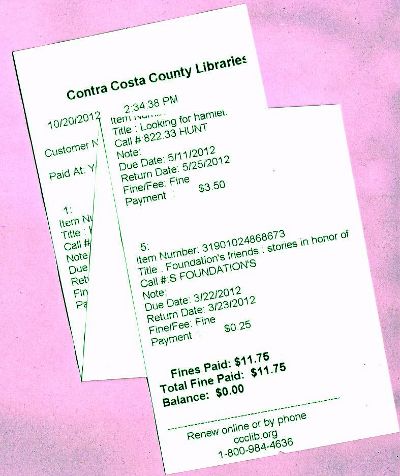
Overdue book fines are a terrible sin, not because of the harm done to other library stakeholders, but because of what they say about you as a person: not only did you not get around to finishing the books you (apparently erroneously) thought you wanted to read, but you weren't even responsible enough to bring them back on time.

Contra Costa County Library receipt showing paid overdue fines, against a pink background

Subscripting as Function Composition

Dear reader, don't laugh: I had thought I already understood subsequences, but then it turned out that I was mistaken. I should have noticed the vague, unverbalized discomfort I felt about the subscripted-subscript notation, \((a_{n_k})\). But really it shouldn't be confusing at all: as Bernd S. W. Schröder points out in his Mathematical Analysis: A Concise Introduction, it's just a function composition. If it helps (it helped me), say that \((a_n)\) is mere syntactic sugar for \(a(n): \mathbb{N} \to \mathbb{R}\), a function from the naturals to the reals. And \((a_{n_k})\) is just the composition \(a(n(k))\), with \(n(k): \mathbb{N} \to \mathbb{N}\) being a strictly increasing function from the naturals to the naturals.

"It's Not That"

Oftentimes I initially want to write "It's not that X, but rather Y" to mean "You might think I'm implying that X is true, so I want to emphasize that X is false; Y is true, and that's what explains my position," but I worry that this idiom is ambiguous; someone is likely to interpret it as meaning, "X might be true, but it's not the relevant consideration; my position is actually explained by Y (which does not necessarily contradict X)", which doesn't mean the same thing.