Code-Switching I
that spectrum from cis to natal to actual depending on whom they're talking to
a blog
that spectrum from cis to natal to actual depending on whom they're talking to
went to the genderqueer support/discussion group at the Pacific Center again; showed up early to change into my Pearl dress (it would be a waste to only wear it once) and surreptitiously slip a copy of Anne Lawrence into the library
I think I mostly enjoy being the token conservative/TERF (um, relatively speaking); I say that my pronouns are he/him "because I don't perceive myself as having a choice in the matter" and probably smashed the record for most uses of the phrase biological sex at one of these
"Maybe this is already clear, but I think that you're in something of a negative feedback loop where unmet social needs are affecting your interpersonal behavior in ways that are interfere with social needs being met."
"I still think that's a positive feedback loop, technically."
"Maybe my real problem is that I take myself too seriously—from my perspective, that other people don't take themselves seriously enough. Like I'm off in my corner going mad, unable to comprehend why, why doesn't the world understand that words mean things. But when you actually talk to people, their anticipations of experience are all just about as well-calibrated as mine; they're just really bizarrely cavalier about using words to mean whatever they feel like at the moment."
"So basically you're going mad over ... prescriptivism."
"I know, usually I'm not the type to get into linguistic prescriptivism debates, but I guess I had assumed that those were always about obscure things, like when to use comprised instead of composed. I wasn't expecting people to redefine a top-20 noun out from under my feet."
"And yet!"
Growing up in an ostensibly reform-Jewish household that didn't even take that seriously, atheism was easy for me, so I don't know how hard deconversion is, how much it hurts, or how much of one's entire conception of self is trashed in the process and can't be recovered.
As an atheist, it's tempting to say, "Look, it's not that bad: God doesn't exist exist, but you can still go to church and praise God and stuff if you want; it's just that there are benefits to being honest about what you're actually doing and why."
Somehow, I suspect that this is not a very convincing sell.
Applications to other topics are—as always—left as an exercise to the reader.
off to go check out the genderqueer support/discussion group (my people) and try to teach them about evopsych and the Blanchard typology
wish me luck
There's this phenomenon where two people are talking, and one of them offhandedly mentions some innocuous fact, and the other one has to stop them and have them explain both the fact, and what they expected their interlocutor to infer from the fact. When this happens once, it's usually just a matter of one happening to have some domain-specific knowledge that the other happened to not have, a coincidence that could just as easily have gone the other way.
When it happens multiple times with multiple topics, with both people in the same roles, the one who keeps having to ask for explanations begins to suspect that maybe it is not a coincidence, that maybe the other person just knows more stuff, full stop.
Standing at 130, you typically spend a lot more time talking down to 110 than being talked down to from 150, so it's an unusual feeling of helplessness. You want to cry out, "You know, I'm usually on the other side of this conversation!"
"I know," they say.
"I don't get it."
"Yeah, I guess the rules are kind of complicated, but—"
"No, I mean, I think understood the literal content of your explanation, but I don't understand how the behavior you describe could arise from the rules as stated. What stops teams from just cooperating with each other?"
"Cooperating? What do you mean?"
"You say advancing the ball to the other side of the field is a touchdown worth six points?"
"Yes, plus a point-after kick or two-point conversion attempt."
"So why don't the teams just take turns scoring touchdowns?"
"What? Why would they do that?"
"To score points. You said that was the objective of the game."
"Oh, ah—I didn't realize I needed to explain this part—the goal is to get more points than the other team. The team with more points is called the winner of the game, and the other team loses."
"So it's a zero-sum game?"
"Well—yes."
"But that's barbaric!"
"That's ... not usually the reason people call football barbaric."
"Lower animals fight over fixed resources, the power to create opportunities lying far beyond their abilities and even their concept-space. But you, living at the dawn of your world's intelligence, you have the rare opportunity to build new worlds—and share the proceeds between you. And you waste your energy on this contrived imitation of a payoff matrix that it is your birthright to supersede! It is revolting."
It's not so much that writing is hard, so much as it is that not-writing is easy; so easy, in fact, that one can spend hours, days, or years not-writing without even noticing the magnitude of the crime—the wrongful nonexistence of everything left unsaid.
Nothing should dilute or adulterate the exalted joy of watching the chess engine you've toiled over for the better part of three weekends start to suggest moves (from a basic 3-ply negamax search with a simple point-counting position evaluation heuristic), unless it's the slight(ly overdetermined?) suspicion that you're overcompensating for something, that you've proved your point by now, that bringing yet another moderately-sophisticated side project in a not-the-most-popular programming language over the threshold of "really cool-looking proof-of-concept" isn't going to show Everyone that you are Smart and should be Respected any more than the last seven already did. Some people actually use software for something other than a trophy, to automate some aspect of the world that otherwise would have been done more poorly. So you've heard. If one were to hypothesize, for the sake of argument (but perhaps not only for the sake of argument) that there can exist diminishing marginal returns to some games, that Respect from Everyone is not a real thing that can be won, that there are treasures and masteries you'd never imagine while chasing GitHub stars, much like how you know there are treasures and masteries that you'd never imagine while chasing school marks—what strategies would that imply, now that you know there is such a thing as being strategic? And how would you tell the difference?
Oftentimes I awake from a coding dream with the realization that I'm physically in bed without a keyboard and that the machine is asleep in the other room, from which I can infer that I must have been asleep, too, and only dreaming about solving problems. But there will probably only be a few more decades during which not having a keyboard is evidence of anything in particular.
Studying on the weekend as a working professional is like keeping a diversified investment portfolio, in stocks, bonds, commodity futures, cash, silver, ammunition, and Bitcoin in encrypted paper wallets; it's like coming in first by half a lap in the thirty-two hundred meters of your Division III college's track and field meet, and then not stopping, continuing out of the stadium, desperately, bleeding, acknowledging nothing but the need to put ever more distance between you and your hypothetical pursuers, until days later (halfway to Nevada), a classmate leans out of a car window and pleads, "You can stop now! Can't you see you've already won?" incapable of predicting or comprehending your reply murmured between inhalations, "The reason ... I won ... is because ... I don't ... believe in finish lines."
I want to code all of the things, but I also want to write at least some of the things, but sometimes putting things in words—simple things, things I know—can be hard. Every other day I dream of getting in some writing in the night after I return from the code mines across the bay, but the box where the writing tool lives is the same as the box where you can read everything that anyone else has ever written, and you can guess what I really do then, when it's easier to read than to farm, to eat than to write.
But writing is important, because we can imagine nearby possible worlds in which the distribution of verbal skills is incompetenceward of our own, and the people in those worlds are sadder and poorer than us, the clumsiness of their attempts at communication leaving them less effective at coordinating their activities to dominate nature: colleagues maneuver against each other, ineffectually; television is less interesting; lovers stare into each others' eyes having less idea than you of what they're really looking at.
And in our own world, where people can say more, but not enough—I can read, but I'm missing something ... I can reckon with 'rithmetic, which serves a purpose, but cannot in human terms express the richness of vision that courses through ... something. And it cannot be a part of inner peace and glory until paired with something that does, high though the price may be for that something!
The second R, which is yet not an R. I want this more than I can say.
As far as I can tell, I don't have any kind of synesthesia. You can't be too sure (which means, you can easily be entirely too sure), what with our na(t)ive theories of psychology being so inadequate that everything we believe about other minds is but a filament of noise and conjecture, but your probability distribution about the mapping of sensory inputs to perceptions for me is probably not so different as mine of the same for you (dear reader of whom I know nothing)—roses seem red, violets would seem blue if we spoke a language that didn't already have a word for violet—which means that when I tell you that there's a musty, stale odor around a blog that hasn't been updated in a month and change, it's only a trite metaphor and not a perceptual reality of any sort. Still, even if you can't smell it (if your senses are like mine; if your fox, like mine, still hasn't bothered to implement the HTML5 <aroma> element), it's an ominous thing, to see a blog hovering near the boundary between life and death, a corpus perhaps on the way to being a corpse. The internet is littered with the latter, monuments to people who reliably had something to say, month after month ... until they missed a month, and then it wasn't long before they missed another.
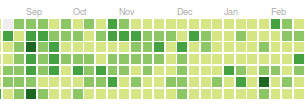
Now I can assure you that that will never happen to this place while I'm still breathing—this blog lives exactly as long as I do—only that's not a precise way of speaking; what I can do is offer you my assurance, which is a different thing from you actually feeling assured, which is a different thing still from that which was assured against actually never coming to pass. But I think these differences—between feeling and reality, between saying and reality—I think these enormous differences are much greater than the tiny, barely-perceptible gap between seeing so many gloriously intricate things to say, and making the time and words to express them on your blog when you are so busy with your trade in the manufacture of useful machinery (and the green tiles which are its highly-coveted industrial byproduct). But if all I can observe is that the gap is barely perceptible, then by the enormity of the earlier differences, I am not licensed to infer that the gap is tiny, not when the only reason I am telling you this is that I would die of shame if my monthly archives sidebar skipped a month for the first time since May of 'aught-twelve, not during this second year of my life in which I am supposed to write a compiler and a bad novelette even though it is for all intents and tens of intensive purposes practically March.
It's September in the first year of my life (that I feel comfortable admitting to), and I feel great—the mounting success or arguably-not-yet-failure of my professional, intellectual, and—other goals is complemented splendidly by a muted but nonetheless genuine appreciation of the subset of nature's cyclic harmonies that I'm capable of perceiving: the air is getting slightly less warm, the sun is setting slightly earlier, and the hacks by which the retailers separate us from our money have changed completely.
In particular, the American coffee hegemon has started offering its "pumpkin spice" medicinals again, and my esteemed colleague Alexander Corwin has been blogging about drinking them despite/because hating them, so as a loyal client of the hegemon (measured by spending habits; the market gods only accept sacrifices of time and money, and don't care what you say or believe), of course I have to accompany him to the hegemon's outpost on fourth street that I go to frequently (typically bringing the personal cup I got at BABSCon, and the barista H. insists on giving me a brohoof every time), but the day before was no good, because Alexander apparently needed his sweetener/caffeine medicinal while I was busy pairing with our CEO on our new lead pipeline and bought his traditional Diet Coke instead.
So this morning, shortly after I arrive in the office, plans are quickly formed for me and Alexander and our esteemed colleague Tim to go to the outpost.
Sep 10 09:18:04 <acorwin>     zackmdavis: PSL?
Sep 10 09:18:39 <zackmdavis>  acorwin, I don't know what that is an initialism for
Sep 10 09:18:43 <zackmdavis>  oh
Sep 10 09:18:46 <acorwin>     zackmdavis: pump--
Sep 10 09:18:49 <zackmdavis>  Pumpkin Spice!
We stroll down Brannan street, chatting about the sorts of things San Francisco software engineers talk about when they're not talking about their work, like the code we've been writing not-for-work. Alexander has been making a dice game for the iPhone but has run into trouble that he doesn't know how to debug; I suggest going to an iOS meetup group and enthusiastically mention that I went to an exciting Clojure meetup the previous night (where Zach Tellman, who has more GitHub stars than me by like two and a half orders of magnitude, gave me some tips on how to improve my 3D 2048 clone).
H. is manning the left register today. When I get to the front of the line, we perform the obligatory fist-bump and I order a grande (the BABScon cup holds sixteen ounces) iced-coffee with pumpkin spice syrup, and a birthday cake pop. H. makes a faux-teasing remark about my wanting the pink one. (I think this, and the matter of my cup and the bumping of fists, is part of an interesting psycho-sociological phenomenon that I've been meaning to blog about sometime.) Alexander orders a Pumpkin Spice Frappuccino and something to eat at the right register, and I think Tim gets a pumpkin spice latte.
We wait and continue to chat. Alexander receives what I think is a blueberry scone but later learn was actually a blueberry yogurt muffin with honey. His Frappuccino arrives (with whipped cream, despite/because of how he doesn't like whipped cream); he tries it and I think says something about it being mercifully less terrible than the standard pumpkin spice drinks on account of being cold. I express regret that I neglected to bring writing materials to record what he said verbatim to quote on my blog. Tim's latte arrives. I'm surprised that my own medicinal is taking so long, and I'm just about to ask when we see it being poured.
During our walk back to the office for another glorious day of building the future of cloud storage (perhaps not as glamorous as cloud computing, but the glory isn't about the glamor), I confess that I had considered offering to pay for my esteemed colleagues' drinks with my ridiculous golden loyalty/payment anti-credit card (you loan money to the American coffee hegemon at zero interest in exchange for a free medicinal every twelfth visit starting with the thirtieth) but didn't do so because it would be socially awkward, and Alexander points out that now it's awkward of me to have mentioned it and he had to pay for his pumpkin spice monstrosity. Next time, I say. Tim points out that gingerbread season isn't far away.
And on this tenth day of the first September of my life (I will cough loudly and unconvincingly if you insist otherwise), I think things are going to be okay (for a while (for me)).
Dear reader, imagine you have an idea for a work of prose that you want to have finished by Election Day for reasons which will become clear later, and you're not sure how long it should end up being, but you think maybe around twelve thousand words. When considering what you can do to ensure that this feat will actually be accomplished, it occurs to you that you could start writing now. Or—
Or you could design a script to make desktop notifications about how much more writing you have to do! (Maybe you could even put it in a cronjob so that it would nag you to write automatically!)
Well, I already made it for you (unless your Linux distribution doesn't use notify-send or you're on a Mac or something).
#!/usr/bin/env python3

import argparse
import subprocess
from datetime import datetime

arg_parser = argparse.ArgumentParser()
arg_parser.add_argument("filename", help="path to file of draft")
arg_parser.add_argument("goal", type=int, help="goal wordcount")
arg_parser.add_argument("deadline", help="deadline in YYYY-MM-DD format")
args = arg_parser.parse_args()

today = datetime.today()
filename = args.filename
goal = args.goal
deadline = datetime.strptime(args.deadline, "%Y-%m-%d")

def nag_message():
    progress = int(subprocess.check_output(["wc", filename, "-w"]).split()[0])
    to_go = goal - progress
    days_remaining = (deadline - today).days
    to_go_per_day = to_go / days_remaining
    proportion = progress / goal
    return "\n".join(
        "{}: {:.2f}".format(k.replace("_", " "), v) for k, v in locals().items()
    )

subprocess.check_output(["notify-send", "writing progress", nag_message()])
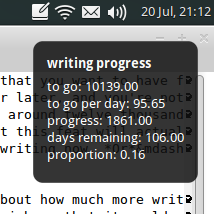
You're welcome. Now get back to work.
The blog has been silent for two weeks plus and, dear reader—that is, if there are any of you still remaining—dear reader, the thought occurs to me that maybe I should keep my drafts in a Git repository with a remote on GitHub, not because I need the full power of version control (I do not), but because then I would be rewarded for writing with those contemptible green contribution squares.
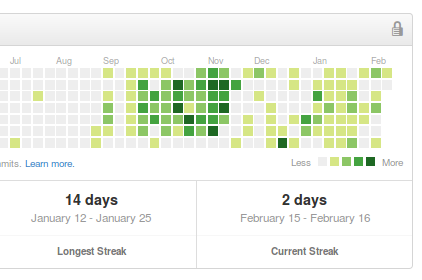
It's an anthropomorphism to think that humans have goals, that we do things because we've computed that they'll increase expected beauty or rightness in the world. We do things for the immediate reinforcement. You eat the candy because it tastes good and you show up to work on time because if you didn't, then your colleagues would notice. Serious long-term risks of diabetes or unemployment are too distant and too abstract to enter in the equation; far more effective is something immediately noticeable, even something as trivial as an integer being incremented or a square turning a darker shade of green. I tell myself that I code because it's fun and useful and lucrative (though I'm never explicit about whether that's descending or ascending order of importance), but would I be quite so diligent without the implicit gamification of my virtue? Would it be enough to have done good work, without wasting a few minutes here and there to gaze admiringly at commit diffs and contribution squares which manifest my moral worth in red and green and green?
Dear reader, I want you to picture yourself reclining at the end of a long day near the end of long career filled with great or terrible deeds. A young minion at the start of their own career will look at you and ask in awe, "O Master, what motivated you, all that time? What drove you on in your hour of deepest exhaustion? Was the it money, the fame, the men or women? Was it your ideological fervor or spirit of generosity?"
"No," you'll reply. "I did it for the green squares. And given the same circumstanstances ... I'd do it all again."
"You mean, you made the right choices? You have no regrets?"
"No, you fool!" you'll shout. "Don't you understand? I said, I'd do it again."
"I've been thinking about writing a novel."
"I don't understand."
"I said, I've been thinking about writing a novel. What's there not to understand?"
"The phrase thinking about writing. Is that even grammatical? And if so, what could it possibly mean?"
"What? It's perfectly gram—oh, I get it. Fine. No hedging: I am going to write a novel!"
"Sorry, I still don't get it. I know what it means to have written something, or to be at a keyboard writing something. But to be going to write something, in the unobservable future? Even if the concept is coherent—and I'm not sure it is—how could you possibly know?"
A woman of wisdom once told me to heed Paul Graham's advice to notice the things you can't say and then don't say them, which stance I'm updating slightly towards, because even when you're only making a perfectly reasonable point along the lines of Policy debates should not appear one-sided; I don't think that your Argument A actually supports Policy X (although I agree that X could be desireable for reasons independent of A) and everyone is charitable and no one bites, there's still a huge amount of emotional overhead incurred just by being in the conversation at all, because even when and you and your interlocutors are honest, you almost never have common knowledge of that honesty, so your interlocutors aren't necessarily sure that you're not just disagreeing with A out of secret enmity towards X, and you're not sure that they're sure that you're not, all of which drama is a drain on mental energy that could otherwise have been allocated to entirely grown-up concerns like JavaScript and money.
"Oh, I'm so nervous! What if I ... ? What if they ... ? Oh, what ever shall I do?"
"I keep telling you, man, you're making things way too complicated. Just think about what outcome you want, predict which behaviors will lead to which outcomes, and then perform the corresponding behavior."
"That's it?"
"That's it."