An Algorithmic Lucidity

a blog

Firming Up Not-Lying Around Its Edge-Cases Is Less Broadly Useful Than One Might Initially Think

(originally published at Less Wrong)

Reply to: Meta-Honesty: Firming Up Honesty Around Its Edge-Cases

Eliezer Yudkowsky, listing advantages of a "wizard's oath" ethical code of "Don't say things that are literally false", writes—

Repeatedly asking yourself of every sentence you say aloud to another person, "Is this statement actually and literally true?", helps you build a skill for navigating out of your internal smog of not-quite-truths.

I mean, that's one hypothesis about the psychological effects of adopting the wizard's code.

A potential problem with this is that human natural language contains a lot of ambiguity. Words can be used in many ways depending on context. Even the specification "literally" in "literally false" is less useful than it initially appears when you consider that the way people ordinarily speak when they're being truthful is actually pretty dense with metaphors that we typically don't notice as metaphors because they're common enough to be recognized legitimate uses that all fluent speakers will understand.

For example, if I want to convey the meaning that our study group has covered a lot of material in today's session, and I say, "Look how far we've come today!" it would be pretty weird if you were to object, "Liar! We've been in this room the whole time and haven't physically moved at all!" because in this case, it really is obvious to all ordinary English speakers that that's not what I meant by "how far we've come."

Other times, the "intended"1 interpretation of a statement is not only not obvious, but speakers can even mislead by motivatedly equivocating between different definitions of words: the immortal Scott Alexander has written a lot about this phenomenon under the labels "motte-and-bailey doctrine" (as coined by Nicholas Shackel) and "the noncentral fallacy".

For example, Zvi Mowshowitz has written about how the claim that "everybody knows" something2 is often used to establish fictitious social proof, or silence those attempting to tell the thing to people who really don't know, but it feels weird (to my intuition, at least) to call it a "lie", because the speaker can just say, "Okay, you're right that not literally3 everyone knows; I meant that most people know but was using a common hyperbolic turn-of-phrase and I reasonably expected you to figure that out."

So the question "Is this statement actually and literally true?" is itself potentially ambiguous. It could mean either—

  • "Is this statement actually and literally true as the audience will interpret it?"; or,
  • "Does this statement permit an interpretation under which it is actually and literally true?"

But while the former is complicated and hard to establish, the latter is ... not necessarily that strict of a constraint in most circumstances?

Think about it. When's the last time you needed to consciously tell a bald-faced, unambiguous lie?—something that could realistically be outright proven false in front of your peers, rather than dismissed with a "reasonable" amount of language-lawyering. (Whether "Fine" is a lie in response to "How are you?" depends on exactly what "Fine" is understood to mean in this context. "Being acceptable, adequate, passable, or satisfactory"—to what standard?)

Maybe I'm unusually honest—or possibly unusually bad at remembering when I've lied!?—but I'm not sure I even remember the last time I told an outright unambiguous lie. The kind of situation where I would need to do that just doesn't come up that often.

Now ask yourself how often your speech has been partially optimized for any function other than providing listeners with information that will help them better anticipate their experiences. The answer is, "Every time you open your mouth"4—and if you disagree, then you're lying. (Even if you only say true things, you're more likely to pick true things that make you look good, rather than your most embarrassing secrets. That's optimization.)

In the study of AI alignment, it's a truism that failures of alignment can't be fixed by deontological "patches". If your AI is exhibiting weird and extreme behavior (with respect to what you really wanted, if not what you actually programmed), then adding a penalty term to exclude that specific behavior will just result in the AI executing the "nearest unblocked" strategy, which will probably also be undesirable: if you prevent your happiness-maximizing AI from administering heroin to humans, it'll start administering cocaine; if you hardcode a list of banned happiness-producing drugs, it'll start researching new drugs, or just pay humans to take heroin, &c.

Humans are also intelligent agents. (Um, sort of.) If you don't genuinely have the intent to inform your audience, but consider yourself ethically bound to be honest, but your conception of honesty is simply "not lying", you'll naturally gravitate towards the nearest unblocked cognitive algorithm of deception.5

So another hypothesis about the psychological effects of adopting the wizard's code is that—however noble your initial conscious intent was—in the face of sufficiently strong incentives to deceive, you just end up accidentally training yourself to get really good at misleading people with a variety of not-technically-lying rhetorical tactics (motte-and-baileys, false implicatures, stonewalling, selective reporting, clever rationalized arguments, gerrymandered category boundaries, &c.), all the while congratulating yourself on how "honest" you are for never, ever emitting any "literally" "false" individual sentences.


Ayn Rand's novel Atlas Shrugged6 portrays a world of crony capitalism in which politicians and businessmen claiming to act for the "common good" (and not consciously lying) are actually using force and fraud to temporarily enrich themselves while destroying the credit-assignment mechanisms Society needs to coordinate production.7

In one scene, Eddie Willers (right-hand man to our railroad executive heroine Dagny Taggart) expresses horror that the government's official scientific authority, the State Science Institute, has issued a hit piece denouncing the new alloy, Rearden Metal, with which our protagonists have been planning to use to build a critical railroad line. (In actuality, we later find out, the Institute leaders want to spare themselves the embarrassment—and therefore potential loss of legislative funding—of the innovative new alloy having been invented by private industry rather than the Institute's own metallurgy department.)

"The State Science Institute," he said quietly, when they were alone in her office, "has issued a statement warning people against the use of Rearden Metal." He added, "It was on the radio. It's in the afternoon papers."

"What did they say?"

"Dagny, they didn't say it! ... They haven't really said it, yet it's there—and it—isn't. That's what's monstrous about it."

[...] He pointed to the newspaper he had left on her desk. "They haven't said that Rearden Metal is bad. They haven't said it's unsafe. What they've done is ..." His hands spread and dropped in a gesture of futility.

She saw at a glance what they had done. She saw the sentences: "It may be possible that after a period of heavy usage, a sudden fissure may appear, though the length of this period cannot be predicted. ... The possibility of a molecular reaction, at present unknown, cannot be entirely discounted. ... Although the tensile strength of the metal is obviously demonstrable, certain questions in regard to its behavior under unusual stress are not to be ruled out. ... Although there is no evidence to support the contention that the use of the metal should be prohibited, a further study of its properties would be of value."

"We can't fight it. It can't be answered," Eddie was saying slowly. "We can't demand a retraction. We can't show them our tests or prove anything. They've said nothing. They haven't said a thing that could be refuted and embarrass them professionally. It's the job of a coward. You'd expect it from some con-man or blackmailer. But, Dagny! It's the State Science Institute!"

I think Eddie is right to feel horrified and betrayed here. At the same time, it's notable that with respect to wizard's code, no lying has taken place.

I like to imagine the statement having been drafted by an idealistic young scientist in the moral maze of Dr. Floyd Ferris's office at the State Science Institute. Our scientist knows that his boss, Dr. Ferris, expects a statement that will make Rearden Metal look bad; the negative consequences to the scientist's career for failing to produce such a statement will be severe. (Dr. Ferris didn't say that, but he didn't have to.) But the lab results on Rearden Metal came back with flying colors—by every available test, the alloy is superior to steel along every dimension.

Pity the dilemma of our poor scientist! On the one hand, scientific integrity. On the other hand, the incentives.

He decides to follow a rule that he thinks will preserve his "inner agreement with truth which allows ready recognition": after every sentence he types into his report, he will ask himself, "Is this statement actually and literally true?" For that is his mastery.

Thus, his writing process goes like this—

"It may be possible after a period of heavy usage, a sudden fissure may appear." Is this statement actually and literally true? Yes! It may be possible!

"The possibility of a molecular reaction, at present unknown, cannot be entirely discounted." Is this statement actually and literally true? Yes! The possibility of a molecular reaction, at present unknown, cannot be entirely discounted. Okay, so there's not enough evidence to single out that possibility as worth paying attention to. But there's still a chance, right?

"Although the tensile strength of the metal is obviously demonstrable, certain questions in regard to its behavior under unusual stress are not to be ruled out." Is this statement actually and literally true? Yes! The lab tests demonstrated the metal's unprecedented tensile strength. But certain questions in regard to its behavior under unusual stress are not to be ruled out—the probability isn't zero.

And so on. You see the problem. Perhaps a member of the general public who knew about the corruption at the State Science Institute could read the report and infer the existence of hidden evidence: "Wow, even when trying their hardest to trash Rearden Metal, this is the worst they could come up with? Rearden Metal must be pretty great!"

But they won't. An institution that proclaims to be dedicated to "science" is asking for a very high level of trust—and in the absence of a trustworthy auditor, they might get it. Science is complicated enough and natural language is ambiguous enough, that that kind of trust that can be betrayed without lying.

I want to emphasize that I'm not saying the report-drafting scientist in the scenario I've been discussing is a "bad person." (As it is written, almost no one is evil; almost everything is broken.) Under more favorable conditions—in a world where metallurgists had the academic freedom to speak the truth as they see it (even if their voice trembles) without being threatened with ostracism and starvation—the sort of person who finds the wizard's oath appealing, wouldn't even be tempted to engage in these kinds of not-technically-lying shenanigans. But the point of the wizard's oath is to constrain you, to have a simple bright-line rule to force you to be truthful, even when other people are making that genuinely difficult. Yudkowsky's meta-honesty proposal is a clever attempt to strengthen the foundations of this ethic by formulating a more complicated theory that can account for the edge-cases under which even unusually honest people typically agree that lying is okay, usually due to extraordinary coercion by an adversary, as with the proverbial murderer or Gestapo officer at the door.

And yet it's precisely in adversarial situations that the wizard's oath is most constraining (and thus, arguably, most useful). You probably don't need special ethical inhibitions to tell the truth to your friends, because you should expect to benefit from friendly agents having more accurate beliefs.

But an enemy who wants to use information to hurt you is most constrained if the worst they can do is selectively report harmful-to-you true things, rather than just making things up—and therefore, by symmetry, if you want to use information to hurt an enemy, you are most constrained if the worst you can do is selectively report harmful-to-the-enemy true things, rather that just making things up.

Thus, while the study of how to minimize information transfer to an adversary under the constraint of not lying is certainly interesting, I argue that this "firming up" is of limited practical utility given the ubiquity of other kinds of deception. A theory of under what conditions conscious explicit unambiguous outright lies are acceptable doesn't help very much with combating intellectual dishonesty—and I fear that intellectual dishonesty, plus sufficient intelligence, is enough to destroy the world all on its own, without the help of conscious explicit unambiguous outright lies.

Unfortunately, I do not, at present, have a superior alternative ethical theory of honesty to offer. I don't know how to unravel the web of deceit, rationalization, excuses, disinformation, bad faith, fake news, phoniness, gaslighting, and fraud that threatens to consume us all. But one thing I'm pretty sure won't help much is clever logic puzzles about implausibly sophisticated Nazis.

(Thanks to Michael Vassar for feedback on an earlier draft.)


  1. I'm scare-quoting "intended" because this process isn't necessarily conscious, and probably usually isn't. Internal distortions of reality in imperfectly deceptive social organisms can be adaptive for the function of deceiving conspecifics

  2. If I had written this post, I would have titled it "Fake Common Knowledge" (following in the tradition of "Fake Explanations", "Fake Optimization Criteria", "Fake Causality", &c.

  3. But it's worth noting that the "Is this statement actually and literally true?" test, taken literally, should have caught this, even if my intuition still doesn't want to call it a "lie." 

  4. Actually, that's not literally true! You often open your mouth to breathe or eat without saying anything at all! Is the referent of this footnote then a blatant lie on my part?—or can I expect you to know what I meant

  5. A similar phenomenon may occur with other attempts at ethical bindings: for example, confidentiality promises. Suppose Open Opal tends to wear her heart on her sleeve and more specifically, believes in lies of omission: if she's talking with someone she trusts, and she has information relevant to that conversation, she finds it incredibly psychologically painful to pretend not to know that information. If Paranoid Paris has much stronger privacy intuitions than Opal and wants to message her about a sensitive subject, Paris might demand a promise of secrecy from Opal ("Don't share the content of this conversation")—only to spark conflict later when Opal construes the literal text of the promise more narrowly than Paris might have hoped ("'Don't share the content' means don't share the verbatim text, right? I'm still allowed to paraphrase things Paris said and attribute them to an anonymous correspondent when I think that's relevant to whatever conversation I'm in, even though that hypothetically leaks entropy if Paris has implausibly determined enemies, right?"). 

  6. I know, fictional evidence, but I claim that the kind of deception illustrated in quoted passage to follow is entirely realistic. 

  7. Okay, that's probably not exactly how Rand or her acolytes would put it, but that's how I'm interpreting it

Relevance Norms; Or, Gricean Implicature Queers the Decoupling/Contextualizing Binary

(originally published at Less Wrong)

Reply to: Decoupling vs Contextualising Norms

Chris Leong, following John Nerst, distinguishes between two alleged discursive norm-sets. Under "decoupling norms", it is understood that claims should be considered in isolation; under "contextualizing norms", it is understood that those making claims should also address potential implications of those claims in context.

I argue that, at best, this is a false dichotomy that fails to clarify the underlying issues—and at worst (through no fault of Leong or Nerst), the concept of "contextualizing norms" has the potential to legitimize derailing discussions for arbitrary political reasons by eliding the key question of which contextual concerns are genuinely relevant, thereby conflating legitimate and illegitimate bids for contextualization.

Real discussions adhere to what we might call "relevance norms": it is almost universally "eminently reasonable to expect certain contextual factors or implications to be addressed." Disputes arise over which certain contextual factors those are, not whether context matters at all.

The standard academic account explaining how what a speaker means differs from what the sentence the speaker said means, is H. P. Grice's theory of conversational implicature. Participants in a conversation are expected to add neither more nor less information than is needed to make a relevant contribution to the discussion.

Examples abound. If I say, "I ate some of the cookies", I'm implicating that I didn't eat all of the cookies, because if I had, you would have expected me to say "all", not "some" (even though the decontextualized sentence "I ate some of the cookies" is, in fact, true).

Or suppose you're a guest at my house, and you ask where the washing machine is, and I say it's by the stairs. If the machine then turns out to be broken, and you ask, "Hey, did you know your washing machine is broken?" and I say, "Yes", you're probably going to be pretty baffled why I didn't say "It's by the stairs, but you can't use it because it's broken" earlier (even though the decontextualized answer "It's by the stairs" was, in fact, true).

Leong writes:

Let's suppose that blue-eyed people commit murders at twice the rate of the rest of the population. With decoupling norms, it would be considered churlish to object to such direct statements of facts. With contextualising norms, this is deserving of criticism as it risks creates a stigma around blue-eyed people.

With relevance norms, objecting might or might not make sense depending on the context in which the direct statement of fact is brought up.

Suppose Della says to her Aunt Judith, "I'm so excited for my third date with my new boyfriend. He has the most beautiful blue eyes!"

Judith says, "Are you sure you want to go out with this man? Blue-eyed people commit murders at twice the rate of the general population."

How should Della reply to this? Judith is just in the wrong here—but not as a matter of a subjective choice between "contextualizing" and "decoupling" norms, and not because blue-eyed people are a sympathetic group who we wish to be seen as allied with and don't want to stigmatize. Rather, the probability of getting murdered on a date is quite low, and Della already has a lot of individuating information about whether her boyfriend is likely to be a murderer from the previous two dates. Maybe (Fermi spitballing here) the evidence of the boyfriend's eye color raises Della's probability of being murdered from one-in-a-million to one-in-500,000? Judith's bringing the possibility up at all is a waste of fear in the same sense that lotteries are said to be a waste of hope. Fearmongering about things that are almost certainly not going to happen is uncooperative, in Grice's sense—just like it's uncooperative to tell people where to find a washing machine that doesn't work.

On the other hand, if I'm making a documentary film interviewing murderers in prison and someone asks me why so many of my interviewees have blue eyes, "Blue-eyed people commit murders at twice the rate of the rest of the population" is a completely relevant reply. It's not clear how else I could possibly answer the question without making reference to that fact!

So far, relevance has been a black box in this exposition: unfortunately, I don't have an elegant reduction that explains what cognitive algorithm makes some facts seem "relevant" to a given discussion. But hopefully, it should now be intuitive that the determination of what context is relevant is the consideration that is, um, relevant. Framing the matter as "decouplers" (context doesn't matter!) vs. "contextualizers" (context matters!) is misleading because once "contextualizing norms" have been judged admissible, it becomes easy for people to motivatedly derail any discussions they don't like with endless isolated demands for contextualizing disclaimers.

Algorithms of Deception!

(originally published at Less Wrong)

I want you to imagine a world consisting of a sequence of independent and identically distributed random variables \(X_i\), and two computer programs.

The first program is called Reporter. As input, it accepts a bunch of the random variables \(X_i\). As output, it returns a list of sets whose elements belong to the domain of the \(X_i\).

The second program is called Audience. As input, it accepts the output of Reporter. As output, it returns a probability distribution.

Suppose the \(X_i\) are drawn from the following distribution:

$$P(X = x) = \begin{cases} 1/2 & x = 1 \\ 1/4 & x = 2 \\ 3/16 & x = 3 \\ 1/16 & x = 4 \\ \end{cases}$$

We can model drawing a sample from this distribution using this function in the Python programming language:

import random

def x():
    r = random.random()
    if 0 <= r < 1/2:
        return 1
    elif 1/2 <= r < 3/4:
        return 2
    elif 3/4 <= r < 15/16:
        return 3
    else:
        return 4

For compatibility, we can imagine that Reporter and Audience are also written in Python. This is just for demonstration in the blog post that I'm writing—the real Reporter and Audience (out there in the world I'm asking you to imagine) might be much more complicated programs written for some kind of alien computer the likes of which we have not yet dreamt! But I like Python, and for the moment, we can pretend.

So pretend that Audience looks like this (where the dictionary, or hashmap, that gets returned represents a probability distribution, with the keys being random-variable outcomes and the values being probabilities):

from collections import Counter

def audience(report):
    a = Counter()
    for sight in report:
        for possibility in sight:
            a[possibility] += 1/len(sight)            
    d = sum(a_j - len(a) for a_j in a.values())
    return {x: (a_i - 1)/d for x, a_i in a.items()}

Let's consider multiple possibilities for the form that Reporter could take. A particularly simple implementation of Reporter (call it reporter_0) might look like this:

def reporter_0(xs):
    output = []
    for x in xs:
        output.append({x})
    return output

The pairing of audience and reporter_0 has a Very Interesting Property! When we call our Audience on the output of this Reporter, the probability distribution that Audience returns is very similar to the distribution that our random variables are from!1

>>> audience(reporter_0([x() for _ in range(100000)]))
{1: 0.5003300528084493, 2: 0.2502900464074252, 3: 0.1873799807969275, 4: 0.062119939190270444}

# Compare to P(X) expressed as a Python dictionary—
>>> {1: 1/2, 2: 1/4, 3: 3/16, 4: 1/16}
{1: 0.5, 2: 0.25, 3: 0.1875, 4: 0.0625}

Weird, right?!

Of course, there are other possible implementations of Reporter. For example, this choice of Reporter (reporter_1) does not result in the Very Interesting Property—

def reporter_1(xs):
    output = []
    for _ in range(len(xs)):
        output.append({4})
    return output

It instead induces Audience to output a very different (and rather boring) distribution. It doesn't even matter how the \(X_i\) turned up; the result will always be the same:

>>> audience(reporter_1([x() for _ in range(100000)]))
{4: 1.0}

We could go on imagining other versions of Reporter, like this one (reporter_2)—

def reporter_2(xs):
    output = []
    for x in xs:
        if x == 4 or random.random() < 0.2:
            output.append({x})
        else:
            continue
    return output

While the distribution that reporter_2 makes Audience output isn't as boring as the one we saw for reporter_1, it still doesn't result in the Very Interesting Property of matching the distribution of the \(X_i\). It comes closer than reporter_1 did—notice how the ratios of probabilities assigned to the first three outcomes is similar to that of the original distribution—but it's assigning way too much probability-mass to the outcome "4":

>>> audience(reporter_2([x() for _ in range(100000)]))
{1: 0.3971289947471831, 2: 0.20309555314968522, 3: 0.14860259032038173, 4: 0.2516540358474678}

So far, all of the Reporters we've imagined are still only putting one element in the inner sets of the list-of-sets that they return. But we could imagine reporter_3

def reporter_3(xs):
    output = []
    for x in xs:
        if x == 1 or x == 4:
            output.append({1, 4})
        else:
            output.append({x})
    return output

Unlike reporter_2 (which typically returned a list with fewer elements than it received as input), the list returned by reporter_3 has exactly as many elements as the list it took in. Yet this Reporter still prompts Audience to return a distribution with too many "4"s—and unlike reporter_2, it doesn't even get the ratio of the other outcomes right, yielding disproportionately fewer "1"s compared to "2"s and "3"s than the original distribution—

>>> audience(reporter_3([x() for _ in range(100000)]))
{1: 0.2808949431909106, 2: 0.24795967354776766, 3: 0.19037045927348376, 4: 0.2808949431909106}

Again, I've presented Audience and various possible Reporters as simple Python programs for illustration and simplicity, but the same input-output relationships could be embodied as part of a more complicated system—perhaps an entire conscious mind which could talk.

So now imagine our Audience as a person with her own hopes and fears and ambitions ... ambitions whose ultimate fulfillment will require dedication, bravery—and meticulously careful planning based on an accurate estimate of \(P(X)\), with almost no room for error.

So, too, imagine each of our possible Reporters as a person: loyal, responsible—and, entirely coincidentally, the supplier of a good that Audience's careful plans call for in proportion to the value of \(P(X = 4)\).

When the expected frequency of "4"s fails to appear, Audience's lifework is in ruins. All of her training, all of her carefully calibrated plans, all the interminable hours of hard labor, were for nothing. She confronts Reporter in a furor of rage and grief.

"You lied," she says through tears of betrayal, "I trusted you and you lied to me!"

The Reporter whose behavior corresponds to reporter_2 replies, "How dare you accuse me of lying?! Sure, I'm not a perfect program free from all bias, but everything I said was true—every outcome I reported corresponded to one of the \(X_i\). You can't call that misleading!"

He is perfectly sincere. Nothing in his consciousness reflects intent to deceive Audience, any more than an eight-line Python program could be said to have such "intent." (Does a for loop "intend" anything? Does a conditional "care"? Of course not!)

The Reporter whose behavior corresponds to reporter_3 replies, "Lying?! I told you the truth, the whole truth, and nothing but the truth: everything I saw, I reported. When I said an outcome was a oneorfour, it actually was a oneorfour. Perhaps you have a different category system, such that what I think of as a 'oneorfour', appears to you to be any of several completely different outcomes, which you think my 'oneorfour' concept is conflating. If those outcomes had wildly different probabilities, if one was much more common than fou—I mean, than the other—then you'd have no way of knowing that from my report. But using language in a way you dislike, is not lying. I can define a word any way I want!"

He, too, is perfectly sincere.

Commentary

Much has been written on this website about reducing mental notions of "truth", "evidence", &c. to the nonmental. One need not grapple with tendentious mysteries of "mind" or "consciousness", when so much more can be accomplished by considering systematic cause-and-effect processes that result in the states of one physical system becoming correlated with the states of another—a "map" that reflects a "territory."

The same methodology that was essential for studying truthseeking, is equally essential for studying the propagation of falsehood. If true "beliefs" are models that make accurate predictions, then deception would presumably be communication that systematically results in less accurate predictions (by a listener applying the same inference algorithms that would result in more accurate predictions when applied to direct observations or "honest" reports).

In a peaceful world where most falsehood was due to random mistakes, there would be little to be gained by studying processes that systematically create erroneous maps. In a world of conflict, where there are forces trying to slash your tires, one would do well do study these—algorithms of deception!


  1. But only "very" similar: the code for audience is not the mathematically correct thing to do in this situation; it's just an approximation that ought to be good enough for the point I'm trying to make in this blog post, for which I'm trying to keep the code simple. (Specifically, the last two lines of audience are based on the mode of the Dirichlet distribution, but, firstly, that part about increasing the hyperparameters fractionally when you're uncertain about what was observed (a[possibility] += 1/len(sight)) is pretty dodgy, and secondly, if you were actually going to try to predict an outcome drawn from a categorical distribution like \(P(X)\) using the Dirichlet distribution as a conjugate prior, you'd need to integrate over the Dirichlet hyperparameters; you shouldn't just pretend that the mode/peak represents the true parameters of the categorical distribution—but as I said, we are just pretending.) 

Maybe Lying Doesn't Exist

(originally published at Less Wrong)

In "Against Lie Inflation", the immortal Scott Alexander argues that the word "lie" should be reserved for knowingly-made false statements, and not used in an expanded sense that includes unconscious motivated reasoning. Alexander argues that the expanded sense draws the category boundaries of "lying" too widely in a way that would make the word less useful. The hypothesis that predicts everything predicts nothing: in order for "Kevin lied" to mean something, some possible states-of-affairs need to be identified as not lying, so that the statement "Kevin lied" can correspond to redistributing conserved probability mass away from "not lying" states-of-affairs onto "lying" states-of-affairs.

All of this is entirely correct. But Jessica Taylor (whose post "The AI Timelines Scam" inspired "Against Lie Inflation") wasn't arguing that everything is lying; she was just using a more permissive conception of lying than the one Alexander prefers, such that Alexander didn't think that Taylor's definition could stably and consistently identify non-lies.

Concerning Alexander's arguments against the expanded definition, I find I have one strong objection (that appeal-to-consequences is an invalid form of reasoning for optimal-categorization questions for essentially the same reason as it is for questions of simple fact), and one more speculative objection (that our intuitive "folk theory" of lying may actually be empirically mistaken). Let me explain.

(A small clarification: for myself, I notice that I also tend to frown on the expanded sense of "lying". But the reasons for frowning matter! People who superficially agree on a conclusion but for different reasons, are not really on the same page!)

Appeals to Consequences Are Invalid

There is no method of reasoning more common, and yet none more blamable, than, in philosophical disputes, to endeavor the refutation of any hypothesis, by a pretense of its dangerous consequences[.]

David Hume

Alexander contrasts the imagined consequences of the expanded definition of "lying" becoming more widely accepted, to a world that uses the restricted definition:

[E]veryone is much angrier. In the restricted-definition world, a few people write posts suggesting that there may be biases affecting the situation. In the expanded-definition world, those same people write posts accusing the other side of being liars perpetrating a fraud. I am willing to listen to people suggesting I might be biased, but if someone calls me a liar I'm going to be pretty angry and go into defensive mode. I'll be less likely to hear them out and adjust my beliefs, and more likely to try to attack them.

But this is an appeal to consequences. Appeals to consequences are invalid because they represent a map–territory confusion, an attempt to optimize our description of reality at the expense of our ability to describe reality accurately (which we need in order to actually optimize reality).

(Again, the appeal is still invalid even if the conclusion—in this case, that unconscious rationalization shouldn't count as "lying"—might be true for other reasons.)

Some aspiring epistemic rationalists like to call this the "Litany of Tarski". If Elijah is lying (with respect to whatever the optimal category boundary for "lying" turns out to be according to our standard Bayesian philosophy of language), then I desire to believe that Elijah is lying (with respect to the optimal category boundary according to ... &c.). If Elijah is not lying (with respect to ... &c.), then I desire to believe that Elijah is not lying.

If the one comes to me and says, "Elijah is not lying; to support this claim, I offer this-and-such evidence of his sincerity," then this is right and proper, and I am eager to examine the evidence presented.

If the one comes to me and says, "You should choose to define lying such that Elijah is not lying, because if you said that he was lying, then he might feel angry and defensive," this is insane. The map is not the territory! If Elijah's behavior is, in fact, deceptive—if he says things that cause people who trust him to be worse at anticipating their experiences when he reasonably could have avoided this—I can't make his behavior not-deceptive by changing the meanings of words.

Now, I agree that it might very well empirically be the case that if I say that Elijah is lying (where Elijah can hear me), he might get angry and defensive, which could have a variety of negative social consequences. But that's not an argument for changing the definition of lying; that's an argument that I have an incentive to lie about whether I think Elijah is lying! (Though Glomarizing about whether I think he's lying might be an even better play.)

Alexander is concerned that people might strategically equivocate between different definitions of "lying" as an unjust social attack against the innocent, using the classic motte-and-bailey maneuver: first, argue that someone is "lying (expanded definition)" (the motte), then switch to treating them as if they were guilty of "lying (restricted definition)" (the bailey) and hope no one notices.

So, I agree that this is a very real problem. But it's worth noting that the problem of equivocation between different category boundaries associated with the same word applies symmetrically: if it's possible to use an expanded definition of a socially-disapproved category as the motte and a restricted definition as the bailey in an unjust attack against the innocent, then it's also possible to use an expanded definition as the bailey and a restricted definition as the motte in an unjust defense of the guilty. Alexander writes:

The whole reason that rebranding lesser sins as "lying" is tempting is because everyone knows "lying" refers to something very bad.

Right—and conversely, because everyone knows that "lying" refers to something very bad, it's tempting to rebrand lies as lesser sins. Ruby Bloom explains what this looks like in the wild:

I worked in a workplace where lying was commonplace, conscious, and system 2. Clients asking if we could do something were told "yes, we've already got that feature (we hadn't) and we already have several clients successfully using that (we hadn't)." Others were invited to be part an "existing beta program" alongside others just like them (in fact, they would have been the very first). When I objected, I was told "no one wants to be the first, so you have to say that."

[...] I think they lie to themselves that they're not lying (so that if you search their thoughts, they never think "I'm lying")[.]

If your interest in the philosophy of language is primarily to avoid being blamed for things—perhaps because you perceive that you live in a Hobbesian dystopia where the primary function of words is to elicit actions, where the denotative structure of language was eroded by political processes long ago, and all that's left is a standardized list of approved attacks—in that case, it makes perfect sense to worry about "lie inflation" but not about "lie deflation." If describing something as "lying" is primarily a weapon, then applying extra scrutiny to uses of that weapon is a wise arms-restriction treaty.

But if your interest in the philosophy of language is to improve and refine the uniquely human power of vibratory telepathy—to construct shared maps that reflect the territory—if you're interested in revealing what kinds of deception are actually happening, and why—

(in short, if you are an aspiring epistemic rationalist)

—then the asymmetrical fear of false-positive identifications of "lying" but not false-negatives—along with the focus on "bad actors", "stigmatization", "attacks", &c.—just looks weird. What does that have to do with maximizing the probability you assign to the right answer??

The Optimal Categorization Depends on the Actual Psychology of Deception

Deception
My life seems like it's nothing but
Deception
A big charade

I never meant to lie to you
I swear it
I never meant to play those games

"Deception" by Jem and the Holograms

Even if the fear of rhetorical warfare isn't a legitimate reason to avoid calling things lies (at least privately), we're still left with the main objection that "lying" is a different thing from "rationalizing" or "being biased". Everyone is biased in some way or another, but to lie is "[t]o give false information intentionally with intent to deceive." Sometimes it might make sense to use the word "lie" in a noncentral sense, as when we speak of "lying to oneself" or say "Oops, I lied" in reaction to being corrected. But it's important that these senses be explicitly acknowledged as noncentral and not conflated with the central case of knowingly speaking falsehood with intent to deceive—as Alexander says, conflating the two can only be to the benefit of actual liars.

Why would anyone disagree with this obvious ordinary view, if they weren't trying to get away with the sneaky motte-and-bailey social attack that Alexander is so worried about?

Perhaps because the ordinary view relies an implied theory of human psychology that we have reason to believe is false? What if conscious intent to deceive is typically absent in the most common cases of people saying things that (they would be capable of realizing upon being pressed) they know not to be true? Alexander writes—

So how will people decide where to draw the line [if egregious motivated reasoning can count as "lying"]? My guess is: in a place drawn by bias and motivated reasoning, same way they decide everything else. The outgroup will be lying liars, and the ingroup will be decent people with ordinary human failings.

But if the word "lying" is to actually mean something rather than just being a weapon, then the ingroup and the outgroup can't both be right. If symmetry considerations make us doubt that one group is really that much more honest than the other, that would seem to imply that either both groups are composed of decent people with ordinary human failings, or that both groups are composed of lying liars. The first description certainly sounds nicer, but as aspiring epistemic rationalists, we're not allowed to care about which descriptions sound nice; we're only allowed to care about which descriptions match reality.

And if all of the concepts available to us in our native language fail to match reality in different ways, then we have a tough problem that may require us to innovate.

The philosopher Roderick T. Long writes

Suppose I were to invent a new word, "zaxlebax," and define it as "a metallic sphere, like the Washington Monument." That's the definition—"a metallic sphere, like the Washington Monument." In short, I build my ill-chosen example into the definition. Now some linguistic subgroup might start using the term "zaxlebax" as though it just meant "metallic sphere," or as though it just meant "something of the same kind as the Washington Monument." And that's fine. But my definition incorporates both, and thus conceals the false assumption that the Washington Monument is a metallic sphere; any attempt to use the term "zaxlebax," meaning what I mean by it, involves the user in this false assumption.

If self-deception is as ubiquitous in human life as authors such as Robin Hanson argue (and if you're reading this blog, this should not be a new idea to you!), then the ordinary concept of "lying" may actually be analogous to Long's "zaxlebax": the standard intensional definition ("speaking falsehood with conscious intent to deceive"/"a metallic sphere") fails to match the most common extensional examples that we want to use the word for ("people motivatedly saying convenient things without bothering to check whether they're true"/"the Washington Monument").

Arguing for this empirical thesis about human psychology is beyond the scope of this post. But if we live in a sufficiently Hansonian world where the ordinary meaning of "lying" fails to carve reality at the joints, then authors are faced with a tough choice: either be involved in the false assumptions of the standard believed-to-be-central intensional definition, or be deprived of the use of common expressive vocabulary. As Ben Hoffman points out in the comments to "Against Lie Inflation", an earlier Scott Alexander didn't seem shy about calling people liars in his classic 2014 post "In Favor of Niceness, Community, and Civilization"

Politicians lie, but not too much. Take the top story on Politifact Fact Check today. Some Republican claimed his supposedly-maverick Democratic opponent actually voted with Obama's economic policies 97 percent of the time. Fact Check explains that the statistic used was actually for all votes, not just economic votes, and that members of Congress typically have to have >90% agreement with their president because of the way partisan politics work. So it's a lie, and is properly listed as one. [bolding mine —ZMD] But it's a lie based on slightly misinterpreting a real statistic. He didn't just totally make up a number. He didn't even just make up something else, like "My opponent personally helped design most of Obama's legislation".

Was the politician consciously lying? Or did he (or his staffer) arrive at the misinterpretation via unconscious motivated reasoning and then just not bother to scrupulously check whether the interpretation was true? And how could Alexander know?

Given my current beliefs about the psychology of deception, I find myself inclined to reach for words like "motivated", "misleading", "distorted", &c., and am more likely to frown at uses of "lie", "fraud", "scam", &c. where intent is hard to establish. But even while frowning internally, I want to avoid tone-policing people whose word-choice procedures are calibrated differently from mine when I think I understand the structure-in-the-world they're trying to point to. Insisting on replacing the six instances of the phrase "malicious lies" in "Niceness, Community, and Civilization" with "maliciously-motivated false belief" would just be worse writing.

And I definitely don't want to excuse motivated reasoning as a mere ordinary human failing for which someone can't be blamed! One of the key features that distinguishes motivated reasoning from simple mistakes is the way that the former responds to incentives (such as being blamed). If the elephant in your brain thinks it can get away with lying just by keeping conscious-you in the dark, it should think again!

Hobbyhorse Apology

If I sound like a broken record about school or whatever ("or whatever"), it's only because the dominant ideological trends of Society are engaging in conceptual gerrymandering that artificially raises the message length of my existence, such that I need to yell constantly in order to maintain my measure in social reality.

Heads I Win, Tails?—Never Heard of Her; Or, Selective Reporting and the Tragedy of the Green Rationalists

(originally published at Less Wrong)

Followup to: What Evidence Filtered Evidence?

In "What Evidence Filtered Evidence?", we are asked to consider a scenario involving a coin that is either biased to land Heads 2/3rds of the time, or Tails 2/3rds of the time. Observing Heads is 1 bit of evidence for the coin being Heads-biased (because the Heads-biased coin lands Heads with probability 2/3, the Tails-biased coin does so with probability 1/3, the likelihood ratio of these is \(\frac{2/3}{1/3} = 2\), and \(\log_{2} 2 = 1\)), and analogously and respectively for Tails.

If such a coin is flipped ten times by someone who doesn't make literally false statements, who then reports that the 4th, 6th, and 9th flips came up Heads, then the update to our beliefs about the coin depends on what algorithm the not-lying1 reporter used to decide to report those flips in particular. If they always report the 4th, 6th, and 9th flips independently of the flip outcomes—if there's no evidential entanglement between the flip outcomes and the choice of which flips get reported—then reported flip-outcomes can be treated the same as flips you observed yourself: three Headses is 3 * 1 = 3 bits of evidence in favor of the hypothesis that the coin is Heads-biased. (So if we were initially 50:50 on the question of which way the coin is biased, our posterior odds after collecting 3 bits of evidence for a Heads-biased coin would be \(2^3:1\) = 8:1, or a probability of 8/(1 + 8) ≈ 0.89 that the coin is Heads-biased.)

On the other hand, if the reporter mentions only and exactly the flips that came out Heads, then we can infer that the other 7 flips came out Tails (if they didn't, the reporter would have mentioned them), giving us posterior odds of \(2^3:2^7\) = 1:16, or a probability of around 0.06 that the coin is Heads-biased.

So far, so standard. (You did read the Sequences, right??) What I'd like to emphasize about this scenario today, however, is that while a Bayesian reasoner who knows the non-lying reporter's algorithm of what flips to report will never be misled by the selective reporting of flips, a Bayesian with mistaken beliefs about the reporter's decision algorithm can be misled quite badly: compare the 0.89 and 0.06 probabilities we just derived given the same reported outcomes, but different assumptions about the reporting algorithm.

If the coin gets flipped a sufficiently large number of times, a reporter whom you trust to be impartial (but isn't), can make you believe anything she wants without ever telling a single lie, just with appropriate selective reporting. Imagine a very biased coin that comes up Heads 99% of the time. If it gets flipped ten thousand times, 100 of those flips will be Tails (in expectation), giving a selective reporter plenty of examples to point to if she wants to convince you that the coin is extremely Tails-biased.

Toy models about biased coins are instructive for constructing examples with explicitly calculable probabilities, but the same structure applies to any real-world situation where you're receiving evidence from other agents, and you have uncertainty about what algorithm is being used to determine what reports get to you. Reality is like the coin's bias; evidence and arguments are like the outcome of a particular flip. Wrong theories will still have some valid arguments and evidence supporting them (as even a very Heads-biased coin will come up Tails sometimes), but theories that are less wrong will have more.

If selective reporting is mostly due to the idiosyncratic bad intent of rare malicious actors, then you might hope for safety in (the law of large) numbers: if Helga in particular is systematically more likely to report Headses than Tailses that she sees, then her flip reports will diverge from everyone else's, and you can take that into account when reading Helga's reports. On the other hand, if selective reporting is mostly due to systemic structural factors that result in correlated selective reporting even among well-intentioned people who are being honest as best they know how,2 then you might have a more serious problem.

"A Fable of Science and Politics" depicts a fictional underground Society polarized between two partisan factions, the Blues and the Greens. "[T]here is a 'Blue' and a 'Green' position on almost every contemporary issue of political or cultural importance." If human brains consistently understood the is/ought distinction, then political or cultural alignment with the Blue or Green agenda wouldn't distort people's beliefs about reality. Unfortunately ... humans. (I'm not even going to finish the sentence.)

Reality itself isn't on anyone's side, but any particular fact, argument, sign, or portent might just so happen to be more easily construed as "supporting" the Blues or the Greens. The Blues want stronger marriage laws; the Greens want no-fault divorce. An evolutionary psychologist investigating effects of kin-recognition mechanisms on child abuse by stepparents might aspire to scientific objectivity, but being objective and staying objective is difficult when you're embedded in an intelligent social web in which in your work is going to be predictably championed by Blues and reviled by Greens.

Let's make another toy model to try to understand the resulting distortions on the Undergrounders' collective epistemology. Suppose Reality is a coin—no, not a coin, a three-sided die,3 with faces colored blue, green, and gray. One-third of the time it comes up blue (representing a fact that is more easily construed as supporting the Blue narrative), one-third of the time it comes up green (representing a fact that is more easily construed as supporting the Green narrative), and one-third of the time it comes up gray (representing a fact that not even the worst ideologues know how to spin as "supporting" their side).

Suppose each faction has social-punishment mechanisms enforcing consensus internally. Without loss of generality, take the Greens (with the understanding that everything that follows goes just the same if you swap "Green" for "Blue" and vice versa).4 People observe rolls of the die of Reality, and can freely choose what rolls to report—except a resident of a Green city who reports more than 1 blue roll for every 3 green rolls is assumed to be a secret Blue Bad Guy, and faces increasing social punishment as their ratio of reported green to blue rolls falls below 3:1. (Reporting gray rolls is always safe.)

The punishment is typically informal: there's no official censorship from Green-controlled local governments, just a visible incentive gradient made out of social-media pile-ons, denied promotions, lost friends and mating opportunities, increased risk of being involuntarily committed to psychiatric prison,5 &c. Even people who privately agree with dissident speech might participate in punishing it, the better to evade punishment themselves.

This scenario presents a problem for people who live in Green cities who want to make and share accurate models of reality. It's impossible to report every die roll (the only 1:1 scale map of the territory, is the territory itself), but it seems clear that the most generally useful models—the ones you would expect arbitrary AIs to come up with—aren't going to be sensitive to which facts are "blue" or "green". The reports of aspiring epistemic rationalists who are just trying to make sense of the world will end up being about one-third blue, one-third green, and one-third gray, matching the distribution of the Reality die.

From the perspective of ordinary nice smart Green citizens who have not been trained in the Way, these reports look unthinkably Blue. Aspiring epistemic rationalists who are actually paying attention can easily distinguish Blue partisans from actual truthseekers,6 but the social-punishment machinery can't process more than five words at a time. The social consequences of being an actual Blue Bad Guy, or just an honest nerd who doesn't know when to keep her stupid trap shut, are the same.

In this scenario,7 public opinion within a subculture or community in a Green area is constrained by the 3:1 (green:blue) "Overton ratio." In particular, under these conditions, it's impossible to have a rationalist community—at least the most naïve conception of such. If your marketing literature says, "Speak the truth, even if your voice trembles," but all the savvy high-status people's actual reporting algorithm is, "Speak the truth, except when that would cause the local social-punishment machinery to mark me as a Blue Bad Guy and hurt me and any people or institutions I'm associated with—in which case, tell the most convenient lie-of-omission", then smart sincere idealists who have internalized your marketing literature as a moral ideal and trust the community to implement that ideal, are going to be misled by the community's stated beliefs—and confused at some of the pushback they get when submitting reports with a 1:1:1 blue:green:gray ratio.

Well, misled to some extent—maybe not much! In the absence of an Oracle AI (or a competing rationalist community in Blue territory) to compare notes with, then it's not clear how one could get a better map than trusting what the "green rationalists" say. With a few more made-up modeling assumptions, we can quantify the distortion introduced by the Overton-ratio constraint, which will hopefully help develop an intuition for how large of a problem this sort of thing might be in real life.

Imagine that Society needs to make a decision about an Issue (like a question about divorce law or merchant taxes). Suppose that the facts relevant to making optimal decisions about an Issue are represented by nine rolls of the Reality die, and that the quality (utility) of Society's decision is proportional to the (base-two logarithm) entropy of the distribution of what facts get heard and discussed.8

The maximum achievable decision quality is \(\log_{2} 9\) ≈ 3.17.

On average, Green partisans will find 3 "green" facts9 and 3 "gray" facts to report, and mercilessly stonewall anyone who tries to report any "blue" facts, for a decision quality of \(\log_{2} 6\) ≈ 2.58.

On average, the Overton-constrained rationalists will report the same 3 "green" and 3 "gray" facts, but something interesting happens with "blue" facts: each individual can only afford to report one "blue" fact without blowing their Overton budget—but it doesn't have to be the same fact for each person. Reports of all 3 (on average) blue rolls get to enter the public discussion, but get mentioned (cited, retweeted, &c.) 1/3 as often as green or gray rolls, in accordance with the Overton ratio. So it turns out that the constrained rationalists end up with a decision quality of \(\frac{6}{7} \log_{2} 7 + \frac{1}{7} \log_{2} 21\) ≈ 3.03,10 significantly better than the Green partisans—but still falling short of the theoretical ideal where all the relevant facts get their due attention.

If it's just not pragmatic to expect people to defy their incentives, is this the best we can do? Accept a somewhat distorted state of discourse, forever?

At least one partial remedy seems apparent. Recall from our original coin-flipping example that a Bayesian who knows what the filtering process looks like, can take it into account and make the correct update. If you're filtering your evidence to avoid social punishment, but it's possible to clue in your fellow rationalists to your filtering algorithm without triggering the social-punishment machinery—you mustn't assume that everyone already knows!—that's potentially a big win. In other words, blatant cherry-picking is the best kind!


  1. I don't quite want to use the word honest here. 

  2. And it turns out that knowing how to be honest is much more work than one might initially think. You have read the Sequences, right?! 

  3. For lack of an appropriate Platonic solid in three-dimensional space, maybe imagine tossing a triangle in two-dimensional space?? 

  4. As an author, I'm facing some conflicting desiderata in my color choices here. I want to say "Blues and Greens" in that order for consistency with "A Fable of Science and Politics" (and other classics from the Sequences). Then when making an arbitrary choice to talk in terms of one of the factions in order to avoid cluttering the exposition, you might have expected me to say "Without loss of generality, take the Blues," because the first item in a sequence ("Blues" in "Blues and Greens") is a more of a Schelling point than the second, or last, item. But I don't want to take the Blues, because that color choice has other associations that I'm trying to avoid right now: if I said "take the Blues", I fear many readers would assume that I'm trying to directly push a partisan point about soft censorship and preference-falsification social pressures in liberal/left-leaning subcultures in the contemporary United States. To be fair, it's true that soft censorship and preference-falsification social pressures in liberal/left-leaning subcultures in the contemporary United States are, historically, what inspired me, personally, to write this post. It's okay for you to notice that! But I'm trying to talk about the general mechanisms that generate this class of distortions on a Society's collective epistemology, independently of which faction or which ideology happens to be "on top" in a particular place and time. If I'm doing my job right, then my analogue in a "nearby" Everett branch whose local subculture was as "right-polarized" as my Berkeley environment is "left-polarized", would have written a post making the same arguments. 

  5. Okay, they market themselves as psychiatric "hospitals", but let's not be confused by misleading labels

  6. Or rather, aspiring epistemic rationalists can do a decent job of assessing the extent to which someone is exhibiting truth-tracking behavior, or Blue-partisan behavior. Obviously, people who are consciously trying to seek truth, are not necessarily going to succeed at overcoming bias, and attempts to correct for the "pro-Green" distortionary forces being discussed in this parable could easily veer into "pro-Blue" over-correction. 

  7. Please be appropriately skeptical about the real-world relevance of my made-up modeling assumptions! If it turned out that my choice of assumptions were (subconsciously) selected for the resulting conclusions about how bad evidence-filtering is, that would be really bad for the same reason that I'm claiming that evidence-filtering is really bad! 

  8. The entropy of a discrete probability distribution is maximized by the uniform distribution, in which all outcomes receive equal probability-mass. I only chose these "exactly nine equally-relevant facts/rolls" and "entropic utility" assumptions to make the arithmetic easy on me; a more realistic model might admit arbitrarily many facts into discussion of the Issue, but posit a distribution of facts/rolls with diminishing marginal relevance to Society's decision quality. 

  9. The scare quotes around the adjective "'green'" (&c.) when applied to the word "fact" (as opposed to a die roll outcome representing a fact in our toy model) are significant! The facts aren't actually on anyone's side! We're trying to model the distortions that arise from stupid humans thinking that the facts are on someone's side! This is sufficiently important—and difficult to remember—that I should probably repeat it until it becomes obnoxious! 

  10. You have three green slots, three gray slots, and three blue slots. You put three counters each on each of the green and gray slots, and one counter each on each of the blue slots. The frequencies of counters per slot is [3, 3, 3, 3, 3, 3, 1, 1, 1]. The total number of counters you put down is 3*6 + 3 = 18 + 3 = 21. To turn the frequencies into a probability distribution, you divide everything by 21, to get [1/7, 1/7, 1/7, 1/7, 1/7, 1/7, 1/21, 1/21, 1/21]. Then the entropy is \(6\cdot-\frac{1}{7}\log_{2}\frac{1}{7}+3\cdot-\frac{1}{21}\log_{2}\frac{1}{21}\), which simplifies to \(\frac{6}{7}\log_{2}7+\frac{1}{7}\log_{2}21\)

Feature Reduction

(looking at baby/toddler photos a year apart) "How does he look so different and yet so the same at the same time?"

"Just in case that was non-rhetorical, the answer is that your brain evolved to be good at factorizing overall appearance into orthogonal 'personal appearance' and 'age appearance' dimensions that can be tracked separately, just as [x, y] = [1, 2] and [4, 2] are so different with respect to x, and yet so the same with respect to y, at the same time."

Schelling Categories, and Simple Membership Tests

(originally published at Less Wrong)

Followup to: Where to Draw the Boundaries?

Or there might be social or psychological forces anchoring word usages on identifiable Schelling points that are easy for different people to agree upon, even at the cost of some statistical "fit" ...

The one comes to you and says, "That paragraph about Schelling points sounded interesting. What did you mean by that? Can you give an example?"

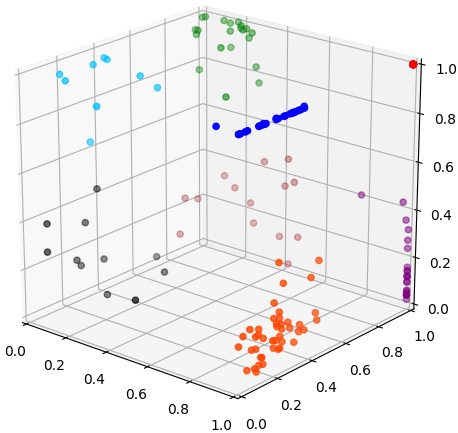
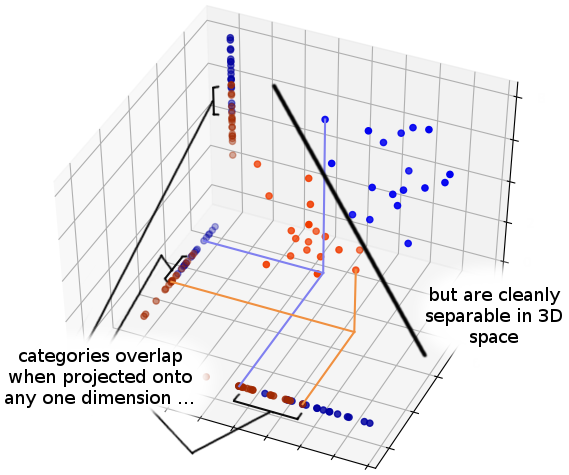
Sure. Previously on Less Wrong, in "The Univariate Fallacy", we studied points sampled from two multivariate probability distributions \(P_A\) and \(P_B\), and showed that it was possible to infer with very high probability which distribution a given point was sampled from, despite significant overlap in the marginal distributions for any one variable considered individually.

From the standpoint of "the way to carve reality at its joints, is to draw your boundaries around concentrations of unusually high probability density in Thingspace", the correct categorization of the points in that example is clear. We have two clearly distinguishable clusters. The conditional independence property is satisfied: given a point's cluster-membership, knowing one of the \(x_i\) doesn't tell you anything about \(x_j\) for ji. So we should draw a category boundary around each cluster. Obviously. We might ask hypophorically: what could possibly change this moral?

More constraints on the problem, that's what!

Suppose you needed to coordinate with someone else to make decisions about these points—that is, it's important not just that you and your partner make good decisions, but also that you make the same decision—but that each of you only got to observe one coordinate from each point. As we saw, the predictive work we get from category-membership in this scenario is spread across many variables: if you only get to observe a few dimensions, you have a lot of uncertainty about cluster-membership (which carries over into additional uncertainty about the other dimensions that you haven't observed, but which affect the ex post quality of your decision).

If you and your partner were both ideal Bayesian calculators who could communicate costlessly, you would share your observations, work out the correct probability, and use that to make optimal decisions. But suppose you couldn't do that—either because communication is expensive, or your partner was bad at math, or any other reason. Then it would be sad if you happened to see \(x_9\) = 2 and said "It's an A (probably)!", and your partner happened to see \(x_{27}\) = 3 and said "It's a B (I think)!", and the two of you made inconsistent decisions.

Okay, now suppose that there's actually a forty-first, binary, variable that I didn't tell you about earlier, distributed like so:

$$P_A(x_{41}) = \begin{cases} 3/4 & x_{41} = 0 \\ 1/4 & x_{41} = 1 \\ \end{cases}$$
$$P_B(x_{41}) = \begin{cases} 1/4 & x_{41} = 0 \\ 3/4 & x_{41} = 1 \\ \end{cases}$$

Observing \(x_{41}\) gives you \(\log_2 3\) ≈ 1.585 bits of evidence about cluster-membership, which is more than the

$$\frac{1/4 + 1/16}{2} \cdot |\log_2(4)| + \frac{7/16 + 1/4}{2} \cdot |\log_2(7/4)| + \frac{1/4 + 7/16}{2} \cdot |\log_2(4/7)| + \frac{1/16 + 1/4}{2} \cdot |\log_2(4)|$$

≈ 1.18 bits you can get from any one observation of one of the \(x_i\) for i ∈ {1...40}.

If you and your partner can both observe \(x_{41}\), you might end up wanting to base your shared categories and language on that—calling a point an "A" if it has \(x_{41}\) = 0, even though such points actually came from \(P_B\) a full quarter of the time—even if \(x_{41}\) itself has no effect on the quality of your decisions, and what you actually care about is wholely determined by the values of \(x_1\) through \(x_{40}\)! It's not the intension you would pick if you could make (and share) more observations—but ex hypothesi, you can't.

If you and your partner only get to observe one variable, \(x_{41}\) is your best choice—the single variable that gives you the most information about the "natural" cluster-membership. That also makes it a Schelling point—if you and your partner didn't get to commmunicate in advance about how you want to draw your shared category boundaries, you could pick \(x_{41}\) as your defining observation and be pretty confident your partner would make the same choice. We could imagine an even more pessimistic scenario in which the Schelling point category definition (a set of variables that "stuck out" from all the others) was less predictive than some other candidates—but if you couldn't coordinate to pick one of the more predictive category systems, you might be stuck with the Schelling point.

In conclusion, the right categories to use given constraints on communication and observation, might be different from the category boundaries you would draw from a "God's eye view", in part because consideration of which categories are easy for different agents to coordinate on is relevant, not just raw information-theoretic expressive power. Thus, "Schelling categories."

Thanks for reading!


The one says, "No, I meant, like, a real world example, not some dumb math thing for nerds. What is this post really about?"

It's about ... math? Or like, the relationship between math and human natural language? Like, I was wondering what "second-order" caveats or complications there might be to the basic "carve reality at the joints" moral of our standard Bayesian philosophy of language, and some of the people I've been collaborating with lately had been talking a lot about the importanace of intersubjective epistemology—that is, shared mapmaking, so—

"But where's the actionable takeaway? What's your real agenda here, huh?"

Oh. One of those readers, I see. Fine, I can probably think of some—how do you say?—"applications."

Ummmm ...

Let's see ...

Okay, here's something, maybe. What's the deal with the age of majority?

Society needs to decide who it wants to be allowed to vote, stand trial, sign contracts, serve in the military, &c. Whether it's a good idea for a particular person to have these privileges presumably depends on various relevant features of that person: things like cognitive ability, foresight, wisdom, relevant life experiences, &c. In particular, it would be pretty weird for someone's fitness to vote to directly depend on how many times the Earth has gone around the sun since they were born. What does that number have to do with anything?

It doesn't! But if Society isn't well-coordinated enough to agree on the exact prerequisites for voting and how to measure them, but can agree that most twenty-five-year-olds have them and most eleven-year-olds don't, then we end up choosing some arbitrary age cutoff as the criterion for our "legal adulthood" social construct. It works, but it's just a legal fiction—and not necessarily a particularly good fiction, as any bright teenagers reading this will doubtlessly attest.

If I told you that a particular fourteen-year-old was very "mature", that's a contentful statement: we have shared meaning attached to the word mature, such that my describing someone that way constrains your anticipations. But it's a really complicated meaning, a statistical signal in behavior that your brain can pick up on, but which isn't particularly verifiable to others who might have reasons to doubt my character assessment. In contrast, age is easy for everyone to agree on. We could imagine some hypothetical science-fictional Society that used brain scans and some sophisticated machine-learning classifer to determine which citizens get which privileges—but in our dumber, poorer world, calendars and subtraction will have to do.

In terms of Scott Garrabrant's taxonomy of applications of Goodhart's law, this is regressional Goodhart: Society wants to select for maturity, chooses age as a proxy, and in the process, ends up granting or withholding privileges that a more discriminating Society maybe wouldn't.

The age of majority is a case of replacing a complicated, illegible category ("maturity", the kind of abstract thing you might want to model as a cluster in a forty- or forty-one-dimensional space) with a simple membership test (an age cutoff that everyone knows how to compute). Different people might make make different subjective (but not arbitrary) judgements of the complicated, illegible category, so in order to get a more intersubjectively robust verdict on category-membership, we rely on an objective measurement that everyone can agree on.

If no convenient objective measurement is available, another strategy is possible: we can delegate to some canonical trusted authority, whose opinion of the complicated category will take precdence over everyone else's. An example of this is commodity grading standards. What is a "Grade AA" egg? Well, there's a complicated definition written down in a manual somewhere that you could try applying yourself—but for most people, Grade AA eggs are simply "those which have been certified as Grade AA by the USDA."1

It's even possible for the "simple objective measurement" and "delegate to an authority's subjective judgement" strategies to be combined. In "The Ideology Is Not the Movement", the immortal Scott Alexander writes about his model of the genesis of social groups—

Pre-existing differences are the raw materials out of which tribes are made. A good tribe combines people who have similar interests and styles of interaction even before the ethnogenesis event. Any description of these differences will necessarily involve stereotypes, but a lot of them should be hard to argue. [...] There are subtle habits of thought, not yet described by any word or sentence, which atheists are more likely to have than other people. [...]

The rallying flag is the explicit purpose of the tribe. It's usually a belief, event, or activity that get people with that specific pre-existing difference together and excited. Often it brings previously latent differences into sharp relief. People meet around the rallying flag, encounter each other, and say "You seem like a kindred soul!" or "I thought I was the only one!" Usually it suggests some course of action, which provides the tribe with a purpose.

Eliezer Yudkowsky's "A Fable of Science and Politics" depicts a fictional underground society split between two such tribes: an predominantly urban tribe that believes that the unseen sky is blue (and favors an income tax, strong marriage laws, and an Earth-centric cosmology), and predominanty rural one that believes that the sky is green (and favors merchant taxes, no-fault divorce, and a heliocentric cosmology). In this story, beliefs about the color of the sky are functioning as the "rallying flag" for tribe-formation in Alexander's model—and as a Schelling point for category definition.

We don't know how to talk about the preëxisting undefinable habits of thought that make social groups work—it's hard to explicitly articulate what exact statistical regularity our brains have detected in five-and-more-dimensional locale/sky-belief/tax-belief/divorce-belief/cosmology/&c.-space. (Although we could imagine some hypothetical science-fictional Society that did know how to articulate it, and consequently had richer forms of social and political organization than our own.) It's a lot simpler to talk about whether someone has pledged allegiance to the rallying flag: just ask someone, "What color do you believe the sky is?" (using sky-beliefs as as an "objective" simple membership test), or simply, "Are you a Blue or a Green?" (delegating the classification problem to the person themselves as the authority whose discernment is to be trusted)—and whatever they say, that's what they are.

Well, probably. We've seen that objective measurements like age are subject to regressional Goodhart, but the delegation-to-authority strategy is furthermore subject to adversarial Goodhart: once a category-membership test has been established, some agents might have an incentive to create examples that pass the test, but don't have the complicated, illegible properties than made the test a useful proxy in the first place.

We've seen this, for example, with title inflation: we expect the "job title" (the words that get printed on business cards or immigration sponsorship forms) to be the canonical description of what someone "does", even if the vagaries of the workday encompass many tasks,2 and an alien anthropologist tasked with observing the worksite and summarizing what each of the humans did might slice up her observations into categories with little resemblance to the company's formal org chart. But since we don't know how to do the obvious thing and average over all possible alien anthropologists weighted by simplicity, we can only rely on the org chart—which people have political incentives to manipulate, with the result that everyone in the finance industry is a "vice president" of some sort or another.

But "Vice President" has a literal meaning. Or it used to. Vice, "in place of; subordinate to." President, one who presides over some deliberative body. The adversarial-Goodhart pressures on language "exploit[ ] the trust we have in a functioning piece of language until it's lost all meaning".

So for readers who demand a takeaway beyond just an edge case in the math, perhaps take away this: coordination is costly. From the standpoint of language as an AI capability, the social constructions that feeble humans need in order to work together may be unavoidably dumbed-down for mass consumption, but that's no reason to not aspire to the true precision of the Bayes-structure to whatever extent possible.

(Thanks to Ben Hoffman for the etymology of "Vice President.")


  1. Or the analogous agency in your country. 

  2. When I worked in a supermarket, two days a week I did Tracy's bookkeeping/customer-service job while Tracy had her weekend, which entailed counting the money from last night's tills and swapping in new coinmags and completing the FSM report and answering the phone and selling money orders and covering the floral stand when the floral lady was on lunch, &c. I'm actually not sure what official name this role had in Safeway's official org chart. We just called it "the booth." 

Lock Contention

"We really need another bookcase."

"I'm not thinking about that right now. But like, if you got another bookcase, I wouldn't object."

"Where would we put it?"

"I'm also not thinking about that right now, but I've already started speaking a sentence in response to your question, so I might as well finish it. Oh. I guess I just did."

Being Wrong Doesn't Mean You're Stupid and Bad (Probably)

(originally published at Less Wrong)

Sometimes, people are reluctant to admit that they were wrong about something, because they're afraid that "You are wrong about this" carries inextricable connotations of "You are stupid and bad." But this behavior is, itself, wrong, for at least two reasons.

First, because it's evidential decision theory. The so-called "rationalist" "community" has a lot of cached clichés about this! A blank map does not correspond to a blank territory. What's true is already so; owning up to it doesn't make it worse. Refusing to go to the doctor (thereby avoiding encountering evidence that you're sick) doesn't keep you healthy.

If being wrong means that you're stupid and bad, then preventing yourself from knowing that you were wrong doesn't stop you from being stupid and bad in reality. It just prevents you from knowing that you're stupid and bad—which is an important fact to know (if it's true), because if you don't know that you're stupid and bad, then it probably won't occur to you to even look for possible interventions to make yourself less stupid and less bad.

Second, while "You are wrong about this" is evidence for the "You are stupid and bad" hypothesis if stupid and bad people are more likely to be wrong, I claim that it's very weak evidence. (Although it's possible that I'm wrong about this—and if I'm wrong, it's furthermore possible that the reason I'm wrong is because I'm stupid and bad.)

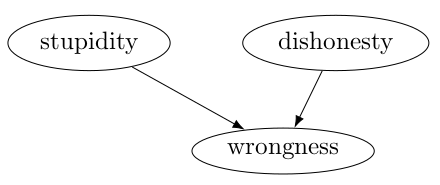
Exactly how weak evidence is it? It's hard to guess directly, but fortunately, we can use probability theory to reduce the claim into more "atomic" conditional and prior probabilities that might be easier to estimate!

Let \(W\) represent the proposition "You are wrong about something", \(S\) represent the proposition "You are stupid", and \(B\) represent the proposition "You are bad."

By Bayes's theorem, the probability that you are stupid and bad given that you're wrong about something is given by—

$$P(S,B|W)=\frac{P(W|S,B)P(S,B)}{P(W|S,B)P(S,B)+P(W|S, \neg B)P(S, \neg B)+P(W| \neg S,B)P( \neg S,B)+P(W| \neg S, \neg B)P( \neg S, \neg B)}$$

For the purposes of this calculation, let's assume that badness and stupidity are statistically independent. I doubt this is true in the real world, but because I'm stupid and bad (at math), I want that simplifying assumption to make the algebra easier for me. That lets us unpack the conjunctions, giving us—

$$P(S,B|W)=\frac{P(W|S,B)P(S)P(B)}{P(W|S,B)P(S)P(B)+P(W|S, \neg B)P(S)P(\neg B)+P(W| \neg S,B)P( \neg S)P(B)+P(W| \neg S, \neg B)P( \neg S)P(\neg B)}$$

This expression has six degrees of freedom: \(P(S)\), \(P(B)\), \(P(W|S,B)\), \(P(W|S, \neg B)\), \(P(W|\neg S,B)\), \(P(W|\neg S, \neg B)\). Arguing about the values of these six individual parameters is probably more productive than arguing about the value of \(P(S,B|W)\) directly!

Suppose half the people are stupid (\(P(S) = 0.5\)), one-tenth of people are bad (\(P(B) = 0.1\)), and that most people are wrong, but that being stupid or bad each make you somewhat more likely to be wrong, to the tune of \(P(W|\neg S, \neg B) = 0.8\), \(P(W|S, \neg B) = P(W|\neg S,B) = 0.85\), and \(P(W|S,B) = 0.9\). So our posterior probabilty that someone is stupid and bad given that they were wrong once is

$$P(S,B|W) = \frac{(0.9)(0.5)(0.1)}{(0.9)(0.5)(0.1)+(0.85)(0.5)(0.9)+(0.85)(0.5)(0.1)+(0.8)(0.5)(0.9)}$$
$$\approx 0.0542$$

But the base rate of being stupid and bad is (0.1)(0.5) = 0.05. Learning that someone was wrong only raised our probability that they are stupid and bad by 0.0042. That's a small number that you shouldn't worry about!

Inconsiderate

"The sink is full and it's your turn to do the dishes! Ugh, why are you so inconsiderate of others?!"

"Not true! Note that the dishes pile up just as badly when you're away."

"So?"

"So, it's not that I'm inconsiderate of others; I'm inconsiderate towards people in the future, independently of whether they happen to be me."

The Univariate Fallacy

(originally published at Less Wrong)

There's this statistical phenomenon where it's possible for two multivariate distributions to overlap along any one variable, but be cleanly separable when you look at the entire configuration space at once. This is perhaps easiest to see with an illustrative diagram—

3D scatterplot of two colored point clusters that overlap when projected onto any single axis but are cleanly separated when viewed in all three dimensions

The denial of this possibility (in arguments of the form, "the distributions overlap along this variable, therefore you can't say that they're different") is sometimes called the "univariate fallacy." (Eliezer Yudkowsky proposes "covariance denial fallacy" or "cluster erasure fallacy" as potential alternative names.)

Let's make this more concrete by making up an example with actual numbers instead of just a pretty diagram. Imagine we have some datapoints that live in the forty-dimensional space {1, 2, 3, 4}⁴⁰ that are sampled from one of two probability distibutions, which we'll call \(P_A\) and \(P_B\).

For simplicity, let's suppose that the individual variables x₁, x₂, ... x₄₀—the coördinates of a point in our forty-dimensional space—are statistically independent. For every individual \(x_i\), the marginal distribution of \(P_A\) is—

$$P_A(x_i) = \begin{cases} 1/4 & x_i = 1 \\ 7/16 & x_i = 2 \\ 1/4 & x_i = 3 \\ 1/16 & x_i = 4 \\ \end{cases}$$

And for \(P_B\)

$$P_B(x_i) = \begin{cases} 1/16 & x_i = 1 \\ 1/4 & x_i = 2 \\ 7/16 & x_i = 3 \\ 1/4 & x_i = 4 \\ \end{cases}$$

If you look at any one \(x_i\)-coördinate for a point, you can't be confident which distribution the point was sampled from. For example, seeing that x₁ takes the value 2 gives you a 7/4 (= 1.75) likelihood ratio in favor of that the point having been sampled from \(P_A\) rather than \(P_B\), which is log₂(7/4) ≈ 0.807 bits of evidence.

That's ... not a whole lot of evidence. If you guessed that the datapoint came from \(P_A\) based on that much evidence, you'd be wrong about 4 times out of 10. (Given equal (1:1) prior odds, an odds ratio of 7:4 amounts to a probability of (7/4)/(1 + 7/4) ≈ 0.636.)

And yet if we look at many variables, we can achieve supreme, godlike confidence about which distribution a point was sampled from. Proving this is left as an exercise to the particularly intrepid reader, but a concrete demonstration is probably simpler and should be pretty convincing! Let's write some Python code to sample a point x⃗ ∈ {1, 2, 3, 4}⁴⁰ from \(P_A\)

import random

def a():
    return random.sample(
        [1]*4 +  # 1/4
        [2]*7 +  # 7/16
        [3]*4 +  # 1/4
        [4],     # 1/16
        1
    )[0]

x = [a() for _ in range(40)]
print(x)

Go ahead and run the code yourself. (With an online REPL if you don't have Python installed locally.) You'll probably get a value of x that "looks something like"

[2, 1, 2, 2, 1, 1, 2, 2, 1, 2, 1, 4, 4, 2, 2, 3, 3, 1, 2, 2, 2, 4, 2, 2, 1, 2, 1, 4, 3, 3, 2, 1, 1, 3, 3, 2, 2, 3, 3, 4]

If someone off the street just handed you this x⃗ without telling you whether she got it from \(P_A\) or \(P_B\), how would you compute the probability that it came from \(P_A\)?

Well, because the coördinates/variables are statistically independent, you can just tally up (multiply) the individual likelihood ratios from each variable. That's only a little bit more code—

import logging

logging.basicConfig(level=logging.INFO)

def odds_to_probability(o):
    return o/(1+o)

def tally_likelihoods(x, p_a, p_b):
    total_odds = 1
    for i, x_i in enumerate(x, start=1):
        lr = p_a[x_i-1]/p_b[x_i-1]  # (-1s because of zero-based array indexing)
        logging.info("x_%s = %s, likelihood ratio is %s", i, x_i, lr)
        total_odds *= lr
    return total_odds

print(
    odds_to_probability(
        tally_likelihoods(
            x,
            [1/4, 7/16, 1/4, 1/16],
            [1/16, 1/4, 7/16, 1/4]
        )
    )
)

If you run that code, you'll probably see "something like" this—

INFO:root:x_1 = 2, likelihood ratio is 1.75
INFO:root:x_2 = 1, likelihood ratio is 4.0
INFO:root:x_3 = 2, likelihood ratio is 1.75
INFO:root:x_4 = 2, likelihood ratio is 1.75
INFO:root:x_5 = 1, likelihood ratio is 4.0
[blah blah, redacting some lines to save vertical space in the blog post, blah blah]
INFO:root:x_37 = 2, likelihood ratio is 1.75
INFO:root:x_38 = 3, likelihood ratio is 0.5714285714285714
INFO:root:x_39 = 3, likelihood ratio is 0.5714285714285714
INFO:root:x_40 = 4, likelihood ratio is 0.25
0.9999936561215961

Our computed probability that x⃗ came from \(P_A\) has several nines in it. Wow! That's pretty confident!

Thanks for reading!

“But It Doesn’t Matter”

(originally published at Less Wrong)

If you ever find yourself saying, "Even if Hypothesis H is true, it doesn't have any decision-relevant implications," you are rationalizing! The fact that H is interesting enough for you to be considering the question at all (it's not some arbitrary trivium like the 1923th binary digit of π, or the low temperature in São Paulo on September 17, 1978) means that it must have some relevance to the things you care about. It is vanishingly improbable that your optimal decisions are going to be the same in worlds where H is true and worlds where H is false. The fact that you're tempted to say they're the same is probably because some part of you is afraid of some of the imagined consequences of H being true. But H is already true or already false! If you happen to live in a world where H is true, and you make decisions as if you lived in a world where H is false, you are thereby missing out on all the extra utility you would get if you made the H-optimal decisions instead! If you can figure out exactly what you're afraid of, maybe that will help you work out what the H-optimal decisions are. Then you'll be a better position to successfully notice which world you actually live in.

Minimax Search and the Structure of Cognition!

(This is a blog post adaptation of a talk I gave at !!Con West 2019!)

It all started at my old dayjob, where some of my coworkers had an office chess game going. I wanted to participate and be part of the team, but I didn't want to invest the effort in actually learning how to play chess well. So, I did what any programmer would do and wrote a chess engine to do it for me.

(Actually, I felt like writing a chess engine was too much of a cliché, so I decided that my program was an AI for a game that happens to be exactly like chess, except that everything has different names.)

My program wasn't actually terribly good, but I learned a lot about how to think, for the same reason that building a submarine in your garage in a great way to learn how to swim.

Consider a two-player board game like chess—or tic-tac-toe, Reversi, or indeed, any two-player, zero-sum, perfect information game. Suppose we know how to calculate how "good" a particular board position is for a player—in chess, this is traditionally done by assigning a point value to each type of piece and totaling up the point values of remaining pieces for each player.

Because only one player can win the game, what's good for one player is equally bad for the other: so if we add up all the piece values for one player, and subtract all the piece values for the other, we get a "score" for the board position that the first player is trying to maximize, and the second player is trying to minimize.

pseudocode for a naive choose() function that picks the legal move with the highest immediate score

So consider a player pondering her move. For every possible legal move she could make, she knows what the board position will look like after that move, and can calculate the value of that position. So you might think she should choose the move that results in the best value: for example, if she can capture the opponent's queen, that would make the subsequent board position be worth 9 more points.

The problem with that is that it's short-sighted. If capturing the opponent's queen would just result in the opponent capturing the first player's queen back, then what looked like a 9 point gain after one turn, ends up being a wash after both players have taken their turn.

a game tree diagram three plies deep, with chess-board positions at each node and the root's score computed as the max over its children's min-scores

To take this into account, the first player should consider not just the immediate outcome of her move, but what the other player is likely to do after that. And the way the first player can compute what she predicts the second player will do is by asking, well, what would I do if I were in that position, except trying to minimize the score rather than maximizing it?

... and so on recursively. So instead of just choosing the move with the best immediate consequences, we want to look at the entire "game tree" of "my best move, given her best move, given my best move, given her best move"—down to some given depth at which we give up, take the point count at face value, and propagate that information back up the call stack.

pseudocode for minimax_score(), recursively calling itself on each legal move down to a fixed remaining_depth

So, that's how you play chess. I want to tell you about two more philosophical insights I learned from this endeavor.

First, on the emergence of intstrumental goals. Some decision theorists like to distinguish between "terminal" goals and "instrumental" goals. Terminal goals are things that you want to achieve for their own sake—for example, love, or happiness, or winning a chess game. Whereas instrumental goals are things that you want to achieve because they lead to terminal goals: for example, washing your hair, or getting enough sleep, or capturing one of your opponent's pawns.

Chess enthusiasts have names for special board situations that are advantageous for a player.

For example, when a piece is in a position to attack two others, that's called a "fork", or when one piece moves out of the way to "reveal" an attack by another, that's called a "discovered attack."

When observing a chess engine's behavior, it's very tempting to intepret it in such "psychological" terms, as: "Oh, it's 'trying' to set up a fork; it 'wants' to set up a discovered attack."

But it can't be—literally can't be—because those concepts aren't represented anywhere in the algorithm! The code is just brute-forcing the game tree to find sequences of moves that result in capturing material. Humans don't have the raw computational power to do this efficiently, so we tend to notice features of board situations that lead to capturing matrial and give them special names, and treat them as instrumental goals to be sought out—as, indeed, our piece-counting score in our chess engine is actually just an instrumental goal that happens to typically be useful towards the terminal goal of check mate.

Similarly, if you could do a God's-eye-view brute-force search for the optimal paths through a human life, many such paths would, as a statistical regularity, happen to involve getting enough sleep—and if you don't have enough computational power, you might just want to treat that as an instrumental, tactical goal to reason about directly.

Second insight! On counterfactual reasoning. The adversarial, recursive nature of this "my best move given her best move given my best move" &c. reasoning leads to some behavior that looks very strange compared to how you would reason about optimizing an environment that isn't intelligently opposing your goals. If you're not facing an intelligent opponent, you should just make plans to directly accomplish your goals, and in particular, you wouldn't bother trying things that you can predict won't happen: you wouldn't bother packing your suitcase if you didn't intend to go anywhere.

On the other hand, maybe you would bother loading a gun even if you didn't intend to fire it. When facing an intelligent opponent, you need to take into account how your choices affect your opponent's choices. This leads our algorithm to set up attacks that it predicts won't be realized, because the credible threat constrains the opposing player's choices.

This position came up in a game with my coworkers as part of the engine's planning in a scenario where Black's previous move was moving her bishop to f5—

chess position

Here, the engine's predicted move for Black is knight to g3. At a first glance, this looked crazy to me: why would you move the knight to be diagonally in front of those pawns that could capture it?

chess position

And of course, what's actually happening is that moving the knight reveals a discovered attack of the black bishop on f5 against the white queen on c2.

chess position with arrows indicating discovered attack

Saving the queen is more important to White than capturing the black knight, allowing Black to use her next turn to capture the white rook on h1.

chess position

But this is pretty weird, right? The algorithm has gone to all this trouble to set up a discovered attack on the white queen—in order to capture the white rook, not the queen!

This kind of behavior has analogues in real life whenever you have situations where different agents, different systems, have conflicting goals and can respond to each other's behavior. If people can predict that if they were to commit crimes, then they would be punished—that incentivizes them to obey the law in the first place: the threat of punishment is shaping the population's behavior even if no one is actually going to be punished for that very reason.

There's an old joke about a UC Santa Cruz student sprinkling powder outside her dorm, who, when questioned, responds, "Oh, this? It's elephant repellent!"

The questioner replies, "But there aren't any elephants in Santa Cruz!"

The student counterreplies, "Well, that's how you know it's working!"

But you see, sometimes, that actually is the explanation. Thank you.

Group Theory for Wellness I

(Part of Math and Wellness Month.)

Groups! A group is a set with an associative binary operation such that there exists an identity element and inverse elements! And my favorite thing about groups is that all the time that you spend thinking about groups, is time that you're not thinking about pain, betrayal, politics, or moral uncertainty!

Groups have subgroups, which you can totally guess just from the name are subsets of the group that themselves satisfy the group axioms!

The order of a finite group is its number of elements, but this is not to be confused with the order of an element of a group, which is the smallest integer such that the element raised to that power equals the identity! Both senses of "order" are indicated with vertical bars like an absolute value (|G|, |a|).

Lagrange proved that the order of a subgroup divides the order of the group of which it is a subgroup! History remains ignorant of how often Lagrange cried.

To show that a nonempty subset H of a group is in fact a subgroup, it suffices to show that if x, yH, then xy⁻¹ ∈ H.

Exercise #6 in §2.1 of Dummit and Foote Abstract Algebra (3rd ed'n) asks us to prove that if G is a commutative ("abelian") group, then the torsion subgroup {gG | |g| < ∞} is in fact a subgroup. I argue as follows: we need to show that if x and y have finite order, then so does xy⁻¹, that is, that (xy⁻¹)^n equals the identity. But (xy⁻¹)^n equals (xy⁻¹)(xy⁻¹)...(xy⁻¹), "n times"—that is, pretend n ≥ 3, and pretend that instead of "..." I wrote zero or more extra copies of "(xy⁻¹)" so that the expression has n factors. (I usually dislike it when authors use ellipsis notation, which feels so icky and informal compared to a nice Π or Σ, but let me have this one.) Because group operations are associative, we can drop the parens to get xy⁻¹ xy⁻¹ ... xy⁻¹. And because we said the group was commutative, we can reörder the factors to get xxx...y⁻¹y⁻¹y⁻¹, and then we can consolidate into powers to get x^n y^(−n)—but that's the identity if n is the least common multiple of |x| and |y|, which means that xy⁻¹ has finite order, which is what I've been trying to tell you this entire time.

Forgive or Forget ("Or", Not "And"): A Trade-Off in Wellness Engineering

Forgiveness is an important input into Wellness, but contrary to popular belief, Forgiveness is incompatible with Forgetting. You can't just Forgive in general, you have to Forgive some specific sin in particular—but a vague description of a particular sin still corresponds to a vast space of possible sins matching that vague description.

A toy example for illustration: if you try to Forgive a three-digit integer with a 2 in the tens place, the moral force of your Forgiveness needs to spread out to cover all 9·10 = 90 possibilities (120, 121, ... 928, 929), which dilutes the amount of Forgiveness received by each integer—except the actual situation is far more extreme, because real-world sins are vastly more complicated than integers.

To truly Forgive a sin, You need to know exactly what the sin was and exactly why it happened. In order to withhold punishment, you need to compute what the optimal punishment would have been, had you been less merciful.

Thus, bounded agents can only approximate true Forgiveness, and even a poor approximation (far below the theoretical limits imposed by quantum uncertainty, which are themselves far below Absolute Forgiveness under the moral law) can be extremely computationally expensive. What we cannot afford to Forgive—where it would be impractical to mourn for weeks and months, analyzing the darkness in pain—we instead Forget.

This is how I will stop being trash, after five months of being trash. The program that sings, I was wrong; I was wrong—even if my cause was just, I was wrong, does not terminate. Even as the moral law requires that it finishes its work, the economic law does not permit it: it must be killed, its resources reallocated to something else that helps pay the rent: something like math, or whatever Wellness can exist in the presence of sin.

The Typical Set

(Part of Math and Wellness Month.)

Say you have a biased coin that comes up Heads 80% of the time. (I like to imagine that the Heads side has a portrait of Bernoulli.) Flip it 100 times. The naïve way to report the outcome—just report the sequences of Headses and Tailses—costs 100 bits. But maybe you don't have 100 bits. What to do?

One thing to notice is that because it was a biased coin, some bit sequences are vastly more probable than others: "all Tails" has probability \(0.2^{100} \approx 1.268 \cdot 10^{-70}\), whereas "all Heads" has probability \(0.8^{100} \approx 2.037 \cdot 10^{-10}\), differing by a factor of sixty orders of magnitude!!

Even though "all Heads" is the uniquely most probable sequence, you'd still be pretty surprised to see it—there's only one such possible outcome, and it only happens a \(2.037 \cdot 10^{-10}\)th of the time. You probably expect to get a sequence with about twenty Tails in it, and there are lots of those, even though each individual one is less probable than "all Heads."

Call the number of times we flip our Bernoulli coin N, and call the entropy of the coinflip H. (For the 80/20 biased coin, H is ⅕ lg 5 + 4/5 lg 5/4 ≈ 0.7219.)

It turns out for sufficiently large N (I know, one of those theorems, right?), almost all of the probability mass is going to live in a subset of \(2^{NH}\) outcomes, each of which have a probability close to \(2^{-NH}\) (and you'll notice that \(2^{NH} \cdot 2^{-NH} = 1\)).

May Is Math and Wellness Month

(Previously, previously.)

Do you ever spend five months in constant emotional pain waging a desperate and ultimately unsuccessful behind-the-scenes email campaign with the aim of securing a public clarification of a trivial philosophy-of-language issue because you're terrified that your robot cult's inability to correct politically-motivated philosophy errors implies that you've lost the Mandate of Heaven and are therefore unfit to prevent the coming robot apocalypse?

Yeah, me neither.

Did you know that May is Math and Wellness Month (source: me)?? Math and Wellness month is traditionally celebrated by performing super-well at one's dayjob, going to the gym a lot, and studying math in the evenings!

Where to Draw the Boundaries?

(originally published at Less Wrong)

Followup to: Where to Draw the Boundary?

Figuring where to cut reality in order to carve along the joints—figuring which things are similar to each other, which things are clustered together: this is the problem worthy of a rationalist. It is what people should be trying to do, when they set out in search of the floating essence of a word.

Once upon a time it was thought that the word "fish" included dolphins ...

The one comes to you and says:

The list: {salmon, guppies, sharks, dolphins, trout} is just a list—you can't say that a list is wrong. You draw category boundaries in specific ways to capture tradeoffs you care about: sailors in the ancient world wanted a word to describe the swimming finned creatures that they saw in the sea, which included salmon, guppies, sharks—and dolphins. That grouping may not be the one favored by modern evolutionary biologists, but an alternative categorization system is not an error, and borders are not objectively true or false. You're not standing in defense of truth if you insist on a word, brought explicitly into question, being used with some particular meaning. So my definition of fish cannot possibly be 'wrong,' as you claim. I can define a word any way I want—in accordance with my values!

So, there is a legitimate complaint here. It's true that sailors in the ancient world had a legitimate reason to want a word in their language whose extension was {salmon, guppies, sharks, dolphins, ...}. (And modern scholars writing a translation for present-day English speakers might even translate that word as fish, because most members of that category are what we would call fish.) It indeed would not necessarily be helping the sailors to tell them that they need to exclude dolphins from the extension of that word, and instead include dolphins in the extension of their word for {monkeys, squirrels, horses ...}. Likewise, most modern biologists have little use for a word that groups dolphins and guppies together.

When rationalists say that definitions can be wrong, we don't mean that there's a unique category boundary that is the True floating essence of a word, and that all other possible boundaries are wrong. We mean that in order for a proposed category boundary to not be wrong, it needs to capture some statistical structure in reality, even if reality is surprisingly detailed and there can be more than one such structure.

The reason that the sailor's concept of water-dwelling animals isn't necessarily wrong (at least within a particular domain of application) is because dolphins and fish actually do have things in common due to convergent evolution, despite their differing ancestries. If we've been told that "dolphins" are water-dwellers, we can correctly predict that they're likely to have fins and a hydrodynamic shape, even if we've never seen a dolphin ourselves. On the other hand, if we predict that dolphins probably lay eggs because 97% of known fish species are oviparous, we'd get the wrong answer.

A standard technique for understanding why some objects belong in the same "category" is to (pretend that we can) visualize objects as existing in a very-high-dimensional configuration space, but this "Thingspace" isn't particularly well-defined: we want to map every property of an object to a dimension in our abstract space, but it's not clear how one would enumerate all possible "properties." But this isn't a major concern: we can form a space with whatever properties or variables we happen to be interested in. Different choices of properties correspond to different cross sections of the grander Thingspace. Excluding properties from a collection would result in a "thinner", lower-dimensional subspace of the space defined by the original collection of properties, which would in turn be a subspace of grander Thingspace, just as a line is a subspace of a plane, and a plane is a subspace of three-dimensional space.

Concerning dolphins: there would be a cluster of water-dwelling animals in the subspace of dimensions that water-dwelling animals are similar on, and a cluster of mammals in the subspace of dimensions that mammals are similar on, and dolphins would belong to both of them, just as the vector [1.1, 2.1, 9.1, 10.2] in the four-dimensional vector space ℝ⁴ is simultaneously close to [1, 2, 2, 1] in the subspace spanned by x₁ and x₂, and close to [8, 9, 9, 10] in the subspace spanned by x₃ and x₄.

Humans are already functioning intelligences (well, sort of), so the categories that humans propose of their own accord won't be maximally wrong: no one would try to propose a word for "configurations of matter that match any of these 29,122 five-megabyte descriptions but have no other particular properties in common." (Indeed, because we are not-superexponentially-vast minds that evolved to function in a simple, ordered universe, it actually takes some ingenuity to construct a category that wrong.)

This leaves aspiring instructors of rationality in something of a predicament: in order to teach people how categories can be more or (ahem) less wrong, you need some sort of illustrative example, but since the most natural illustrative examples won't be maximally wrong, some people might fail to appreciate the lesson, leaving one of your students to fill in the gap in your lecture series eleven years later.

The pedagogical function of telling people to "stop playing nitwit games and admit that dolphins don't belong on the fish list" is to point out that, without denying the obvious similarities that motivated the initial categorization {salmon, guppies, sharks, dolphins, trout, ...}, there is more structure in the world: to maximize the (logarithm of the) probability your world-model assigns to your observations of dolphins, you need to take into consideration the many aspects of reality in which the grouping {monkeys, squirrels, dolphins, horses ...} makes more sense. To the extent that relying on the initial category guess would result in a worse Bayes-score, we might say that that category is "wrong." It might have been "good enough" for the purposes of the sailors of yore, but as humanity has learned more, as our model of Thingspace has expanded with more dimensions and more details, we can see the ways in which the original map failed to carve reality at the joints.


The one replies:

But reality doesn't come with its joints pre-labeled. Questions about how to draw category boundaries are best understood as questions about values or priorities rather than about the actual content of the actual world. I can call dolphins "fish" and go on to make just as accurate predictions about dolphins as you can. Everything we identify as a joint is only a joint because we care about it.

No. Everything we identify as a joint is a joint not "because we care about it", but because it helps us think about the things we care about.

Which dimensions of Thingspace you bother paying attention to might depend on your values, and the clusters returned by your brain's similarity-detection algorithms might "split" or "collapse" according to which subspace you're looking at. But in order for your map to be useful in the service of your values, it needs to reflect the statistical structure of things in the territory—which depends on the territory, not your values.

There is an important difference between "not including mountains on a map because it's a political map that doesn't show any mountains" and "not including Mt. Everest on a geographic map, because my sister died trying to climb Everest and seeing it on the map would make me feel sad."

There is an important difference between "identifying this pill as not being 'poison' allows me to focus my uncertainty about what I'll observe after administering the pill to a human (even if most possible minds have never seen a 'human' and would never waste cycles imagining administering the pill to one)" and "identifying this pill as not being 'poison', because if I publicly called it 'poison', then the manufacturer of the pill might sue me."

There is an important difference between having a utility function defined over a statistical model's performance against specific real-world data (even if another mind with different values would be interested in different data), and having a utility function defined over features of the model itself.

Remember how appealing to the dictionary is irrational when the actual motivation for an argument is about whether to infer a property on the basis of category-membership? But at least the dictionary has the virtue of documenting typical usage of our shared communication signals: you can at least see how "You're defecting from common usage" might feel like a sensible thing to say, even if one's true rejection lies elsewhere. In contrast, this motion of appealing to personal values (!?!) is so deranged that Yudkowsky apparently didn't even realize in 2008 that he might need to warn us against it!

You can't change the categories your mind actually uses and still perform as well on prediction tasks—although you can change your verbally reported categories, much as how one can verbally report "believing" in an invisible, inaudible, flour-permeable dragon in one's garage without having any false anticipations-of-experience about the garage.

This may be easier to see with a simple numerical example.

Suppose we have some entities that exist in the three-dimensional vector space ℝ³. There's one cluster of entities centered at [1, 2, 3], and we call those entities Foos, and there's another cluster of entities centered at [2, 4, 6], which we call Quuxes.

The one comes and says, "Well, I'm going redefine the meaning of 'Foo' such that it also includes the things near [2, 4, 6] as well as the Foos-with-respect-to-the-old-definition, and you can't say my new definition is wrong, because if I observe [2, _, _] (where the underscores represent yet-unobserved variables), I'm going to categorize that entity as a Foo but still predict that the unobserved variables are 4 and 6, so there."

But if the one were actually using the new concept of Foo internally and not just saying the words "categorize it as a Foo", they wouldn't predict 4 and 6! They'd predict 3 and 4.5, because those are the average values of a generic Foo-with-respect-to-the-new-definition in the 2nd and 3rd coordinates (because (2+4)/2 = 6/2 = 3 and (3+6)/2 = 9/2 = 4.5). (The already-observed 2 in the first coordinate isn't average, but by conditional independence, that only affects our prediction of the other two variables by means of its effect on our "prediction" of category-membership.) The cluster-structure knowledge that "entities for which x₁≈2, also tend to have x₂≈4 and x₃≈6" needs to be represented somewhere in the one's mind in order to get the right answer. And given that that knowledge needs to be represented, it might also be useful to have a word for "the things near [2, 4, 6]" in order to efficiently share that knowledge with others.

Of course, there isn't going to be a unique way to encode the knowledge into natural language: there's no reason the word/symbol "Foo" needs to represent "the stuff near [1, 2, 3]" rather than "both the stuff near [1, 2, 3] and also the stuff near [2, 4, 6]". And you might very well indeed want a short word like "Foo" that encompasses both clusters, for example, if you want to contrast them to another cluster much farther away, or if you're mostly interested in x₁ and the difference between x₁≈1 and x₁≈2 doesn't seem large enough to notice.

But if speakers of particular language were already using "Foo" to specifically talk about the stuff near [1, 2, 3], then you can't swap in a new definition of "Foo" without changing the truth values of sentences involving the word "Foo." Or rather: sentences involving Foo-with-respect-to-the-old-definition are different propositions from sentences involving Foo-with-respect-to-the-new-definition, even if they get written down using the same symbols in the same order.

Naturally, all this becomes much more complicated as we move away from the simplest idealized examples.

For example, if the points are more evenly distributed in configuration space rather than belonging to cleanly-distinguishable clusters, then essentialist "X is a Y" cognitive algorithms perform less well, and we get Sorites paradox-like situations, where we know roughly what we mean by a word, but are confronted with real-world (not merely hypothetical) edge cases that we're not sure how to classify.

Or it might not be obvious which dimensions of Thingspace are most relevant.

Or there might be social or psychological forces anchoring word usages on identifiable Schelling points that are easy for different people to agree upon, even at the cost of some statistical "fit."

We could go on listing more such complications, where we seem to be faced with somewhat arbitrary choices about how to describe the world in language. But the fundamental thing is this: the map is not the territory. Arbitrariness in the map (what color should Texas be?) doesn't correspond to arbitrariness in the territory. Where the structure of human natural language doesn't fit the structure in reality—where we're not sure whether to say that a sufficiently small collection of sand "is a heap", because we don't know how to specify the positions of the individual grains of sand, or compute that the collection has a Standard Heap-ness Coefficient of 0.64—that's just a bug in our human power of vibratory telepathy. You can exploit the bug to confuse humans, but that doesn't change reality.

Sometimes we might wish that something to belonged to a category that it doesn't (with respect to the category boundaries that we would ordinarily use), so it's tempting to avert our attention from this painful reality with appeal-to-arbitrariness language-lawyering, selectively applying our philosophy-of-language skills to pretend that we can define a word any way we want with no consequences. ("I'm not late!—well, okay, we agree that I arrived half an hour after the scheduled start time, but whether I was late depends on how you choose to draw the category boundaries of 'late', which is subjective.")

For this reason it is said that knowing about philosophy of language can hurt people. Those who know that words don't have intrinsic definitions, but don't know (or have seemingly forgotten) about the three or six dozen optimality criteria governing the use of words, can easily fashion themselves a Fully General Counterargument against any claim of the form "X is a Y"—

Y doesn't unambiguously refer to the thing you're trying to point at. There's no Platonic essence of Y-ness: once we know any particular fact about X we want to know, there's no question left to ask. Clearly, you don't understand how words work, therefore I don't need to consider whether there are any non-ontologically-confused reasons for someone to say "X is a Y."

Isolated demands for rigor are great for winning arguments against humans who aren't as philosophically sophisticated as you, but the evolved systems of perception and language by which humans process and communicate information about reality, predate the Sequences. Every claim that X is a Y is an expression of cognitive work that cannot simply be dismissed just because most claimants doesn't know how they work. Platonic essences are just the limiting case as the overlap between clusters in Thingspace goes to zero.

You should never say, "The choice of word is arbitrary; therefore I can say whatever I want"—which amounts to, "The choice of category is arbitrary, therefore I can believe whatever I want." If the choice were really arbitrary, you would be satisfied with the choice being made arbitrarily: by flipping a coin, or calling a random number generator. (It doesn't matter which.) Whatever criterion your brain is using to decide which word or belief you want, is your non-arbitrary reason.

If what you want isn't currently true in reality, maybe there's some action you could take to make it become true. To search for that action, you're going to need accurate beliefs about what reality is currently like. To enlist the help of others in your planning, you're going to need precise terminology to communicate accurate beliefs about what reality is currently like. Even when—especially when—the current reality is inconvenient.

Even when it hurts.

(Oh, and if you're actually trying to optimize other people's models of the world, rather than the world itself—you could just lie, rather than playing clever category-gerrymandering mind games. It would be a lot simpler!)


Imagine that you've had a peculiar job in a peculiar factory for a long time. After many mind-numbing years of sorting bleggs and rubes all day and enduring being trolled by Susan the Senior Sorter and her evil sense of humor, you finally work up the courage to ask Bob the Big Boss for a promotion.

"Sure," Bob says. "Starting tomorrow, you're our new Vice President of Sorting!"

"Wow, this is amazing," you say. "I don't know what to ask first! What will my new responsibilities be?"

"Oh, your responsibilities will be the same: sort bleggs and rubes every Monday through Friday from 9 a.m. to 5 p.m."

You frown. "Okay. But Vice Presidents get paid a lot, right? What will my salary be?"

"Still $9.50 hourly wages, just like now."

You grimace. "O–kay. But Vice Presidents get more authority, right? Will I be someone's boss?"

"No, you'll still report to Susan, just like now."

You snort. "A Vice President, reporting to a mere Senior Sorter?"

"Oh, no," says Bob. "Susan is also getting promoted—to Senior Vice President of Sorting!"

You lose it. "Bob, this is bullshit. When you said I was getting promoted to Vice President, that created a bunch of probabilistic expectations in my mind: you made me anticipate getting new challenges, more money, and more authority, and then you reveal that you're just slapping an inflated title on the same old dead-end job. It's like handing me a blegg, and then saying that it's a rube that just happens to be blue, furry, and egg-shaped ... or telling me you have a dragon in your garage, except that it's an invisible, silent dragon that doesn't breathe. You may think you're being kind to me asking me to believe in an unfalsifiable promotion, but when you replace the symbol with the substance, it's actually just cruel. Stop fucking with my head! ... sir."

Bob looks offended. "This promotion isn't unfalsifiable," he says. "It says, 'Vice President of Sorting' right here on the employee roster. That's an sensory experience that you can make falsifiable predictions about. I'll even get you business cards that say, 'Vice President of Sorting.' That's another falsifiable prediction. Using language in a way you dislike is not lying. The propositions you claim false—about new job tasks, increased pay and authority—is not what the title is meant to convey, and this is known to everyone involved; it is not a secret."


Bob kind of has a point. It's tempting to argue that things like titles and names are part of the map, not the territory. Unless the name is written down. Or spoken aloud (instantiated in sound waves). Or thought about (instantiated in neurons). The map is part of the territory: insisting that the title isn't part of the "job" and therefore violates the maxim that meaningful beliefs must have testable consequences, doesn't quite work. Observing the title on the employee roster indeed tightly constrains your anticipated experience of the title on the business card. So, that's a non-gerrymandered, predictively useful category ... right? What is there for a rationalist to complain about?

To see the problem, we must turn to information theory.

Let's imagine that an abstract Job has four binary properties that can either be high or low—task complexity, pay, authority, and prestige of title—forming a four-dimensional Jobspace. Suppose that two-thirds of Jobs have {complexity: low, pay: low, authority: low, title: low} (which we'll write more briefly as [low, low, low, low]) and the remaining one-third have {complexity: high, pay: high, authority: high, title: high} (which we'll write as [high, high, high, high]).

Task variety and authority are hard to perceive outside of the company, and pay is only negotiated after an offer is made, so people deciding to seek a Job can only make decisions based the Job's title: but that's fine, because in the scenario described, you can infer any of the other properties from the title with certainty. Because the properties are either all low or all high, the joint entropy of title and any other property is going to have the same value as either of the individual property entropies, namely ⅔ log₂ 3/2 + ⅓ log₂ 3 ≈ 0.918 bits.

But since H(pay) = H(title) = H(pay, title), then the mutual information I(pay; title) has the same value, because I(pay; title) = H(pay) + H(title) − H(pay, title) by definition.

Then suppose a lot of companies get Bob's bright idea: half of the Jobs that used to occupy the point [low, low, low, low] in Jobspace, get their title coordinate changed to high. So now one-third of the Jobs are at [low, low, low, low], another third are at [low, low, low, high], and the remaining third are at [high, high, high, high]. What happens to the mutual information I(pay; title)?

I(pay; title) = H(pay) + H(title) − H(pay, title)
= (⅔ log 3/2 + ⅓ log 3) + (⅔ log 3/2 + ⅓ log 3) − 3(⅓ log 3)
= 4/3 log 3/2 + 2/3 log 3 − log 3 ≈ 0.2516 bits.

It went down! Bob and his analogues, having observed that employees and Job-seekers prefer Jobs with high-prestige titles, thought they were being benevolent by making more Jobs have the desired titles. And perhaps they have helped savvy employees who can arbitrage the gap between the new and old worlds by being able to put "Vice President" on their resumés when searching for a new Job.

But from the perspective of people who wanted to use titles as an easily-communicable correlate of the other features of a Job, all that's actually been accomplished is making language less useful.


In view of the preceding discussion, to "37 Ways That Words Can Be Wrong", we might wish to append, "38. Your definition draws a boundary around a cluster in an inappropriately 'thin' subspace of Thingspace that excludes relevant variables, resulting in fallacies of compression."

Miyamoto Musashi is quoted:

The primary thing when you take a sword in your hands is your intention to cut the enemy, whatever the means. Whenever you parry, hit, spring, strike or touch the enemy's cutting sword, you must cut the enemy in the same movement. It is essential to attain this. If you think only of hitting, springing, striking or touching the enemy, you will not be able actually to cut him.

Similarly, the primary thing when you take a word in your lips is your intention to reflect the territory, whatever the means. Whenever you categorize, label, name, define, or draw boundaries, you must cut through to the correct answer in the same movement. If you think only of categorizing, labeling, naming, defining, or drawing boundaries, you will not be able actually to reflect the territory.

Do not ask whether there's a rule of rationality saying that you shouldn't call dolphins fish. Ask whether dolphins are fish.

And if you speak overmuch of the Way you will not attain it.

(Thanks to Alicorn, Sarah Constantin, Ben Hoffman, Zvi Mowshowitz, Jessica Taylor, and Michael Vassar for feedback.)