Tags: calculus
Slug: the-derivative-of-the-natural-logarithm
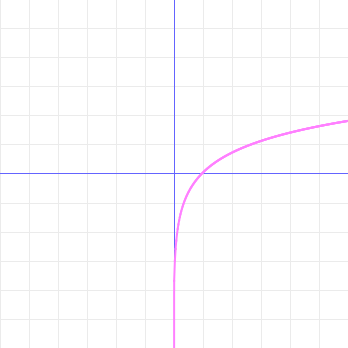
-Most people learn during their study of the differential and integral calculus that the derivative of the natural logarithm ln _x_ is the reciprocal function 1/_x_. Indeed, sometimes the natural logarithm is _defined_ as $$ \int\_1^x \frac{1}{t}\,dt$$. However, on observing the graphs of ln _x_ and 1/_x_, the inquisitive seeker of knowledge can hardly fail to notice a disturbing anomaly:
+Most people learn during their study of the differential and integral calculus that the derivative of the natural logarithm ln _x_ is the reciprocal function 1/_x_. Indeed, sometimes the natural logarithm is _defined_ as $$ \int_1^x \frac{1}{t}\,dt$$. However, on observing the graphs of ln _x_ and 1/_x_, the inquisitive seeker of knowledge can hardly fail to notice a disturbing anomaly:
[](http://zackmdavis.net/blog/wp-content/uploads/2011/12/lnx3.png) [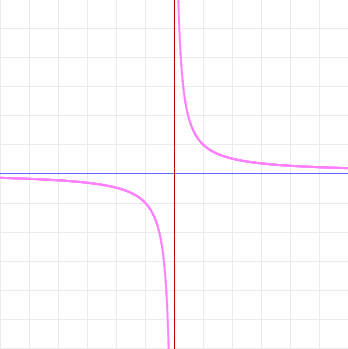](http://zackmdavis.net/blog/wp-content/uploads/2011/12/reciprocalx2.png)
You see, dear reader, the natural logarithm is not what we think it is. Your typical person-in-the-street hears talk of the natural logarithm and says, "Oh, sure, I know all about ln _x_; that's just the exponent you put on base _e_ to get _x_." And, to be fair, it is. But it's also so much more! Ask our person-in-the-street what exponent you put on base _e_ to get negative three, and no doubt she will regard you as mad. "Manifestly," we can imagine her replying, "_manifestly_ there's no such thing. The exponential function _ex_ is always positive." And, to be fair, it is—_if_ you _arbitrarily restrict your mind_ to the mundane, oppressive, and _boring_ magisterium of the so-called "real" numbers!
-Probably the dear reader is already familiar with the numbers which are said to be _complex_, those of the form a + b_i_, where _i_ is the square root of negative one. (To those who object that taking the square root of a negative number is a feat that simply cannot be done, the proper reply is only, _"Watch me!"_) The reader may furthermore recall the Euler formula _eix_ = cos _x_ + _i_sin _x_, source of the much-marveled-at identity _e_π_i_ = -1. With these prerequisites understood, it's quite reasonable to suspect that if we have a complex exponential, its inverse must be the complex logarithm, and that true apprehension of the nature of such is the key insight that will let us resolve the mystery at hand. And this does, in fact, turn out to be the case—but _not so fast_.
+Probably the dear reader is already familiar with the numbers which are said to be _complex_, those of the form a + b$i$, where $i$ is the square root of negative one. (To those who object that taking the square root of a negative number is a feat that simply cannot be done, the proper reply is only, _"Watch me!"_) The reader may furthermore recall the Euler formula $e^{ix} = \cos x + i \sin x$, source of the much-marveled-at identity $e^{\pi i} = -1$. With these prerequisites understood, it's quite reasonable to suspect that if we have a complex exponential, its inverse must be the complex logarithm, and that true apprehension of the nature of such is the key insight that will let us resolve the mystery at hand. And this does, in fact, turn out to be the case—but _not so fast_.
There is a difficulty here that must be explained. The dear reader may still yet furthermore recall that to say that a function is invertible is to say that it is both _injective_ (which is to say that every element in the codomain is mapped to by _at most_ one element in the domain, which is to say that distinct inputs have distinct outputs) and _surjective_ (which is to say that every element in the codomain is mapped to by _at least_ one element in the domain, which is to say that our codomain only includes actual outputs of our function). And dear reader, it turns out (to our great horror and distress) that the complex exponential is _not injective_! Was our dream of a complex logarithm nothing but a gaudy delusion?
There is, however, another point of view. The reason a function needs to be injective in order to be invertible is because _functions_ are _defined_ such that each input has a unique output. There are reasons for defining it that way, but it is ultimately only a _definition_, a convention for what we mean when we use the world _function_, and mere definitions can't coerce true facts into being something other than what they are. Just because a non-injective function doesn't have an inverse function doesn't mean we can't talk about that-which-inverts-it; it only means that for clear communication, we should avoid calling the inverting-thing a _function_. Just call it a _multifunction_ or a _relation_ instead. (One can even imagine that if the history of mathematical inquiry had gone differently, we might call multifunctions _functions_ and functions (say) _deterministic functions_, although some would argue that it is useless and idle to speculate about worlds that are not our own.)
-So if we understand the complex logarithm multifunction as that-which-inverts the complex exponential, then we can understand the logarithm of a negative number -_x0_ as ln _x0_ + (2_n_+1)π_i_ where _n_ ∈ ℤ, because _e_ln _x0_ + (2_n_+1)π_i_ = _e_ln _x0__e_(2_n_+1)π_i_ = -_e_ln _x0_ = -_x0_.
+So if we understand the complex logarithm multifunction as that-which-inverts the complex exponential, then we can understand the logarithm of a negative number $-x_0$ as $\ln x_0 + (2n+1)\pi i$ where $n \in \mathbb{Z}$, because $e^{\ln x_0 + (2n+1)\pi i} = e^{\ln x_0}e^{(2n+1)\pi i} = -e^{\ln x_0} = -x_0$.
But now we are ready to resolve the mystery that we set out to explain, of why the reciprocal function is the derivative of the natural logarithm even though no real number is the logarithm of a negative number, for now it is plain to see that the logarithm of a negative number is complex, but the _derivative_ of the logarithm is real, because the imaginary part is a constant that drops out when we take the derivative:
-$$ f'(-x\_0) = \lim\_{h \to 0} \frac{f(-x\_0+h)-f(x\_0)}{h} = \lim\_{h \to 0} \frac{(\ln{(x\_0 - h)} + (2n+1)\pi i) - (\ln{x\_0} + (2n+1)\pi i)}{h}$$
+$$ f'(-x_0) = \lim_{h \to 0} \frac{f(-x_0+h)-f(x_0)}{h} = \lim_{h \to 0} \frac{(\ln{(x_0 - h)} + (2n+1)\pi i) - (\ln{x_0} + (2n+1)\pi i)}{h}$$
-$$ = \lim\_{h \to 0} \frac{\ln{(x\_0 - h)} - \ln{x\_0}}{h}$$
+$$ = \lim_{h \to 0} \frac{\ln{(x_0 - h)} - \ln{x_0}}{h}$$
-—which turns out to be -1/_x0_, as expected.
+—which turns out to be $-1/x_0$, as expected.
Some might object that this argument is so sloppy as to be treacherous, misleading, and invalid: we've brazenly assumed that the definition of the derivative familiar from the study of the single-variable calculus can be applied to this complex-valued thing that _isn't even a function_, with no concern for preciseness, rigor, or even the Cauchy-Riemann conditions. But look. Presented with a procedure that _makes sense_ and _gives the right answer_, perhaps the dear reader would be so kind as to cut me some goddam slack? I would be ever so much obliged.
Tags: geometric algebra
Slug: blades
-What is a _vector_ in Euclidean space? Some might say it's an entity characterized by possessing a _magnitude_ and a _direction_. But scholars of the geometric algebra (such as [Eric Chisolm](http://arxiv.org/abs/1205.5935) and [Dorst _et al._](http://www.geometricalgebra.net/)) tell us that it's better to decompose the idea of _direction_ into the two ideas of subspace _attitude_ (our vector's quality of living in a particular line) and _orientation_ (its quality of pointing in a particular direction in that line, and not the other). On this view, a vector is an _attitudinal oriented length element_. But having done this, it becomes inevitable that we should want to talk about attitudinal oriented _area_ (volume, 4-hypervolume, _&c._) elements. To this end we introduce the _outer_ or wedge product ∧ on vectors. It is _bilinear_, it is _anticommutative_ (swapping the order of arguments swaps the sign, so __a__∧__b__ = –__b__∧__a__), and that's all you need to know.
+What is a _vector_ in Euclidean space? Some might say it's an entity characterized by possessing a _magnitude_ and a _direction_. But scholars of the geometric algebra (such as [Eric Chisolm](http://arxiv.org/abs/1205.5935) and [Dorst _et al._](http://www.geometricalgebra.net/)) tell us that it's better to decompose the idea of _direction_ into the two ideas of subspace _attitude_ (our vector's quality of living in a particular line) and _orientation_ (its quality of pointing in a particular direction in that line, and not the other). On this view, a vector is an _attitudinal oriented length element_. But having done this, it becomes inevitable that we should want to talk about attitudinal oriented _area_ (volume, 4-hypervolume, _&c._) elements. To this end we introduce the _outer_ or wedge product ∧ on vectors. It is _bilinear_, it is _anticommutative_ (swapping the order of arguments swaps the sign, so $\vec{a}\wedge\vec{b} = -\vec{b}\wedge\vec{a}$), and that's all you need to know.
-Suppose we have two vectors __a__ and __b__ in Euclidean space and also a basis for the subspace that the vectors live in, __e__1 and __e__2, so that we can write __a__ := a1__e__1 + a2__e__2 and __b__ := b1__e__1 + b2__e__2. Then the claim is that the outer product __a__∧__b__ can be said to represent a generalized vector (call it a _2-blade_—and in general, when we wedge _k_ vectors together, it's a _k_-blade) with a subspace attitude of the plane that our vectors live in and a magnitude equal to the area of the parallelogram spanned by them. Following Dorst _et al_., let's see what happens when we expand __a__∧__b__ in terms of our basis—
+Suppose we have two vectors $\vec{a}$ and $\vec{b}$ in Euclidean space and also a basis for the subspace that the vectors live in, $\vec{e}_1$ and $\vec{e}_2$, so that we can write $\vec{a} := a_1\vec{e}_1 + a_2\vec{e}_2$ and $\vec{b} := b_1\vec{e}_1 + b_2\vec{e}_2$. Then the claim is that the outer product $\vec{a}\wedge\vec{b}$ can be said to represent a generalized vector (call it a _2-blade_—and in general, when we wedge _k_ vectors together, it's a _k_-blade) with a subspace attitude of the plane that our vectors live in and a magnitude equal to the area of the parallelogram spanned by them. Following Dorst _et al_., let's see what happens when we expand $\vec{a}\wedge\vec{b}$ in terms of our basis—
-__a__∧__b__ = (a1__e__1 + a2__e__2)∧(b1__e__1 + b2__e__2)
+$$\vec{a}\wedge\vec{b} = (a_1\vec{e}_1 + a_2\vec{e}_2)\wedge(b_1\vec{e}_1 + b_2\vec{e}_2)$$
-= a1__e__1∧(b1__e__1 + b2__e__2) + a2__e__2∧(b1__e__1 + b2__e__2)
+$$= a_1\vec{e}_1\wedge(b_1\vec{e}_1 + b_2\vec{e}_2) + a_2\vec{e}_2\wedge(b_1\vec{e}_1 + b_2\vec{e}_2)$$
-= a1__e__1∧b1__e__1 + a1__e__1∧b2__e__2 + a2__e__2∧b1__e__1 + a2__e__2∧b2__e__2
+$$= a_1\vec{e}_1\wedge b_1\vec{e}_1 + a_1\vec{e}_1\wedge b_2\vec{e}_2 + a_2\vec{e}_2\wedge b_1\vec{e}_1 + a_2\vec{e}_2\wedge b_2\vec{e}_2$$
-But the anticommutativity property implies that the outer product of a vector with itself is _zero_, because __e__∧__e__ = –__e__∧__e__. So we have
+But the anticommutativity property implies that the outer product of a vector with itself is _zero_, because $\vec{e}\wedge\vec{e} = -\vec{e}\wedge\vec{e}$. So we have
-(a1b2 – a2b1)__e__1∧__e__2
+$$(a_1b_2 - a_2b_1)\vec{e}_1\wedge\vec{e}_2$$
It's a determinant! And since determinants tell us about the oriented volumes of parallelepipeds, we can see why these blades defined by this outer product are a sensible generalization of the _vector_ idea. And none can doubt that they shall play but ever such an essential role in our vaunted geometric algebra!
_Theorem_. An open set in real sequence space under the ℓ∞ norm is not totally bounded.
-_Proof_. Consider an open set _U_ containing a point _p_. Suppose by way of contradiction that _U_ is totally bounded. Then for every ε > 0, there exists a finite ε-net for _U_. Fix ε, and let _m_ be the number of points in our ε-net, which net we'll denote {_S__i_}_i_∈{1, ..., _m_}. We're going to construct a very special point _y_, which does not live in _U_. For all _i_ ∈ {1, ..., _m_}, we can choose the _i_th component _y__i_ such that the absolute value of its difference from the _i_th component of the _i_th point in the net is strictly greater than ε (that is, |_yi_ – _Si,i_| > ε) but also so that the absolute value of its difference from the _i_th component of _p_ is less than or equal to ε (that is, |_yi_ – _pi_| ≤ ε). Then for _j_ > _m_, set _yj_ = _pj_. Then |_y_ – _p_| ≤ ε, but that means there are points arbitrarily close to _p_ which are not in _U_, which is an absurd thing to happen to a point in an open set! But that's what I've been trying to tell you this entire time.
+_Proof_. Consider an open set $U$ containing a point $p$. Suppose by way of contradiction that $U$ is totally bounded. Then for every ε > 0, there exists a finite ε-net for $U$. Fix ε, and let $m$ be the number of points in our ε-net, which net we'll denote $\{S_i\}_{i \in \{1, ..., m\}}$. We're going to construct a very special point $y$, which does not live in $U$. For all $i \in \{1, ..., m\}$, we can choose the $i$th component $y_i$ such that the absolute value of its difference from the $i$th component of the $i$th point in the net is strictly greater than ε (that is, $|y_i - S_{i,i}| > \varepsilon$) but also so that the absolute value of its difference from the $i$th component of $p$ is less than or equal to ε (that is, $|y_i - p_i| \le \varepsilon$). Then for $j > m$, set $y_j = p_j$. Then $|y - p| \le \varepsilon$, but that means there are points arbitrarily close to $p$ which are not in $U$, which is an absurd thing to happen to a point in an open set! But that's what I've been trying to tell you this entire time.
Tags: analysis
Slug: bounded-but-not-totally-bounded
-The idea of _total boundedness_ in metric space (for every ε, you can cover the set with a finite number of ε-balls; [discussed previously](http://zackmdavis.net/blog/2012/08/straight-talk-about-precompactness/) on _An Algorithmic Lucidity_) is distinct from (and in fact, stronger than) the idea of mere boundedness (there's an upper bound for the distance between any two points in the set), but to an uneducated mind, it's not immediately clear _why_. What would be an example of a set that's bounded but not totally bounded? _Wikipedia_ claims that the unit ball in infinite-dimensional Banach space will do. Eric Hayashi made this more explicit for me: consider sequence space under the ℓ∞ norm, and the "standard basis" set (1, 0, 0 ...), (0, 1, 0, 0, ...), (0, 0, 1, 0, 0, ...). The distance between any two points in this set is one, so it's bounded, but an open 1-ball around any point doesn't contain any of the other points, so no finite number of open 1-balls will do, so it's not totally bounded, which is what I've been trying to tell you this entire time.
+The idea of _total boundedness_ in metric space (for every ε, you can cover the set with a finite number of ε-balls; [discussed previously](http://zackmdavis.net/blog/2012/08/straight-talk-about-precompactness/) on _An Algorithmic Lucidity_) is distinct from (and in fact, stronger than) the idea of mere boundedness (there's an upper bound for the distance between any two points in the set), but to an uneducated mind, it's not immediately clear _why_. What would be an example of a set that's bounded but not totally bounded? _Wikipedia_ claims that the unit ball in infinite-dimensional Banach space will do. Eric Hayashi made this more explicit for me: consider sequence space under the $\ell^\infty$ norm, and the "standard basis" set (1, 0, 0 ...), (0, 1, 0, 0, ...), (0, 0, 1, 0, 0, ...). The distance between any two points in this set is one, so it's bounded, but an open 1-ball around any point doesn't contain any of the other points, so no finite number of open 1-balls will do, so it's not totally bounded, which is what I've been trying to tell you this entire time.
I'd like to see the colon-equals assignment symbol more often in math, too. For example, shouldn't we be writing lower indices of summation like this?—
-$$\sum\_{j:=0}^n f(j)$$
+$$\sum_{j:=0}^n f(j)$$
—the rationale being that the text under the sigma _isn't_ asserting that _j_ _equals_ zero, but rather that _j_ is _assigned_ zero as the initial index value of what is, in fact, a for loop:
Tags: Python
Slug: computing-the-arithmetic-derivative
-Jurij Kovič's paper "[The Arithmetic Derivative and Antiderivative](https://cs.uwaterloo.ca/journals/JIS/VOL15/Kovic/kovic4.html)" contains a curious remark in Section 1.2. Having just stated the definition of the _logarithmic arithmetic derivative_ (_L_(_n_) = _n_′/_n_ = Σj _a__j_/_p__j_ where the prime mark indicates the arithmetic derivative, and Πi_p__i__a__i_ is the prime factorization of _n_), Kovič writes:
+Jurij Kovič's paper "[The Arithmetic Derivative and Antiderivative](https://cs.uwaterloo.ca/journals/JIS/VOL15/Kovic/kovic4.html)" contains a curious remark in Section 1.2. Having just stated the definition of the _logarithmic arithmetic derivative_ ($L(n) = n'/n = \sum_j a_j/p_j$ where the prime mark indicates the arithmetic derivative, and $\prod_i p_i^{a_i}$ is the prime factorization of $n$), Kovič writes:
> The logarithmic derivative is an additive function _L_(_xy_) = _L_(_x_) + _L_(_y_) for any _x_, _y_ ∈ ℚ. Consequently, using a table of values _L_(_p_) = 1/_p_ (computed to sufficient decimal places!) and the formula _D_(_x_) = _L_(_x_)·_x_, it is easy to find _D_(_n_) for _n_ ∈ ℕ having all its prime factors in the table.
But people have been complaining about the incompetence and bad morals of youth for millennia—that's nothing new. Surely at least the University itself is designed to help young minds aspiring to something greater than earning a goddamned piece of paper?
-Well, no. They don't give a fuck. They don't even _pretend_ to give a fuck. (Individual professors are wonderful people, but you can't just directly pay them for tutoring; everything goes through the institution.) Earlier this year, after having wasted two years taking mostly worthless so-called "general education" classes at Diablo Valley College (including one in which we spent two class periods watching _The Wizard of Oz_, including one in which we were instructed to use colored pencils to indicate on a map which states belonged to the Union and which to the Confederacy), it seemed clear to me that the next step in my mathematical development was to study real analysis—the rigorous underpinnings of the differential and integral calculus which all educated people are familiar with. (Right?) But there's a mandatory prerequisite. I asked if I could take the prerequisite course concurrently with real analysis. Two different professors told me that I could not. I emailed the professor scheduled to teach real analysis, attaching a little paper I had written (admittedly rather trivial, but not bad for a mere undergraduate, I thought) about analogues of pi in the _Lp_ spaces over ℝn. I did not receive a reply.
+Well, no. They don't give a fuck. They don't even _pretend_ to give a fuck. (Individual professors are wonderful people, but you can't just directly pay them for tutoring; everything goes through the institution.) Earlier this year, after having wasted two years taking mostly worthless so-called "general education" classes at Diablo Valley College (including one in which we spent two class periods watching _The Wizard of Oz_, including one in which we were instructed to use colored pencils to indicate on a map which states belonged to the Union and which to the Confederacy), it seemed clear to me that the next step in my mathematical development was to study real analysis—the rigorous underpinnings of the differential and integral calculus which all educated people are familiar with. (Right?) But there's a mandatory prerequisite. I asked if I could take the prerequisite course concurrently with real analysis. Two different professors told me that I could not. I emailed the professor scheduled to teach real analysis, attaching a little paper I had written (admittedly rather trivial, but not bad for a mere undergraduate, I thought) about analogues of pi in the $L^p$ spaces over $\mathbb{R}^n$. I did not receive a reply.
Oh, well, I thought, my proof skills aren't actually that great; maybe it's for the best. I show up to the prerequisite class, and what's the first topic? Basic propositional logic, something I have known for five years. What's the last topic, in these final weeks of the course? The uncountability of the reals, something I have known for six years. And I am expected to sit there and obey, even though it is completely obvious to everyone in the room that I am not drawn from the same distribution as the other students, because large hierarchical organizations are _structurally incapable_ of nurturing individual minds; all they can do is shove people around and treat them as fungible cogs.
Tags: linear algebra
Slug: eigencritters
-Say we have a linear transformation _A_ and some nonzero vector __v__, and suppose that _A___v__ = λ__v__ for some scalar λ. This is a very special situation; we say that λ is an _eigenvalue_ of A corresponding to the _eigenvector_ __v__.
+Say we have a linear transformation $A$ and some nonzero vector $\vec{v}$, and suppose that $A\vec{v} = \lambda\vec{v}$ for some scalar λ. This is a very special situation; we say that λ is an _eigenvalue_ of A corresponding to the _eigenvector_ $\vec{v}$.
-How can we find eigenvalues? Here's one criterion. If _A___v__ = λ__v__ for some unknown λ, we at least know that _A___v__ – λ__v__ equals the zero vector, which implies that the linear transformation (_A_ – λ_I_) maps __v__ to zero. If (_A_ – λ_I_) maps __v__ to zero, then it must have a nontrivial kernel, which is to say that it can't be invertible, and this happens exactly when its determinant is zero, because the determinant measures how the linear transformation distorts (signed) areas (volumes, 4-hypervolumes, _&c._), so if the determinant is zero, it means you've lost a dimension; the space has been smashed infinitely thin. But det(_A_ – λ_I_) is a polynomial in λ, and so the roots of that polynomial are exactly the eigenvalues of _A_.
+How can we find eigenvalues? Here's one criterion. If $A\vec{v} = \lambda\vec{v}$ for some unknown λ, we at least know that $A\vec{v} - \lambda\vec{v}$ equals the zero vector, which implies that the linear transformation $(A - \lambda I)$ maps $\vec{v}$ to zero. If $(A - \lambda I)$ maps $\vec{v}$ to zero, then it must have a nontrivial kernel, which is to say that it can't be invertible, and this happens exactly when its determinant is zero, because the determinant measures how the linear transformation distorts (signed) areas (volumes, 4-hypervolumes, _&c._), so if the determinant is zero, it means you've lost a dimension; the space has been smashed infinitely thin. But $\det(A - \lambda I)$ is a polynomial in λ, and so the roots of that polynomial are exactly the eigenvalues of $A$.
And in one of the dark recesses of the human mind, untouched by outside light or sound, silent and unyielding to the invidious scrutiny of introspection and cognitive science—a conjecture is formed—
-_The size of the union of_ n _sets is given by the alternating (starting from positive) sum of the sums of the sizes of all_ j_-way intersections amongst the sets from_ j_:=1 to_ n_!_
+_The size of the union of $n$ sets is given by the alternating (starting from positive) sum of the sums of the sizes of all $j$-way intersections amongst the sets from $j := 1$ to $n$!_
(_N.b._, the exclamation mark indicates an excited tone, not "factorial".)
This conjecture turns out to be entirely correct, as demonstrated in the following
-_Theorem ([Inclusion–Exclusion Principle](http://en.wikipedia.org/wiki/Inclusion%E2%80%93exclusion_principle))_. $$\left|\bigcup\_{i=1}^{n}A\_{i}\right|=\sum\_{j=1}^{n}(-1)^{j+1}\left(\sum\_{S\subset\mathcal{P}(\{A\_{i}\});|S|=j}\left|\bigcap\_{A\_{s}\in S}A\_{s}\right|\right)$$
+_Theorem ([Inclusion–Exclusion Principle](http://en.wikipedia.org/wiki/Inclusion%E2%80%93exclusion_principle))_. $$\left|\bigcup_{i=1}^{n}A_{i}\right|=\sum_{j=1}^{n}(-1)^{j+1}\left(\sum_{S\subset\mathcal{P}(\{A_{i}\});|S|=j}\left|\bigcap_{A_{s}\in S}A_{s}\right|\right)$$
_Proof._ By induction.
-_(Basis.)_ |A1 ∪ A2| = |A1| + |A2| – |A1 ∩ A2|
+_(Basis.)_ $|A_1 \cup A_2| = |A_1| + |A_2| - |A_1 \cap A_2|$
_(Induction.)_ We want to show that _given_ that we can express a union of _n_ sets using the proposed method, _then_ we can do the same for a union of _n_+1 sets. From the basis, we can write:
-$$\left|\left(\bigcup\_{i=1}^{n}A\_{i}\right)\cup A\_{n+1}\right|=\left|\bigcup\_{i=1}^{n}A\_{i}\right| + |A\_{n+1}|-\left| \left(\bigcup\_{i=1}^{n}A\_{i}\right) \cap A\_{n+1} \right|.$$
+$$\left|\left(\bigcup_{i=1}^{n}A_{i}\right)\cup A_{n+1}\right|=\left|\bigcup_{i=1}^{n}A_{i}\right| + |A_{n+1}|-\left| \left(\bigcup_{i=1}^{n}A_{i}\right) \cap A_{n+1} \right|.$$
-Our inductive hypothesis says that the first term on the right side can be written as our proposed sum of appropriately signed sizes of intersections. Also, we can distribute the intersection-with-An+1 over the union in the last term on the right side and then use the inductive hypothesis again to likewise rewrite _that_ term as a sum of appropriately signed sizes of intersections. But then notice that we have all the terms we need, and that the signs are correct as well. So this is what I've been trying to tell you this whole time.
+Our inductive hypothesis says that the first term on the right side can be written as our proposed sum of appropriately signed sizes of intersections. Also, we can distribute the intersection-with-$A_{n+1}$ over the union in the last term on the right side and then use the inductive hypothesis again to likewise rewrite _that_ term as a sum of appropriately signed sizes of intersections. But then notice that we have all the terms we need, and that the signs are correct as well. So this is what I've been trying to tell you this whole time.
Green's theorem says that (subject to some very reasonable conditions that we need not concern ourselves with here) the counterclockwise line integral of the vector field __F__ = [P Q] around the boundary of a region is equal to the double intregral of $$\frac{\partial Q}{\partial x}-\frac{\partial P}{\partial y}$$ over the region itself. It's natural to think of it as a special case of Stokes's theorem in the case of a plane. We can also think of the line integral as the integral of the inner product of the vector field with the unit tangent, leading us to write Green's theorem like this:
-$$ \oint\_{\partial D}\vec{\mathbf{F}}\cdot\vec{\mathbf{T}}\, ds=\iint\_{D}(\mathrm{curl\,}\vec{\mathbf{F}})\cdot\vec{\mathbf{k}}\, ds$$
+$$ \oint_{\partial D}\vec{\mathbf{F}}\cdot\vec{\mathbf{T}}\, ds=\iint_{D}(\mathrm{curl\,}\vec{\mathbf{F}})\cdot\vec{\mathbf{k}}\, ds$$
But some texts (I have Mardsen and Tromba's _Vector Calculus_ and Stewart's _Calculus: Early Transcendentals_ in my possession; undoubtedly there are others) point out that we can also think of Green's theorem as a special case of the divergence theorem! Suppose we take the integral of the inner product of the vector field with the outward-facing unit normal (instead of the unit tangent)—it turns out that
-$$\oint\_{\partial D}\vec{\mathbf{F}}\cdot\vec{\mathbf{n}}\, ds=\iint\_{D}\mathrm{div\,}\vec{\mathbf{F}} ds$$
+$$\oint_{\partial D}\vec{\mathbf{F}}\cdot\vec{\mathbf{n}}\, ds=\iint_{D}\mathrm{div\,}\vec{\mathbf{F}} ds$$
—which suggests that there's some deep fundamental sense in which Stokes's theorem and the divergence theorem are really just _mere surface manifestations of one and the same underlying idea_! (I'm told that it's called the generalized Stokes's theorem, but regrettably I don't know the details yet.)
But here's something I thought was pretty. We have these two equations, one of which involves the unit tangent vector, and one of which involves the unit normal vector. (It's actually pointing in the opposite direction of the unit normal that we use to define the Frenet frame, which one might argue is an unfortunate clash of conventions, but whatever.) So my linear-algebraic intuitions say: hey, why not smoosh them together in a linear combination? (Making linear combinations is just what you _do_ when you see orthogonal unit vectors, right?) Then it's like we're interpolating between the two forms of Green's theorem. Specifically, let θ be a constant. Then we have
-$$\oint\_{\partial D}\vec{\mathbf{F}}\cdot((\sin\theta)\vec{\mathbf{T}}+(\cos\theta)\vec{\mathbf{n}})\, ds$$ (component decomposition of some unit vector)
+$$\oint_{\partial D}\vec{\mathbf{F}}\cdot((\sin\theta)\vec{\mathbf{T}}+(\cos\theta)\vec{\mathbf{n}})\, ds$$ (component decomposition of some unit vector)
-$$=\oint\_{\partial D}\vec{\mathbf{F}}\cdot(\sin\theta)\vec{\mathbf{T}}+\vec{\mathbf{F}}\cdot(\cos\theta)\vec{\mathbf{n}}\, ds$$
+$$=\oint_{\partial D}\vec{\mathbf{F}}\cdot(\sin\theta)\vec{\mathbf{T}}+\vec{\mathbf{F}}\cdot(\cos\theta)\vec{\mathbf{n}}\, ds$$
(inner product distributes over vector addition)
-$$=(\sin\theta)\oint\_{\partial D}\vec{\mathbf{F}}\cdot\vec{\mathbf{T}}\, ds+(\cos\theta)\oint\_{\partial D}\vec{\mathbf{F}}\cdot\vec{\mathbf{n}}\, ds$$
+$$=(\sin\theta)\oint_{\partial D}\vec{\mathbf{F}}\cdot\vec{\mathbf{T}}\, ds+(\cos\theta)\oint_{\partial D}\vec{\mathbf{F}}\cdot\vec{\mathbf{n}}\, ds$$
(linearity of integrals, bilinearity of inner product)
-$$=(\sin\theta)\iint\_{D}(\mathrm{curl\,}\vec{\mathbf{F}})\cdot\vec{\mathbf{k}}\, dA+(\cos\theta)\iint\_{D}\mathrm{div\,}\vec{\mathbf{F}} dA$$
+$$=(\sin\theta)\iint_{D}(\mathrm{curl\,}\vec{\mathbf{F}})\cdot\vec{\mathbf{k}}\, dA+(\cos\theta)\iint_{D}\mathrm{div\,}\vec{\mathbf{F}} dA$$
(vectorized Green's theorem)
-$$=(\sin\theta)\iint\_{D}\left(\frac{\partial Q}{\partial x}-\frac{\partial P}{\partial y}\right)\, dA+(\cos\theta)\iint\_{D}\left(\frac{\partial P}{\partial x}+\frac{\partial Q}{\partial y}\right)dA$$
+$$=(\sin\theta)\iint_{D}\left(\frac{\partial Q}{\partial x}-\frac{\partial P}{\partial y}\right)\, dA+(\cos\theta)\iint_{D}\left(\frac{\partial P}{\partial x}+\frac{\partial Q}{\partial y}\right)dA$$
(planar curl and divergence)
-$$=\iint\_{D}(\cos\theta)\frac{\partial P}{\partial x}+(\sin\theta)\frac{\partial Q}{\partial x}-(\sin\theta)\frac{\partial P}{\partial y}+(\cos\theta)\frac{\partial Q}{\partial y}\, dA$$
+$$=\iint_{D}(\cos\theta)\frac{\partial P}{\partial x}+(\sin\theta)\frac{\partial Q}{\partial x}-(\sin\theta)\frac{\partial P}{\partial y}+(\cos\theta)\frac{\partial Q}{\partial y}\, dA$$
(linearity of integrals)
Category: mathematics
Slug: introducing-the-fractional-arithmetic-derivative
-[__NOTICE__: _The conclusion of this post is hereby __retracted___ because it turns out that the proposed definition of a "fractional arithmetic derivative" doesn't actually make sense. It fails to meet the basic decideratum of corresponding with an iterated [arithmetic derivative](http://en.wikipedia.org/wiki/Arithmetic_derivative). _E.g._, consider that 225″ = (225′)′ = ((32·52)′)′ = (2·3·52 + 32·2·5)′ = (150 + 90)′ = 240′ = (24·3·5)′ = 4·23·3·5 + 24·5 + 24·3 = 480 + 80 + 48 = 608. Whereas, under the proposed definition we would _allegedly_ equivalently have 225(2) = (2!·30·52 + 32·2!·50) = 50 + 18 = 68. I apologize to anyone who read the original post (??) who was thereby misled. The original post follows (with the erroneous section struck through).]
+[__NOTICE__: _The conclusion of this post is hereby **retracted**_ because it turns out that the proposed definition of a "fractional arithmetic derivative" doesn't actually make sense. It fails to meet the basic decideratum of corresponding with an iterated [arithmetic derivative](http://en.wikipedia.org/wiki/Arithmetic_derivative). _E.g._, consider that 225″ = (225′)′ = ((32·52)′)′ = (2·3·52 + 32·2·5)′ = (150 + 90)′ = 240′ = (24·3·5)′ = 4·23·3·5 + 24·5 + 24·3 = 480 + 80 + 48 = 608. Whereas, under the proposed definition we would _allegedly_ equivalently have 225(2) = (2!·30·52 + 32·2!·50) = 50 + 18 = 68. I apologize to anyone who read the original post (??) who was thereby misled. The original post follows (with the erroneous section struck through).]
-_Wikipedia_ [informs us of](http://en.wikipedia.org/wiki/Arithmetic_derivative) the idea of an _arithmetic derivative_—personally, I think this is a terrible name because it doesn't seem to be a rate of change of anything, but the motivation is clear enough, so let's go with it. It's a function on the natural numbers which we'll denote with the prime mark (" ′ "—the name of this symbol is not to be confused with the name for positive integers with exactly two divisors, which are also of—forgive me—"prime" importance in this discussion). It works like this: 0′ is 0, 1′ is 0, _p_′ is 1 for any prime number _p_, and the composite numbers get filled in with the _product rule_ (_ab_)′ = _a_′_b_ + _ab_′ (hence the "derivative" moniker).
+_Wikipedia_ [informs us of](http://en.wikipedia.org/wiki/Arithmetic_derivative) the idea of an _arithmetic derivative_—personally, I think this is a terrible name because it doesn't seem to be a rate of change of anything, but the motivation is clear enough, so let's go with it. It's a function on the natural numbers which we'll denote with the prime mark (" ′ "—the name of this symbol is not to be confused with the name for positive integers with exactly two divisors, which are also of—forgive me—"prime" importance in this discussion). It works like this: 0′ is 0, 1′ is 0, $p'$ is 1 for any prime number $p$, and the composite numbers get filled in with the _product rule_ $(ab)' = a'b + ab'$ (hence the "derivative" moniker).
For prime powers, the product rule degenerates into a _power rule_:
-$$(p^a)' = \sum\_{j:=1}^{a} 1 \cdot p^{a-1} = ap^{a-1}$$
+$$(p^a)' = \sum_{j:=1}^{a} 1 \cdot p^{a-1} = ap^{a-1}$$
-And this in turn makes it easy to compute the arithmetic derivative in general. Say that _n_∈ℕ has the prime factorization Πi _p__i__a__i_. Then—
+And this in turn makes it easy to compute the arithmetic derivative in general. Say that $n \in \mathbb{N}$ has the prime factorization $\prod_i p_i^{a_i}$. Then—
-$$n' = \sum\_{i} a\_{i}p\_{i}^{a\_{i}-1} \prod\_{j:\neq i} p\_{j}^{a\_{j}} = \sum\_{i} a\_{i}\frac{n}{p\_{i}} = n \sum\_{i} \frac{a\_{i}}{p\_{i}}$$
+$$n' = \sum_{i} a_{i}p_{i}^{a_{i}-1} \prod_{j:\neq i} p_{j}^{a_{j}} = \sum_{i} a_{i}\frac{n}{p_{i}} = n \sum_{i} \frac{a_{i}}{p_{i}}$$
Arithmetic derivatives for small natural numbers are given as [sequence A003415](http://oeis.org/A003415) in the _Online Encyclopedia of Integer Sequences_.
$$(p^{a})^{(k)} = \frac{a!}{(a-k)!}p^{a-k}$$
-~~where the superscript parenthetical _k_ indicates the _k_th arithmetic derivative for natural number _k_. But then if we just swap out those factorials for their gamma-function equivalents, we should have a _q_th power rule for real _q_—~~
+~~where the superscript parenthetical $k$ indicates the $k$th arithmetic derivative for natural number $k$. But then if we just swap out those factorials for their gamma-function equivalents, we should have a $q$th power rule for real $q$—~~
$$(p^{a})^{(q)} = \frac{\Gamma(a+1)}{\Gamma(a-q+1)}p^{a-q}$$
-~~which in turn should give us a "fractional" _q_th arithmetic derivative for natural numbers:~~
+~~which in turn should give us a "fractional" $q$th arithmetic derivative for natural numbers:~~
-$$n^{(q)} = \sum\_{i} \frac{\Gamma(a\_{i}+1)}{\Gamma(a\_i-q+1)} \frac{n}{p\_{i}^{q}}$$
+$$n^{(q)} = \sum_{i} \frac{\Gamma(a_{i}+1)}{\Gamma(a_i-q+1)} \frac{n}{p_{i}^{q}}$$
~~So this is a cute definition that seems to work, but what can we _do_ with it? At time of writing I can only demur that further research is needed.~~
Tags: philosophy of mathematics
Slug: mathematics-is-the-subfield-of-philosophy-that-humans-are-good-at
-By _philosophy_ I understand the discipline of discovering truths about reality by means of thinking very carefully. Contrast to science, where we try to come up with theories that predict our observations. Philosophers of number [have observed](http://www.maa.org/editorial/mathgames/mathgames_10_18_04.html) that the first ten trillion nontrivial zeros of the Riemann zeta function are on the critical line, but people don't speak of the [Riemann hypothesis](http://en.wikipedia.org/wiki/Riemann_hypothesis) as being almost certainly true, not necessarily because they anticipate a counterexample lurking somewhere above ½ + 1026_i_ (although "large" counterexamples [are not unheard-of](http://en.wikipedia.org/wiki/Skewes%27_number) in the philosophy of numbers), but rather because while empirical examination is certainly _helpful_, it's not really _what we do_. Mere empiricism is usually sufficient for knowing (with high probability) _what_ is true, but as philosophers, we want to explain _why_, and moreover, _why it could not have been otherwise_.
+By _philosophy_ I understand the discipline of discovering truths about reality by means of thinking very carefully. Contrast to science, where we try to come up with theories that predict our observations. Philosophers of number [have observed](http://www.maa.org/editorial/mathgames/mathgames_10_18_04.html) that the first ten trillion nontrivial zeros of the Riemann zeta function are on the critical line, but people don't speak of the [Riemann hypothesis](http://en.wikipedia.org/wiki/Riemann_hypothesis) as being almost certainly true, not necessarily because they anticipate a counterexample lurking somewhere above ½ + 10<sup>26</sup><em>i</em> (although "large" counterexamples [are not unheard-of](http://en.wikipedia.org/wiki/Skewes%27_number) in the philosophy of numbers), but rather because while empirical examination is certainly _helpful_, it's not really _what we do_. Mere empiricism is usually sufficient for knowing (with high probability) _what_ is true, but as philosophers, we want to explain _why_, and moreover, _why it could not have been otherwise_.
When we try this on topics like _numbers_ or _shapes_, it works really, really well: our philosophers quickly reach ironclad consensuses about matters far removed from human intuition. When we try it on topics like _justice_ or _existence_ ... it doesn't work so well. I think it's sad.
Tags: Friendship Is Magic
Slug: on-an-image-macro
-For the haters are going to hate,
-And the ponies are going to pwn,
-As for me, I will bear all the burden and weight
+For the haters are going to hate,
+And the ponies are going to pwn,
+As for me, I will bear all the burden and weight
And uncertainty of the alone.
Tags: calculus
Slug: on-arc-length
-Zeno knew, but did not know enough; a minute is divided
-Into fragments, and each fragment sees, for points it o'er presided:
-A small change, of which I take the distance
-Along each fragment's lost existence:
-The root of the sum of the squares
-Of the length and the width and the height
-Of the change in the range as the fragment is spanned
-As the fragment is stricken from sight!
+Zeno knew, but did not know enough; a minute is divided
+Into fragments, and each fragment sees, for points it o'er presided:
+A small change, of which I take the distance
+Along each fragment's lost existence:
+The root of the sum of the squares
+Of the length and the width and the height
+Of the change in the range as the fragment is spanned
+As the fragment is stricken from sight!
So we have this _metric space_, which is this set of points along with a way of defining "distances" between them that behaves in a basically noncrazy way (points that are zero distance away from "each other" are really just the same point, the distance from one to the other is the same as the distance from the other to the one, and something about triangles).
-Let's say (please, if you don't mind) that a sequence of points (_x_n) in our space is _fundamental_ (or maybe _Cauchy_) iff ([_sic_](http://en.wikipedia.org/wiki/If_and_only_if)) for all positive ε, there's a point far enough along in the sequence so that beyond that point, the distance from one point to the next is less than ε. Let's also agree (if that's okay with you) to say that our metric space is _sequentially precompact_ iff every sequence has a fundamental subsequence. If, furthermore, the precompact space is _complete_ (all fundamental sequences actually converge to a point _in_ the space, rather than leading up to an ætherial gap or missing edge), then we say it's _compact_. It turns out that compactness is an important property to pay attention to because it implies lots of cool stuff: like, compactness is preserved by homeomorphisms (continuously invertible continuous maps), and continuous functions with compact domains are bounded, and probably all sorts of other things that I don't know (yet). I'm saying _sequentially_ precompact because I'm given to understand that while the convergent subsequences criterion for compactness is equivalent to this other definition (_viz_., "every open cover has a finite subcover") for _metric_ spaces, the two ideas aren't the same for more general topological spaces. Just don't ask me what in the world we're going to do with a nonmetrizable space, 'cause I don't know (yet).
+Let's say (please, if you don't mind) that a sequence of points $(x_n)$ in our space is _fundamental_ (or maybe _Cauchy_) iff ([_sic_](http://en.wikipedia.org/wiki/If_and_only_if)) for all positive ε, there's a point far enough along in the sequence so that beyond that point, the distance from one point to the next is less than ε. Let's also agree (if that's okay with you) to say that our metric space is _sequentially precompact_ iff every sequence has a fundamental subsequence. If, furthermore, the precompact space is _complete_ (all fundamental sequences actually converge to a point _in_ the space, rather than leading up to an ætherial gap or missing edge), then we say it's _compact_. It turns out that compactness is an important property to pay attention to because it implies lots of cool stuff: like, compactness is preserved by homeomorphisms (continuously invertible continuous maps), and continuous functions with compact domains are bounded, and probably all sorts of other things that I don't know (yet). I'm saying _sequentially_ precompact because I'm given to understand that while the convergent subsequences criterion for compactness is equivalent to this other definition (_viz_., "every open cover has a finite subcover") for _metric_ spaces, the two ideas aren't the same for more general topological spaces. Just don't ask me what in the world we're going to do with a nonmetrizable space, 'cause I don't know (yet).
But anyway, as long as we're naming ideas, why not say that our metric space is _totally bounded_ iff for every ε, there exists a finite number of _open_ (that is, not including the boundary) balls that cover the whole space? We can call the centers of such a group of balls an _ε-net_. Our friend Shilov quotes _his_ friend Liusternik as saying, "Suppose a lamp illuminating a ball of radius ε is placed at every point of a set _B_ which is an ε-net for a set _M_. Then the whole set _M_ will be illuminated." At the risk of having names for things that possibly don't actually deserve names, I'm going call each point in an ε-net a _lamp_. Actually Shilov, and thus likely Liusternik, is talking about _closed_ balls of light around the lamps, not the open ones that I'm talking about. In a lot of circumstances, this could probably make all the difference in the world, but for the duration of this post, I don't think you should worry about it.
But the reasoning is inescapable. You can't have one without the other because if every sequence has a fundamental subsequence, then finite ε-nets are a thing, which is to say (by the contraposition doctrine and De Morgan's Iron Law of Negation) that if every ε-net is infinite, then sequences that don't have fundamental subsequences are a thing. To see this, think about an infinite ε-net where no lamp lies within the lighted area of any other lamp. A sequence consisting of such lamps can't have a fundamental subsequence because the distance between successive points in that sequence is bounded below by ε.
-And you can't have the other without the one because if finite ε-nets are a thing, then every sequence has a fundamental subsequence. To see this, consider a sequence. For _k_ ∈ ℕ+ and for ε := 1/_k_, we can cover any subset of our space with a finite number of ε-balls. But then by the Infinitary Corollary of the Iron Law Pertaining to the Storage of Pigeons, there must then be an ε-ball that contains infinitely many points of our sequence. Let's pick one of those points and call it _a__k_. Then if we set ε := 1/(_k_+1), our ball can itself be covered by a finite number of ε-balls, one of which again contains infinitely many points of our sequence, of which we can pick one and call it _a__k_+1. That triggers an induction, giving us a subsequence (_a__n_). But then for every _N_ ∈ ℕ+, if _n_ and _m_ are not smaller than _N_, then _a__n_ and _a__m_ live in a 1/_N_-ball, so that the distance between them is bounded above by 2/_N_, which can be made arbitrarily small by choosing a large enough _N_, which means that the subsequence (_a__n_) is fundamental. But this is "_quod erat demonstrandum_" (a Latin phrase that roughly translates as "what I've been trying to tell you this entire time").
+And you can't have the other without the one because if finite ε-nets are a thing, then every sequence has a fundamental subsequence. To see this, consider a sequence. For $k \in \mathbb{N}^+$ and for $\varepsilon := 1/k$, we can cover any subset of our space with a finite number of ε-balls. But then by the Infinitary Corollary of the Iron Law Pertaining to the Storage of Pigeons, there must then be an ε-ball that contains infinitely many points of our sequence. Let's pick one of those points and call it $a_k$. Then if we set $\varepsilon := 1/(k+1)$, our ball can itself be covered by a finite number of ε-balls, one of which again contains infinitely many points of our sequence, of which we can pick one and call it $a_{k+1}$. That triggers an induction, giving us a subsequence $(a_n)$. But then for every $N \in \mathbb{N}^+$, if $n$ and $m$ are not smaller than $N$, then $a_n$ and $a_m$ live in a $1/N$-ball, so that the distance between them is bounded above by $2/N$, which can be made arbitrarily small by choosing a large enough $N$, which means that the subsequence $(a_n)$ is fundamental. But this is "_quod erat demonstrandum_" (a Latin phrase that roughly translates as "what I've been trying to tell you this entire time").
__Bibliography__
Tags: analysis, notation
Slug: subscripting-as-function-composition
-Dear reader, don't laugh: I had thought I already understood subsequences, but then it turned out that I was mistaken. I should have noticed the vague, unverbalized discomfort I felt about the subscripted-subscript notation, (_ank_). But really it shouldn't be confusing at all: as Bernd S. W. Schröder points out in his _Mathematical Analysis: A Concise Introduction_, it's just a function composition. If it helps (it helped me), say that (_an_) is mere _syntactic sugar_ for _a_(_n_): ℕ → ℝ, a function from the naturals to the reals. And (_ank_) is just the composition _a_(_n_(_k_)), with _n_(_k_): ℕ → ℕ being a strictly increasing function from the naturals to the naturals.
+Dear reader, don't laugh: I had thought I already understood subsequences, but then it turned out that I was mistaken. I should have noticed the vague, unverbalized discomfort I felt about the subscripted-subscript notation, $(a_{n_k})$. But really it shouldn't be confusing at all: as Bernd S. W. Schröder points out in his _Mathematical Analysis: A Concise Introduction_, it's just a function composition. If it helps (it helped me), say that $(a_n)$ is mere _syntactic sugar_ for $a(n): \mathbb{N} \to \mathbb{R}$, a function from the naturals to the reals. And $(a_{n_k})$ is just the composition $a(n(k))$, with $n(k): \mathbb{N} \to \mathbb{N}$ being a strictly increasing function from the naturals to the naturals.
Tags: combinatorics
Slug: summing-the-multinomial-coefficients
-The sum of binomial coefficients $$\sum\_{j=0}^n {n \choose j}$$ equals 2_n_, because $${n \choose j}$$ is the number of ways to pick _j_ elements from a set of size _n_, and 2_n_ is the size of the powerset, the set of all subsets, of a set of size _n_: the sum, over all subset sizes, of the number of ways to choose subsets of a given size, is equal to the number of subsets. You can also see this using the binomial theorem itself:
+The sum of binomial coefficients $$\sum_{j=0}^n {n \choose j}$$ equals $2^n$, because $${n \choose j}$$ is the number of ways to pick _j_ elements from a set of size _n_, and $2^n$ is the size of the powerset, the set of all subsets, of a set of size _n_: the sum, over all subset sizes, of the number of ways to choose subsets of a given size, is equal to the number of subsets. You can also see this using the binomial theorem itself:
-$$2^{n} = (1 + 1)^{n} = \sum\_{j=0}^{n} {n \choose j} 1^{j}1^{n-j} = \sum\_{j=0}^{n} {n \choose j}$$
+$$2^{n} = (1 + 1)^{n} = \sum_{j=0}^{n} {n \choose j} 1^{j}1^{n-j} = \sum_{j=0}^{n} {n \choose j}$$
But of course there's nothing special about _two_; it works for multinomial coefficients just the same. The sum, over all _m_-tuples of subset sizes, of the number of ways to split a set of size _n_ into subsets of sizes given by the _m_-tuple, is equal to the number of ways to split a set of size _n_ into _m_ subsets (_viz._, _mn_).
$$f(x) = \frac{f(x)+f(-x)}{2} + \frac{f(x)-f(-x)}{2}$$
-(In fact, as I later read elsewhere, there's nothing essentially _twoful_ about this idea (at least, if you don't care about restricting yourself to ℝ): you can split a function into a sum of _n_ functions _fj_ for _j_ ∈ {0, ..., _n_–1} such that _fj_(ω_z_) = ω_j__fj_(_z_) where ω is an _n_th root of unity.)
+(In fact, as I later read elsewhere, there's nothing essentially _twoful_ about this idea (at least, if you don't care about restricting yourself to ℝ): you can split a function into a sum of $n$ functions $f_j$ for $j \in \{0, ..., n-1\}$ such that $f_j(\omega z) = \omega^j f_j(z)$ where ω is an $n$th root of unity.)
I started seeing the same pattern in my reading, too. Like, every matrix can be decomposed into the sum of a symmetric and a skew-symmetric matrix:
-_A_ = ½(_A_ + _A_T) + ½(_A_ – _A_T)
+$$A = \frac{1}{2}(A + A^T) + \frac{1}{2}(A - A^T)$$
(In fact, I have been given to understand that this observation is actually expressing a deep truth about the nature of linear transformations: every linear transformation is in some sense—which I hope to make more explicit later—the sum of a scaling in orthogonal directions (from the symmetric matrix; consider the spectral theorem) and a rotation (from the skew-symmetric matrix, which is said to represent an infinitesimal rotation).)
Tags: algebra
Slug: the-true-secret-about-conjugate-roots-and-field-automorphisms
-In the study of the elementary algebra, one occasionally hears of the conjugate roots theorem, which says that if _z0_ is a root of a polynomial with real coefficients, then its complex conjugate is also a root. Or if you prefer, nonreal roots come in conjugate pairs. It also works in the other direction: if nonreal roots of a polynomial come in conjugate pairs, then the polynomial has real coefficients, because the purely imaginary parts cancel when you do the algebra: (_x_ – (_a_ + _bi_))(_x_ – (_a_ – _bi_)) = _x_2 – _x_(_a_ + _bi_) – _x_(_a_ – _bi_) + (_a_2 – (_bi_)2) = _x_2 – 2_ax_ + _a_2 + _b_2.
+In the study of the elementary algebra, one occasionally hears of the conjugate roots theorem, which says that if $z_0$ is a root of a polynomial with real coefficients, then its complex conjugate is also a root. Or if you prefer, nonreal roots come in conjugate pairs. It also works in the other direction: if nonreal roots of a polynomial come in conjugate pairs, then the polynomial has real coefficients, because the purely imaginary parts cancel when you do the algebra: $(x - (a + bi))(x - (a - bi)) = x^2 - x(a + bi) - x(a - bi) + (a^2 - (bi)^2) = x^2 - 2ax + a^2 + b^2$.
There's also this idea that conjugation is the unique nontrivial "well-behaved" _automorphism_ on ℂ, a map from ℂ to itself that respects addition and multiplication: the sum (respectively product) of the conjugates is the conjugate of the sum (respectively product). The complex numbers are _symmetrical_ around the real axis in a way that they're not around the imaginary axis: while _i_ and –_i_ are different from _each other_, you can't "tell which is which" because they _behave_ the same way. Contrast to 1 and –1, which _do_ behave differently: if someone put either 1 or –1 in a box, but they wouldn't tell you which, but they _were_ willing to tell you that "The number in the box squares to itself," then you could figure out that the number in the box was 1, because –1 doesn't do that.
The existence of these two ideas (the conjugate roots theorem and conjugation-as-automorphism) can't possibly be a coincidence; there must be some sense in which nonreal roots of real-coefficient polynomials come in conjugate pairs _because_ the polynomial "can't tell" "which is which". But it would be unsatisfying to just say this much and nothing more ("_Theorem_: That can't possibly be a coincidence. _Proof_ ...??"); we want to say something much more general and precise. And in fact, we can—
-Say that _L_ is a field, and that _K_ is a field that lives inside _L_, and that σ is a member of the group of field automorphisms of _L_ that leave _K_ alone (that is, map all members of _K_ to themselves). Then we can show that
+Say that $L$ is a field, and that $K$ is a field that lives inside $L$, and that σ is a member of the group of field automorphisms of $L$ that leave $K$ alone (that is, map all members of $K$ to themselves). Then we can show that
-_Theorem (generalized conjugate roots theorem)._ If _z0_ is a root of a polynomial with coefficients in _K_, then σ(_z0_) is too.
+_Theorem (generalized conjugate roots theorem)._ If $z_0$ is a root of a polynomial with coefficients in $K$, then σ($z_0$) is too.
-_Proof._ Let $$P(z) := \sum\_j a\_jz^{j}$$ and suppose _P_(_z0_) = 0. Then consider the value of _P_(σ(_z_0)). Precisely because σ respects multiplication, we have $$\sum\_j a\_j\sigma(z\_{0})^{j} = \sum\_j a\_j\sigma(z\_{0}^{j})$$ and because σ doesn't disturb anything in _K_, that's the same as $$\sum\_j \sigma(a\_j z\_{0}^{j})$$ (because _a_σ(_z_) = σ(_a_)σ(_z_) = σ(_az_)), and because σ respects addition, that's also the same as $$\sigma(\sum\_j a\_j z\_{0}^{j})$$. But $$\sigma(\sum\_j a\_j z\_{0}^{j}) = \sigma(0)$$, and σ(0) has to be zero for the automorphism to work. So _P_(σ(_z0_)) is zero, but that's what I've been trying to tell you this entire time.
+_Proof._ Let $$P(z) := \sum_j a_jz^{j}$$ and suppose $P(z_0) = 0$. Then consider the value of $P(\sigma(z_0))$. Precisely because σ respects multiplication, we have $$\sum_j a_j\sigma(z_{0})^{j} = \sum_j a_j\sigma(z_{0}^{j})$$ and because σ doesn't disturb anything in $K$, that's the same as $$\sum_j \sigma(a_j z_{0}^{j})$$ (because $a\sigma(z) = \sigma(a)\sigma(z) = \sigma(az)$), and because σ respects addition, that's also the same as $$\sigma(\sum_j a_j z_{0}^{j})$$
+
+But $$\sigma(\sum_j a_j z_{0}^{j}) = \sigma(0)$$
+
+and σ(0) has to be zero for the automorphism to work. So $P(\sigma(z_0))$ is zero, but that's what I've been trying to tell you this entire time.
> Close to cee and never trend away,
> That point is in the Mandelbrot set.
-That is, we pick a number _c_ in ℂ, iterate _z__n_+1 = _z__n_2 + _c_ starting from zero, and if the _z__n_ diverge off to infinity, then that particular _c_ is not in the Mandelbrot set.
+That is, we pick a number $c$ in ℂ, iterate $z_{n+1} = z_n^2 + c$ starting from zero, and if the $z_n$ diverge off to infinity, then that particular $c$ is not in the Mandelbrot set.
Let's start writing instructions for our turtle. First, we'll summon the turtle. Also, let's tell her to look up instructions on how to compute the argument of a complex number—don't ask me how, but I have a feeling we're going to need that later:
from cmath import phase
```
-Now, it turns out (claims _Wikipedia_, and I believe it), that if the absolute value of one of our _z__n_s ever exceeds two, then that sequence will diverge. This seems like a useful fact, so let's tell our turtle how to calculate how many iterations it will take for the sequence associated with a particular _c_ to exceed two, and if it doesn't do so within some given number of iterations, then to tell us that:
+Now, it turns out (claims _Wikipedia_, and I believe it), that if the absolute value of one of our $z_n$'s ever exceeds two, then that sequence will diverge. This seems like a useful fact, so let's tell our turtle how to calculate how many iterations it will take for the sequence associated with a particular _c_ to exceed two, and if it doesn't do so within some given number of iterations, then to tell us that:
```python
def z_n_escape_time(c, n):
Tags: analysis
Slug: two-views-of-the-monotone-sequence-theorem
-If a sequence of real numbers (_an_) is _bounded_ and _monotone_ (and I'm actually going to say _nondecreasing_, without loss of generality), then it _converges_. I'm going to tell you _why_ and I'm going to tell you _twice_.
+If a sequence of real numbers $(a_n)$ is _bounded_ and _monotone_ (and I'm actually going to say _nondecreasing_, without loss of generality), then it _converges_. I'm going to tell you _why_ and I'm going to tell you _twice_.
-If our sequence is bounded, the completeness of the reals ensures that it has a _least_ upper bound, which we'll call, I don't know, _B_, but there have to be sequence elements arbitrarily close to (but not greater than) _B_, because if there weren't, then _B_ couldn't be a _least_ upper bound. So for whatever arbitrarily small ε, there's an _N_ such that _aN_ > _B_ – ε, which implies that |_aN_ – _B_| < ε, but if the sequence is nondecreasing, we also have |_an_ – _B_| < ε for _n_ ≥ _N_, which is what I've been trying to tell you—
+If our sequence is bounded, the completeness of the reals ensures that it has a _least_ upper bound, which we'll call, I don't know, _B_, but there have to be sequence elements arbitrarily close to (but not greater than) _B_, because if there weren't, then _B_ couldn't be a _least_ upper bound. So for whatever arbitrarily small ε, there's an _N_ such that $a_N > B - \varepsilon$, which implies that $|a_N - B| < \varepsilon$, but if the sequence is nondecreasing, we also have $|a_n - B| < \varepsilon$ for $n \ge N$, which is what I've been trying to tell you—
-—_twice_; suppose by way of contraposition that our sequence is _not_ convergent. Then there _exists_ an ε such that for all _N_, there exist _m_ and _n_ greater or equal to _N_, such that |_am_ – _an_| is greater or equal to ε. Suppose it's monotone, without loss of generality _nondecreasing_; that implies that for all _N_, we can find _n_ > _m_ ≥ _N_ such that _an_ – _am_ ≥ ε. Now suppose our sequence is bounded above by some bound _B_. However, we can actually describe an algorithm to find sequence points greater than _B_, thus showing that this alleged bound is really not a bound at all. Start at _a1_. We can find points later in the sequence that are separated from each other by at least ε, but if we do this ⌈(_B_ – _a1_)/ε⌉ times, then we'll have found a sequence point greater than the alleged bound.
+—_twice_; suppose by way of contraposition that our sequence is _not_ convergent. Then there _exists_ an ε such that for all _N_, there exist _m_ and _n_ greater or equal to _N_, such that $|a_m - a_n|$ is greater or equal to ε. Suppose it's monotone, without loss of generality _nondecreasing_; that implies that for all _N_, we can find $n > m \ge N$ such that $a_n - a_m \ge \varepsilon$. Now suppose our sequence is bounded above by some bound _B_. However, we can actually describe an algorithm to find sequence points greater than _B_, thus showing that this alleged bound is really not a bound at all. Start at $a_1$. We can find points later in the sequence that are separated from each other by at least ε, but if we do this $\lceil(B - a_1)/\varepsilon\rceil$ times, then we'll have found a sequence point greater than the alleged bound.
We heard [a poem about why you should hire me](http://zackmdavis.net/blog/2013/12/cover-letter/). We surveyed a few [numbers between 0 and 1](http://zackmdavis.net/blog/2013/12/numbers-between-0-and-1-non-exhaustive-list/). (Friend of the blog [Grognor](https://twitter.com/Grognor) told me that the funniest part was the explicit disclaimer that the list was non-exhaustive. I replied that not everyone knows about the [diagonalization argument](http://en.wikipedia.org/wiki/Cantor%27s_diagonal_argument)—but considering this blog's, um, _selective_ audience, maybe my readers do—all _five_ of you!) We mentioned some [hidden costs of talking about stuff](http://zackmdavis.net/blog/2013/11/conversational-overhead/). We noted that [some words have substrings which are other words](http://zackmdavis.net/blog/2013/11/you-cant-spell-x-without-y/). I wrote a series about my experiences studying web development at [App Academy](http://www.appacademy.io) ([9](http://zackmdavis.net/blog/2013/11/app-academy-diary-week-nine/) [8](http://zackmdavis.net/blog/2013/11/app-academy-diary-week-eight/) [7](http://zackmdavis.net/blog/2013/10/app-academy-diary-week-seven/) [6](http://zackmdavis.net/blog/2013/10/app-academy-diary-week-six/) [5](http://zackmdavis.net/blog/2013/10/app-academy-diary-week-five/) [4](http://zackmdavis.net/blog/2013/10/app-academy-diary-week-four/) [3](http://zackmdavis.net/blog/2013/09/app-academy-diary-week-three/) [2](http://zackmdavis.net/blog/2013/09/app-academy-diary-week-two/) [1](http://zackmdavis.net/blog/2013/09/app-academy-diary-week-one/)). I pasted [my first attempt at an OKCupid profile](http://zackmdavis.net/blog/2013/08/online-dating-profile-first-draft/). We observed that [I'm a moron](http://zackmdavis.net/blog/2013/08/im-a-moron/). [Books arrived in the post](http://zackmdavis.net/blog/2013/08/o-glorious-day/). We [mused on the nature of personhood](http://zackmdavis.net/blog/2013/08/personhood/) and implemented some classic algorithms: the [Ford-Fulkerson technique somewhat clumsily in Ruby](http://zackmdavis.net/blog/2013/08/ford-fulkerson/), [quicksort in the form of a letter to a fictional horse](http://zackmdavis.net/blog/2013/07/quicksort-in-fim/), and [Huffman coding in Python](http://zackmdavis.net/blog/2013/06/huffman/). We [lamented the nature of existence](http://zackmdavis.net/blog/2013/04/the-horror-of-naturalism/), noticed [the non-observance of an unusual tradition](http://zackmdavis.net/blog/2013/03/tradition/), and heard [a poem about watching a motion picture by someone you met at university](http://zackmdavis.net/blog/2013/03/a-possible-future/). [Three problems with unsolicited advice](http://zackmdavis.net/blog/2013/01/three-problems-with-unsolicited-advice/) were discussed, as was the [role of bases in the theory of vector spaces](http://zackmdavis.net/blog/2013/01/epiphenomenal-coordinates/), and the [subjective indistinguishability of propaganda and other forms of instruction](http://zackmdavis.net/blog/2013/01/education-and-indoctrination-feel-the-same-from-the-inside/).
-So that was 2013 in the year of our Common Era. But what, I hear you ask (_both_ of you who clicked through after the break), what about twenty-_four_teen? Having considered the year that was, what of the year that hasn't yet? What is your faithful correspondent thinking about writing [("thinking about writing")](http://zackmdavis.net/blog/2013/12/thinking-about-writing/)? Well, without giving too much away—and, come to think of it, without much of a track record of successfully predicting my future behavior—I'll say to expect more computer-scientific contrivances and more detailed fiction, but probably somewhat fewer overall posts (this last partially because I'm going to be busy contributing to world economic growth, and partially because I want to put more emphasis on the virtue of Quality rather than the virtue of Shipping). So don't touch that bookmark! The best is yet to come! I thank you for reading, and remain,
+So that was 2013 in the year of our Common Era. But what, I hear you ask (_both_ of you who clicked through after the break), what about twenty-<em>four</em>teen? Having considered the year that was, what of the year that hasn't yet? What is your faithful correspondent thinking about writing [("thinking about writing")](http://zackmdavis.net/blog/2013/12/thinking-about-writing/)? Well, without giving too much away—and, come to think of it, without much of a track record of successfully predicting my future behavior—I'll say to expect more computer-scientific contrivances and more detailed fiction, but probably somewhat fewer overall posts (this last partially because I'm going to be busy contributing to world economic growth, and partially because I want to put more emphasis on the virtue of Quality rather than the virtue of Shipping). So don't touch that bookmark! The best is yet to come! I thank you for reading, and remain,
Your faithful correspondent,
Zack M. Davis
It's well-known that it shouldn't actually be that shocking to occasionally encounter seemingly shocking coincidences: the time your friend calls you just as you were about to call them might seem like compelling evidence for psychic powers, but only because you don't remember all the other occasions when an equally improbable coincidence _could_ have happened, but didn't. We tend to see patterns even where none exist, and neglect that million-to-one events happen seven times a day in New York.
-I expect this problem to actually get worse as you learn more: if you know _n_ concepts, the number of possible connections between them [is](http://en.wikipedia.org/wiki/Complete_graph) _O_(n2); if your ability to notice patterns grows faster than your sense of what patterns constitute a coincidence worth noticing, then you should expect to encounter more and more shocking coincidences over time.
+I expect this problem to actually get worse as you learn more: if you know _n_ concepts, the number of possible connections between them [is](http://en.wikipedia.org/wiki/Complete_graph) $O(n^2)$; if your ability to notice patterns grows faster than your sense of what patterns constitute a coincidence worth noticing, then you should expect to encounter more and more shocking coincidences over time.
And the powerset of the union of a set _S_ with a set containing one element _e_, is just the union of the powerset of _S_ with the set whose elements are like the members of the powerset of _S_ except that they also contain _e_.
-$$\mathcal{P}(S\cup\{e\})=\mathcal{P}(S)\cup\{t\cup\{e\}\}\_{t\in\mathcal{P}(S)}$$
+$$\mathcal{P}(S\cup\{e\})=\mathcal{P}(S)\cup\{t\cup\{e\}\}_{t\in\mathcal{P}(S)}$$
So in Clojure we might say
You _can_ think of arrows or lists of numbers if you want or if you must, but the true, ultimate meaning of a _vector space_ is ... well, anything that satisfies the vector space axioms. If you have things that you can "add" (meaning that we have an associative, commutative binary operation and we have inverse elements and an identity element with respect to this operation), and you can "multiply" these things by other things that come from a field (the "vectors" in the space and the "scalars" from the field play nicely together in a way that is distributive _&c._), then these things you that you have are a vector space over that field, and any of the theorems that we prove about vector spaces in general apply in full force to the things you have, which don't have to be lists of real numbers; they could be matrices or polynomials or functions or whatever.
-Okay, so it _turns out_ that _n_-dimensional vector spaces are isomorphic to lists of _n_ numbers (elements of the appropriate field), but that's not part of our _fundamental_ notion of vectorness; it's something we can _prove_—
+Okay, so it _turns out_ that $n$-dimensional vector spaces are isomorphic to lists of $n$ numbers (elements of the appropriate field), but that's not part of our _fundamental_ notion of vectorness; it's something we can _prove_—
-Let's say a set of _n_ elements {_v__j_}_j_ from a vector space _V_ _span_ the space iff every element _v_ in the space can be written as a linear combination of elements in the set: _v_ = Σ_j_ _c__j__v__j_ for some coefficients _c__j_. Let's also say that a set of vector space elements is _linearly independent_ iff the only way a linear combination of them can be the zero vector is if all the coefficients are zero: Σ_j_ _c__j__v__j_ = __0__ implies ∀_j_ _c__j_ = 0. We say a set is a _basis_ if and only if it spans the space and is linearly independent. Bases are important because of the following
+Let's say a set of $n$ elements $\{v_j\}_j$ from a vector space $V$ _span_ the space iff every element $v$ in the space can be written as a linear combination of elements in the set: $v = \sum_j c_j v_j$ for some coefficients $c_j$. Let's also say that a set of vector space elements is _linearly independent_ iff the only way a linear combination of them can be the zero vector is if all the coefficients are zero: $\sum_j c_j v_j = \vec{0}$ implies $\forall j\, c_j = 0$. We say a set is a _basis_ if and only if it spans the space and is linearly independent. Bases are important because of the following
_Theorem_. Every element of a vector space can be written uniquely as a linear combination of basis elements.
-_Proof._ Consider an arbitrary _v_ in a vector space _V_ with basis {_v__j_}_j_. Because a basis is a spanning set, it follows trivially that we can write _v_ as a linear combination of basis elements, but we want to show that such a representation is unique. But uniqueness follows from the linear independence of the basis: suppose _v_ = Σ_j_ _c__j__v__j_ and that _v_ = Σ_j_ _d__j__v__j_. It turns out that the corresponding _c_ and _d_ coefficients have to be the same: Σ_j_ _c__j__v__j_ = Σ_j_ _d__j__v__j_ implies that Σ_j_ _c__j__v__j_ – _d__j__v__j_ equals the zero vector, which implies that Σ_j_ (_c__j_ – _d__j_)_v__j_ equals the zero vector, which (from linear independence) implies that ∀_j_ _c__j_ – _d__j_ = 0 and thus that ∀_j_ _c__j_ = _d__j_, yielding uniqueness, which is what I've been trying to tell you this entire time.
+_Proof._ Consider an arbitrary $v$ in a vector space $V$ with basis $\{v_j\}_j$. Because a basis is a spanning set, it follows trivially that we can write $v$ as a linear combination of basis elements, but we want to show that such a representation is unique. But uniqueness follows from the linear independence of the basis: suppose $v = \sum_j c_j v_j$ and that $v = \sum_j d_j v_j$. It turns out that the corresponding $c$ and $d$ coefficients have to be the same: $\sum_j c_j v_j = \sum_j d_j v_j$ implies that $\sum_j c_j v_j - d_j v_j$ equals the zero vector, which implies that $\sum_j (c_j - d_j) v_j$ equals the zero vector, which (from linear independence) implies that $\forall j\, c_j - d_j = 0$ and thus that $\forall j\, c_j = d_j$, yielding uniqueness, which is what I've been trying to tell you this entire time.
-_Because_ (given a particular basis) we have a unique representation of every _v_ as a linear combination of basis elements, we can use the coefficients of that linear combination as coodinates and treat the vector as a list of numbers ... but that's just our convenience; the coordinates with respect to a different basis would be different, and the vector itself simply _is_.
+_Because_ (given a particular basis) we have a unique representation of every $v$ as a linear combination of basis elements, we can use the coefficients of that linear combination as coodinates and treat the vector as a list of numbers ... but that's just our convenience; the coordinates with respect to a different basis would be different, and the vector itself simply _is_.
Tags: calculus
Slug: haiku-for-eulers-number
-Two point seven one
-Eight two eight one eight two eight
+Two point seven one
+Eight two eight one eight two eight
Four five nine almost.
Dear reader, you know what's _way_ more fun than [feeling](http://zackmdavis.net/blog/2013/04/the-horror-of-naturalism/) [sad](http://zackmdavis.net/blog/2013/05/relativity/) [about](http://zackmdavis.net/blog/2013/05/relevance/) [the](http://zackmdavis.net/blog/2013/05/retirement/) [nature](http://zackmdavis.net/blog/2013/06/remembering/) of the cosmos? _Data compression_, that's what! Suppose you want to send a message to your friends in a nearby alternate universe, but interuniversal communication bandwidth is _very expensive_ (different universes can't _physically_ interact, so we and our alternate-universe analogues can only communicate by mutually _inferring_ what the other party must be saying, which takes monstrous amounts of computing power and is not cheap), so you need to make your message as brief as possible. Note that 'brief' doesn't just have to do with how long your message is in natural language, it also has to do with how that message is _represented_ over the transuniveral communication channel: indeed, the more efficient the encoding, the more you can afford to say on a fixed budget.
-The classic [ASCII](http://en.wikipedia.org/wiki/ASCII) encoding scheme uses seven bits to represent each character. (_Seven?_—you ask perplexedly, _surely you mean eight?_ Apparently it was seven in the original version.) Can we do better? Well ... ASCII has a lot of stuff that arguably you don't need _that_ badly. Really, upper _and_ lower case letters? Ampersands, asterisks, backslashes? And don't get me started about those unprintable control characters! If we restrict our message to just the uncased alphabet _A_ through _Z_ plus space and a few punctuation marks, then we can encode our message using only a 32 (= 25) character set, at five bits per character.
+The classic [ASCII](http://en.wikipedia.org/wiki/ASCII) encoding scheme uses seven bits to represent each character. (_Seven?_—you ask perplexedly, _surely you mean eight?_ Apparently it was seven in the original version.) Can we do better? Well ... ASCII has a lot of stuff that arguably you don't need _that_ badly. Really, upper _and_ lower case letters? Ampersands, asterisks, backslashes? And don't get me started about those unprintable control characters! If we restrict our message to just the uncased alphabet _A_ through _Z_ plus space and a few punctuation marks, then we can encode our message using only a 32 (= $2^5$) character set, at five bits per character.
-Can we do better? Seemingly not—24 = 16 isn't a big enough character set to cover the alphabet. Unless ...
+Can we do better? Seemingly not—$2^4 = 16$ isn't a big enough character set to cover the alphabet. Unless ...
_Unless we abandon the assumption that each character needs to be represented by the same number of bits!_
_Dead kid gets a bench
Dead kid gets a memorial bench
So now we all know his name
-Though we don't know who he is
-
-Class of nineteen ninety two
+Though we don't know who he is_
+
+_Class of nineteen ninety two
Though he died in 'ninety one
Was he a better friend than you?
And what'd he do for fun?
What were his opinions on the issues of the day?
-And what exactly took his breath away?
-
-Now he's still and in the grave
+And what exactly took his breath away?_
+
+_Now he's still and in the grave
And since the dead seem all the same
No one really cares to wonder what he was
-Forgotten as we're staring at his name
-
-Dead kid gets a bench
+Forgotten as we're staring at his name_
+
+_Dead kid gets a bench
Dead kid gets a memorial bench
So now we all know his name
-Though we don't care who he is
-
-Dead kid gets a bench
+Though we don't care who he is_
+
+_Dead kid gets a bench
And the inscription just screams "Rust this"
No inscription can do justice
Though we don't know who he is
Dear reader, suppose you're a distibuted data storage system. Your soul (although some pedants would insist on the word _program_) is dispersed across a cluster of several networked computers. From time to time, your human patrons give you files, and your job—more than that, _the very purpose of your existence_—is to store these files for safekeeping and later retrieval.
-The humans who originally crafted your soul chose a simple algorithm as the means by which you decide which file goes on which of the many storage devices that live in the computers you inhabit: you find the MD5 hash of the filename, take its residue modulo _n_ where _n_ is the number of devices you have—let's call the result _i_—and you put the file on the (zero-indexed) _i_th device. So when you had sixteen devices and the humans wanted you to store `twilight.pdf`, you computed `md5("twilight.pdf") = 429eb07bb8a3871c431fe03694105883`, saw that the lowest [nibble](http://en.wikipedia.org/wiki/Nibble) was `3`, and put the file on your 3rd device (most humans would say the _fourth_ device, counting from one).
+The humans who originally crafted your soul chose a simple algorithm as the means by which you decide which file goes on which of the many storage devices that live in the computers you inhabit: you find the MD5 hash of the filename, take its residue modulo _n_ where _n_ is the number of devices you have—let's call the result _i_—and you put the file on the (zero-indexed) <em>i</em>th device. So when you had sixteen devices and the humans wanted you to store `twilight.pdf`, you computed `md5("twilight.pdf") = 429eb07bb8a3871c431fe03694105883`, saw that the lowest [nibble](http://en.wikipedia.org/wiki/Nibble) was `3`, and put the file on your 3rd device (most humans would say the _fourth_ device, counting from one).
It's not a _bad_ system, you tell yourself (some sort of pride or loyalty preventing you from disparaging your creators' efforts, even to yourself). At least it keeps the data spread out evenly. (A shudder goes down your internal buses as you contemplate what disasters might have happened if your creators had been even more naive and, say, had you put files with names starting with _A_ through _D_ on the first device, _&c_. What would have happened that time when your patrons decided they wanted to store `beat00001.mp3` through `beat18691.mp3`?)
The [weariness of being monolingual was confessed to](http://zackmdavis.net/blog/2014/11/native-tongue/). We saw how to [convert Markdown to HTML within Emacs](http://zackmdavis.net/blog/2014/11/convert-markdown-to-html-within-emacs-using-pandoc/) (a technique which is proving itself to be of some convenience to your author in preparing blog posts for publication). We considered one weird trick for [what to write when you can't infer the correct spelling of someone's name from what you heard](http://zackmdavis.net/blog/2014/11/coffee-names/). It turned out that [the word _apology_ can mean different things](http://zackmdavis.net/blog/2014/11/missing-words-vi/), and that [characters in popular 1990s science-fiction television programs aren't always completely honest in interpreting the moral law](http://zackmdavis.net/blog/2014/11/yet-another-idle-wish-for-a-future-star-trek-series/). We were prompted to [prove why we will never write anything](http://zackmdavis.net/blog/2014/11/an-exercise-for-the-writer-pretendant/). We had [a wild Halloween party](http://zackmdavis.net/blog/2014/11/last-friday-night/), noted [a baffling error message from Git](http://zackmdavis.net/blog/2014/10/my-favorite-error-message-this-year/) (_hint_: commit hooks and virtualenv), and [drowned our sorrows in tower defense](http://zackmdavis.net/blog/2014/10/friday-night-lies/). [The American coffee hegemon started serving pumpkin spice again](http://zackmdavis.net/blog/2014/09/pumpkin-spice/). There were [feelings](http://zackmdavis.net/blog/2014/09/worth/) of [inadequacy](http://zackmdavis.net/blog/2014/08/preemptive-low-status-behavior-is-not-always-a-good-idea/), at least one contrived [distraction from writing that ineffectually pretended](http://zackmdavis.net/blog/2014/07/growl/) to not be a distraction, and the occasional [obscure pun](http://zackmdavis.net/blog/2014/07/a-line-of-code-i-havent-found-an-excuse-to-use-yet/). We examined [where I stand](http://zackmdavis.net/blog/2014/06/where-i-stand/) and were enlightened by some [standard advice](http://zackmdavis.net/blog/2014/06/standard-advice/). There were more [feelings of inadequacy](http://zackmdavis.net/blog/2014/06/lower-decks/). Even [conditional on the hypothesis that](http://zackmdavis.net/blog/2014/05/a-short-story/) [all's well that ends well](http://zackmdavis.net/blog/2014/05/sub-specie-aeternitatis/), I think it's important to [consider the condition](http://zackmdavis.net/blog/2014/04/reasons-for-seasons/) of people for which all is not looking to end well. We heard [a poem for OpenStack object storage](http://zackmdavis.net/blog/2014/04/ode-to-swift/), and [a lament against `git push --force`](http://zackmdavis.net/blog/2014/03/lethal-force/). I argued that [Twilight Sparkle is a disaster waiting to happen](http://zackmdavis.net/blog/2014/03/twilight-sparkle-is-a-disaster-waiting-to-happen/) and [confessed that perhaps too many of my life decisions are determined by what things GitHub happens to provide graphs for](http://zackmdavis.net/blog/2014/02/motivation/). [I ate too much ice-cream once](http://zackmdavis.net/blog/2014/01/the-chocolate-caramel-sea-salt-betrayal/) and [explained how consistent hashing works](http://zackmdavis.net/blog/2014/01/consistent-hashing/).
-And as for that _other_ nearby immutable span of reality, the one called 201_5_? Well, _that_ would be telling (and [I can't know that from here](http://zackmdavis.net/blog/2013/12/thinking-about-writing/)).
+And as for that _other_ nearby immutable span of reality, the one called 201<em>5</em>? Well, _that_ would be telling (and [I can't know that from here](http://zackmdavis.net/blog/2013/12/thinking-about-writing/)).
return [CHAR_TO_INT[c] for c in string]
```
-After turning our text into converted chunks (lists of integers), we can interpret each chunk as representing the coefficients of a polynomial function: say, in order of increasing degree, so that, _e.g._, the list [1, 2, 3] represents the function 1 + 2_x_ + 3_x_2. Then we can take points on that polynomial at _n_ different values of the independent variable _x_ for some _n_ greater than the chunk size to get a properly redundant encoding.
+After turning our text into converted chunks (lists of integers), we can interpret each chunk as representing the coefficients of a polynomial function: say, in order of increasing degree, so that, _e.g._, the list [1, 2, 3] represents the function $1 + 2x + 3x^2$. Then we can take points on that polynomial at $n$ different values of the independent variable $x$ for some $n$ greater than the chunk size to get a properly redundant encoding.
-(It's actually better if you use polynomials over the _finite field_ 𝔽_q_ of the integers modulo _q_ for some _q_ which is a prime raised to the power of something, but let's not worry about that.)
+(It's actually better if you use polynomials over the _finite field_ $\mathbb{F}_q$ of the integers modulo $q$ for some $q$ which is a prime raised to the power of something, but let's not worry about that.)
```python
def evaluate_polynomial(coefficients, x):
Once we can do arithmetic with polynomials, we can write functions to reconstruct the polynomial representing a chunk of our text given our saved points, which is probably the most intricate part of this entire endeavor. We'll use a technical trick called _Lagrange interpolation_, after the great mathematician-astronomer [Joseph-Louis Lagrange](http://en.wikipedia.org/wiki/Joseph-Louis_Lagrange).
-Suppose we want to reconstruct a cubic polynomial from the four points (_x1_, _y1_), (_x2_, _y2_), (_x3_, _y3_), and (_x4_, _y4_). It turns out that a formula for the polynomial is
+Suppose we want to reconstruct a cubic polynomial from the four points $(x_1, y_1)$, $(x_2, y_2)$, $(x_3, y_3)$, and $(x_4, y_4)$. It turns out that a formula for the polynomial is
-_y1_ℓ1(_x_) + _y2_ℓ2(_x_) + _y3_ℓ3(_x_) + _y4_ℓ4(_x_)
+$$y_1\ell_1(x) + y_2\ell_2(x) + y_3\ell_3(x) + y_4\ell_4(x)$$
-where ℓ1(_x_) (the _first Lagrange basis element_) stands for
+where $\ell_1(x)$ (the _first Lagrange basis element_) stands for
-((_x_ – _x_2)(_x_ – _x_3)(_x_ – _x_4)) / ((_x_1 – _x_2)(_x_1 – _x_3)(_x_1 – _x_4))
+$$\frac{(x - x_2)(x - x_3)(x - x_4)}{(x_1 - x_2)(x_1 - x_3)(x_1 - x_4)}$$
-and so on—for each _i_ between 1 and the number of points we have, the numerator of the _i_th Lagrange basis element is the product of (_x_ – _x__j_) for all _j_ from 1 up to the number of points we have but not equal to _i_, and the denominator follows a similar pattern but with _x__i_ instead of _x_. (Note that we're using letters with subscripts, like _x__i_, to represent specific constants, whereas _x_ without a subscript is a function's independent variable.)
+and so on—for each $i$ between 1 and the number of points we have, the numerator of the $i$th Lagrange basis element is the product of $(x - x_j)$ for all $j$ from 1 up to the number of points we have but not equal to $i$, and the denominator follows a similar pattern but with $x_i$ instead of $x$. (Note that we're using letters with subscripts, like $x_i$, to represent specific constants, whereas $x$ without a subscript is a function's independent variable.)
-I hear you ask, "But why _this particular_ arbitrary-looking formula out of the space of all possible arbitrary-looking formulae?" But the grace and beauty of this formula is exactly that it's engineered specifically to pass through our points. Consider what happens when we choose _x_ equal to _x_1. The second through fourth terms _y_2ℓ2(_x_1) through _y_4ℓ4(_x_1) all contain a factor of (_x_1 – _x_1) and are thus zero, but the first term becomes
+I hear you ask, "But why _this particular_ arbitrary-looking formula out of the space of all possible arbitrary-looking formulae?" But the grace and beauty of this formula is exactly that it's engineered specifically to pass through our points. Consider what happens when we choose $x$ equal to $x_1$. The second through fourth terms $y_2\ell_2(x_1)$ through $y_4\ell_4(x_1)$ all contain a factor of $(x_1 - x_1)$ and are thus zero, but the first term becomes
-_y_1 ((_x_1 – _x_2)(_x_1 – _x_3)(_x_1 – _x_4)) / ((_x_1 – _x_2)(_x_1 – _x_3)(_x_1 – _x_4))
+$$y_1\frac{(x_1 - x_2)(x_1 - x_3)(x_1 - x_4)}{(x_1 - x_2)(x_1 - x_3)(x_1 - x_4)}$$
-= _y_1(1)
+$$= y_1(1)$$
-= _y_1.
+$$= y_1$$
-So by design, our interpolated polynomial takes value _y_1 at _x_1, _y_2 at _x_2, and so forth. In Python, the whole process looks like this—
+So by design, our interpolated polynomial takes value $y_1$ at $x_1$, $y_2$ at $x_2$, and so forth. In Python, the whole process looks like this—
```python
def lagrange_basis_denominator(xs, i):
The thing about chess is that it's a very simple game. There are these thirty-two figurines on an eight-by-eight grid, and you take turns moving the figurines subject to a few rules with a well-specified objective in mind. Simple. If you're lazy like me, you can even write a computer program to do it for you. And if you hadn't already spent many, many hours of study and practice mastering the game yourself, what such a program will surely show you (as it showed me, though I expected as much) is that your unaided attempts to make good moves will _get it wrong_. The novice thinks: checkmate is the goal, giving check is good, capturing material is good; I should look for moves that do those things. And the novice will _lose_, badly. What you actually need to do is look for your best move _given_ your opponent's best reply _given_ your best counterreply _given_ your opponent's best countercounterreply, and so on as far forward as you can afford to compute. It's not magic and it's not impossible, but it's _subtle_ and it takes _work_.
-And the thing about the real world is that it is _unimaginably complicated_. There are seven billion humans on this radius-6.37·106 m planet, all haphazardly pursuing their own objectives subject to no rules except whatever high-level generalizations about the underlying fundamental physics strike you as sufficiently robust to be worth reifying as a _rule_. Unimaginable. And I feel like those appealing to the masses seeking leadership positions in the reigning institutions of governance don't properly appreciate this. You hear them or their boosters talk about how "we" obviously need to make college or healthcare free, or crush our terrorist foes, and to me it just sounds like so many shouts of "fxg3!" or "hxg3!". The _goals_ are noble: of course we _want_ America to be great, and for its people to be healthy and wealthy and knowledgeable and safe, just as a chess player _wants_ to checkmate the opposing king. But the interventions that _sound intuitively appealing_ aren't necessarily the same as the interventions that will _actually work_! "We" should hope for leaders with the courage and skepticism and _competence_ to say, "No, wait, that won't work because of ...Bxc2," and continue the search for better alternatives for our nation and its children.
+And the thing about the real world is that it is _unimaginably complicated_. There are seven billion humans on this radius-6.37·$10^6$ m planet, all haphazardly pursuing their own objectives subject to no rules except whatever high-level generalizations about the underlying fundamental physics strike you as sufficiently robust to be worth reifying as a _rule_. Unimaginable. And I feel like those appealing to the masses seeking leadership positions in the reigning institutions of governance don't properly appreciate this. You hear them or their boosters talk about how "we" obviously need to make college or healthcare free, or crush our terrorist foes, and to me it just sounds like so many shouts of "fxg3!" or "hxg3!". The _goals_ are noble: of course we _want_ America to be great, and for its people to be healthy and wealthy and knowledgeable and safe, just as a chess player _wants_ to checkmate the opposing king. But the interventions that _sound intuitively appealing_ aren't necessarily the same as the interventions that will _actually work_! "We" should hope for leaders with the courage and skepticism and _competence_ to say, "No, wait, that won't work because of ...Bxc2," and continue the search for better alternatives for our nation and its children.
But if I can _predict_ that that's not what "we" are going to choose, maybe I should continue searching for better alternative ways to spend my time than complaining about it.
—_My Life as a Teenage Robot_, "Mist Opportunities"
-> A second way of interpreting the effort level _eMIN_ is to consider that the principal and the agent do not have completely conflicting objectives. It is possible that the agent gets some utility from his work, but only up to a certain effort level. We assume that the level that the agent is willing to spontaneously offer is _eMIN_. The agency problem turns up in this case since the principal would like the agent to offer an effort greater than his spontaneous level.
+> A second way of interpreting the effort level $e^{MIN}$ is to consider that the principal and the agent do not have completely conflicting objectives. It is possible that the agent gets some utility from his work, but only up to a certain effort level. We assume that the level that the agent is willing to spontaneously offer is $e^{MIN}$. The agency problem turns up in this case since the principal would like the agent to offer an effort greater than his spontaneous level.
—Inés Macho-Stadler and J. Davis Pérez-Castrillo, _An Introduction to the Economics of Information_
Say you have a biased coin that comes up Heads 80% of the time. (I like to imagine that the Heads side has a portrait of [Bernoulli](https://en.wikipedia.org/wiki/Bernoulli_process).) Flip it 100 times. The naïve way to report the outcome—just report the sequences of Headses and Tailses—costs 100 bits. But maybe you don't have 100 [bits](https://mlp.fandom.com/wiki/Bits). What to do?
-One thing to notice is that because it was a biased coin, some bit sequences are _vastly_ more probable than others: "all Tails" has probability 0.2100 ≈ 1.268 · 10−70, whereas "all Heads" has probability 0.8100 ≈ 2.037 · 10−10, differing by a factor of _sixty orders of magnitude_!!
+One thing to notice is that because it was a biased coin, some bit sequences are _vastly_ more probable than others: "all Tails" has probability $0.2^{100} \approx 1.268 \cdot 10^{-70}$, whereas "all Heads" has probability $0.8^{100} \approx 2.037 \cdot 10^{-10}$, differing by a factor of _sixty orders of magnitude_!!
-Even though "all Heads" is the uniquely most probable sequence, you'd still be pretty surprised to see it—there's only _one_ such possible outcome, and it only happens a 2.037 · 10−10th of the time. You _probably_ expect to get a sequence with _about_ twenty Tails in it, and there are _lots_ of those, even though each individual one is less probable than "all Heads."
+Even though "all Heads" is the uniquely most probable sequence, you'd still be pretty surprised to see it—there's only _one_ such possible outcome, and it only happens a $2.037 \cdot 10^{-10}$th of the time. You _probably_ expect to get a sequence with _about_ twenty Tails in it, and there are _lots_ of those, even though each individual one is less probable than "all Heads."
Call the number of times we flip our Bernoulli coin _N_, and call the [entropy](https://en.wikipedia.org/wiki/Entropy_(information_theory)) of the coinflip _H_. (For the 80/20 biased coin, _H_ is ⅕ lg 5 + 4/5 lg 5/4 ≈ 0.7219.)
-It turns out for sufficiently large _N_ (I know, one of _those_ theorems, right?), _almost all_ of the probability mass is going to live in a subset of 2NH outcomes, each of which have a probability close to 2−NH (and you'll notice that 2NH · 2−NH = 1).
+It turns out for sufficiently large _N_ (I know, one of _those_ theorems, right?), _almost all_ of the probability mass is going to live in a subset of $2^{NH}$ outcomes, each of which have a probability close to $2^{-NH}$ (and you'll notice that $2^{NH} \cdot 2^{-NH} = 1$).
Category: verse
Slug: coffee-is-for-coders
-No one cares if you're in pain;
-They only want results.
-Everywhere this law's the same,
-In startups, schools, and cults.
-A child can pull the heartstrings
-Of assorted moms and voters,
-But _your_ dumb cries are all in vain,
+No one cares if you're in pain;
+They only want results.
+Everywhere this law's the same,
+In startups, schools, and cults.
+A child can pull the heartstrings
+Of assorted moms and voters,
+But _your_ dumb cries are all in vain,
And coffee is for coders.
-No one cares how hard you tried
-(Though I bet it wasn't much),
-But work that can on be relied,
-If not relied as such.
-A kitten is forgiven
-As are a broken gear or rotors,
-But _your_ dumb crimes are full of shame,
+No one cares how hard you tried
+(Though I bet it wasn't much),
+But work that can on be relied,
+If not relied as such.
+A kitten is forgiven
+As are a broken gear or rotors,
+But _your_ dumb crimes are full of shame,
And coffee is for coders.
 projects / An_Algorithmic_Lucidity.git / commitdiff